Explanation of
the Emblem of the Theosophical Society
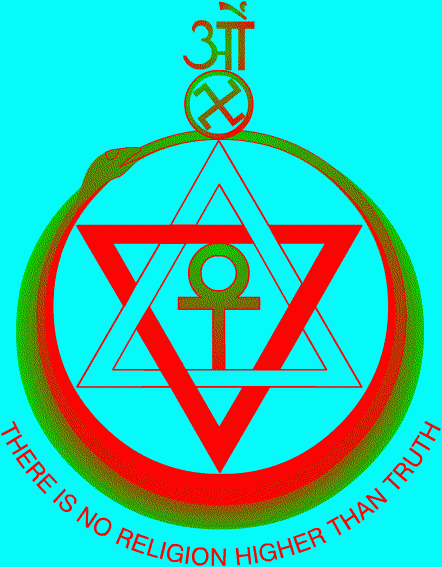
The emblem of the Theosophical Society is composed of a number of
symbols, all of them having been used
from ancient times to express profound
spiritual and philosophical concepts about humanity and the universe.
They may be found in a variety of forms in the great religions of the
world and their universality is further shown by their appearance in widely separated
cultures.
Each symbol, studied separately, will yield a wealth of understanding,
but none of them can be interpreted with a narrow precision. Taken together as in
the Society's emblem, they represent a unity of meaning, suggesting a vast
evolutionary scheme embracing the whole of nature, physical and spiritual.
Study and contemplation of the emblem as well as its several component symbols
will lead the serious student to an awareness of some of the deepest mysteries
of existence.
The Serpent

The Serpent is the timeless symbol of the highest spiritual Wisdom. Swallowing
its tail, it is a symbol of regeneration. It is the self-born, the circle of
infinite wisdom, life and immortality. The circle itself is an ancient symbol
of eternity and represents the Absolute, the unmanifested universe containing
the potentials of all form. As representative of the infinite sphere, the
'world egg' of archaic cosmology, this symbol is found in every world religion
and philosophy.
The Interlaced Triangles

The interlaced triangles, one (lighter) pointing upwards and the other (darker)
pointing downwards, symbolize the descent of spirit into matter and its
re-emergence from the confining limits of form. They also suggest the constant
conflict between the light and dark forces in nature as well as the inseparable
unity of spirit and matter. When depicted within the circle of the serpent, the
figure represents the universe and the manifestation of Deity in time and
space. The three lines and three angles of each of the two triangles may remind
us of the triple aspects of spirit: existence, consciousness and bliss, and the
three aspects of matter: mobility, resistance and rhythm. The glyph can also be
seen as thesix-pointed star, embracing spiritual and physical consciousness and
viewed by the Pythagoreans as the symbol of creation.
The Ankh

In the centre of the emblem is the Ankh or Crux Ansata, an ancient Egyptian
symbol of resurrection. It is composed of the Tau or T-shaped cross surmounted
by a small circle and is seen in Egyptian statuary and in wall and tomb
paintings where it is depicted as being held in the hand.
The Tau symbolizes matter or the world of form; the small circle above
it represents spirit or life. With the circle marking the position of the head,
it represents the mystic cube unfolded to form a Latin cross, symbol of spirit
descended into matter and crucified thereon, but risen from death resting
triumphant on the arms of the conquered slayer. So it may be said that the
figure of the interlaced triangles enclosing the ankh represents the human
triumphant and the divine triumphant in the human. As the cross of life, the
ankh becomes a symbol of resurrection and immortality.
The Jaina Cross

Placed in the emblem at the head of the serpent, is one of the numerous forms
in which the symbol of the cross is found. It is a fiery cross, with arms of
whirling flame revolving clockwise to represent the tremendous energies of
nature incessantly creating and dissolving forms through which the evolutionary
process takes place.
In religions which recognise three aspects of Deity, the Jaina Cross is associated
with the Third Person of the Trinity, who is at once the Creator and the
Destroyer: Shiva in Hinduism and the Holy Ghost in Christianity. Applied to
humanity, the figure may show the human as the link between heaven and earth,
one 'hand' pointing to heaven or spirit and the other toward earth or matter.
Aum

Above the emblem, in Sanskrit characters, is the sacred word of
Hinduism, Aum or Om, a word of profound significance. It may be said to stand
for the creative Word or Logos, the ineffable Reality, which is the source of all
existence. We are reminded of the statement: 'In the beginning was the Word,
and the Word was with God, and the Word was God'. Om is a word of power and
should be uttered only with the greatest reverence.
MOTTO
There is no religion higher than truth
Around the emblem appears the MOTTO of the Theosophical Society. Truth
is the quest of every Theosophist,
whatever his or her faith, and every great
religion reflects in some measure the light of the one eternal and spiritual
wisdom. Each points a way toward the realisation of Truth.
The Whole Emblem
Speaks to an inner perception, to the intuition and to the heart,
calling forth the divine in each individual who contemplates it. In its
totality, it represents a synthesis of great cosmic principles operating
through involutionary and evolutionary cycles, bringing us all, in the fullness
of time, to the realisation of our divine nature.
Try these links for
more info about Theosophy
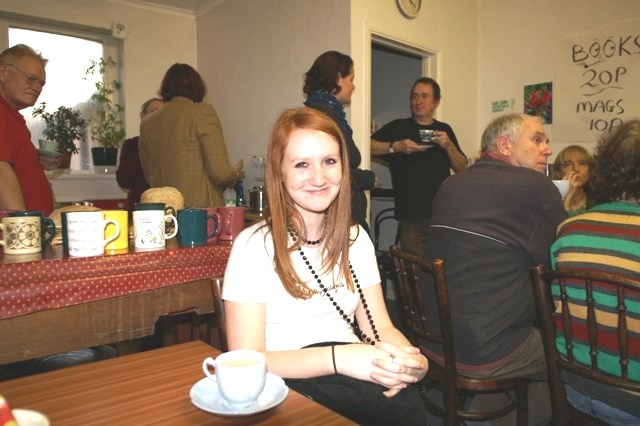
Cardiff Theosophical Society meetings are informal
and there’s always a cup of tea afterwards
The Cardiff Theosophical Society Website
The National Wales
Theosophy Website
Theosophy Cardiff’s
Instant Guide to Theosophy
Theosophy Cardiff’s
Gallery of Great Theosophists
Dave’s Streetwise
Theosophy Boards
The Theosophy Website that welcomes
If you run a Theosophy Study Group, please
feel free to use any material on this Website
Independent Theosophy Blog
The Most
Basic Theosophy
Website in the Universe
A quick
overview of Theosophy
and the Theosophical Society
If you
run a Theosophy Study Group you
can use this as an introductory handout.
One liners and quick explanations
About aspects of Theosophy
The Voice of the Silence Website
An Independent
Theosophical Republic
Links to Free
Online Theosophy
Study Resources;
Courses,
Writings,
The main criteria for the
inclusion of
links on this site is that
they have some
relationship (however tenuous)
to Theosophy
and are lightweight, amusing
or entertaining.
Topics include Quantum Theory
and Socks,
Dick Dastardly and Legendary Blues Singers.
An entertaining introduction to Theosophy
For everyone everywhere, not just in Wales
It’s all “water under the
bridge” but everything you do
makes an imprint on the
Space-Time Continuum.
A selection of articles on Reincarnation
Provided in response to the
large number
of enquiries we receive on
this subject
No Aardvarks were harmed
in the
The
Spiritual Home of Urban Theosophy
The Earth Base for Evolutionary Theosophy
____________________________________
A B C D EFG H IJ KL M N OP QR S T UV WXYZ
Complete
Theosophical Glossary in Plain Text Format
1.22MB
___________________________
Classic Introductory Theosophy Text
A Text Book of Theosophy By C
What Theosophy Is From the Absolute to Man
The Formation of a Solar System The Evolution of Life
The Constitution of Man After Death Reincarnation
The Purpose of Life The Planetary Chains
The Result of Theosophical Study
_____________________
Preface to the American Edition Introduction
Occultism and its Adepts The Theosophical Society
First Occult Experiences Teachings of Occult Philosophy
Later Occult Phenomena Appendix
Try these if you are looking for a
local Theosophy Group or Centre
UK
Listing of Theosophical Groups
General pages about Wales,
Welsh History
and The History of Theosophy
in Wales
Wales is a
Principality within the United Kingdom
and has an
eastern border with England.
The land area is
just over 8,000 square miles.
Snowdon in North
Wales is the highest mountain at 3,650 feet.
The coastline is
almost 750 miles long.
The population of Wales as at the 2001 census is 2,946,200.