THEOSOPHY
Theosophical Society,
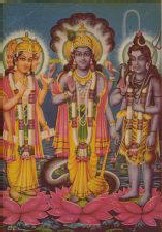
The
Hindu Trinity
Brahma
- Vishnu -
Shiva
Hinduism Glossary
Overview
Of all the world’s great religions,
Hinduism is the most difficult to define. It did not have any one founder. It
has many “scriptures” which are authoritative but none that is exclusively so.
Hinduism is more like a tree that has grown gradually than like a building that
has been erected by some great architect at some definite point in time.
Hindus themselves refer to their religion
as the “eternal system,” or sanatana dharma. The term
“Hindu” was coined by the Persians after the “
The Upanishads are the concluding portions
of the Vedas and contain the developed essence of Vedic teaching. They teach
that any man can who strives for it reach a divine
state. The individual personality is denied, being considered part of the world
of illusion, or maya, the merging and the
obliteration of the self in the sea of the “One Reality,” or god. They teach
that every aspect of the universe, both animate and inanimate, shares the same
essentially divine nature. Approximately
700 BCE a system for interpreting the Vedas, called Vedanta, was established,
and it remains the leading
Karma operates as an inexorable law of
retributive justice. It is an internal law of nature, independent of the
decrees of the gods. According to the
law of karma, a man is the result of his own past. Whatever a man sows, he will also reap. If
one does good, he will escape the human condition
(which is illusion), and return to the divine state. If a man does bad, he will remain in bondage to the human condition, being
born again and again until he has worked out his bad karma. This belief in the
rebirth, or the transmigration of the soul, which many call reincarnation[1], is known in
Hinduism as samsara. Not only men, but also all
animals, are engaged in the wheel of samsara, passing
from one level of life to another. The
formation of the Bhagavad-Gita marked a turning point in Hinduism. It is the
philosophical basis of popular Hinduism. The book was probably written around
203 BCE and reached its present form around 200 CE. During this period the
concept of the avatar, or incarnation of deity, was introduced and became very
popular. The avatars are the warrior gods who triumph over sin and evil by
becoming what could be termed redeemers within the evil world of maya.
There are three major paths to salvation
discussed in the Gita and recognized generally by all Hindus today. These
methods of attaining salvation are karma marga
(method), which is the way of disinterested action; bhakti
marga the way of devotion; and jnana
marga, which is the path of knowledge or mystical
insight. Those who hold to the monistic philosophy of Vedanta use jnana as a means of achieving their self-realization
through intuitive awareness. Those who are theistic (or henotheistic) and
believe that god is a personal being (albeit one with the universe), follow the
path of bhakti (devotion) in hopes of freeing
themselves of their bad karma.
The old school of ritualistic Hinduism is
concerned with karma marga.
The Hindu Trinity
Brahma-Vishnu-Shiva
While Vedanta has been the most influential
philosophy among the intellectuals of
1. The abstract monists, who are followers of Advaita monism, and are few in number; they refuse to
personify Brahma.
2. The Vishnuites, or Vaishnavas, who are devoted to the god Vishnu.
3. The Shivaites, or Shaivas, who are devoted to the god Shiva.
Vaishnavas consider Vishnu to have incarnated in the
form of his avatars, or manifestations in the flesh. Chief among these are Rama and
As we shall see in our later discussions,
Transactional Meditation can be loosely aligned with the Advaita
monism and ISKCON with the Vishnuites.
The three primary Hindu gods form what is
sometimes referred to as
the “Hindu trinity:”
·
Brahma
is “the Creator”
·
Shiva
is “the Destroyer”
·
Vishnu
is “the Preserver”
Rama,
Shiva’s consort Shakti
is manifest as Kali, who is depicted in Hindu idolatry as standing on a
beheaded body, wearing a necklace of human skulls. It is estimated by
authorities in
1. The ideas of
transmigration and reincarnation are slightly different, in that reincarnation
is generally associated only with humans, whereas transmigration includes all
living things. When Westerners become involved in the Eastern religions, most
find past and future human lives as acceptable, but are repulsed by the idea
that they may be forced to return to earth as a cockroach or even as a
toadstool. Thus they choose to profess a belief in reincarnation rather than
the philosophy of transmigration as it is actually taught in the religions the seek to embrace.
Glossary
A
Adi Shankara –
well-known theologian and founder of the advaita school. Also called Adi
Shankaracharya.
Advaita – non-dualism, the name of the theology
equating the soul with God.
Advaitin – a follower of the advaita school of thought founded by Adi-Shankara.
Agamas – a generic name for sectarian
literature, particularly the 28 Shaiva Agamas.
Aghori – a group of ascetics
whose deliberate practice is to contravene social and moral norms.
Agni
– the god of fire, particularly prominent in the Vedic period.
Ahalya – wife of the sage Gautama,
and one of the “five virtuous women.”
Ahimsa –
non-violence, a key Hindu principle.
Akhand Bharat –
“undivided
Akka Mahadevi –
famous medieval woman saint from
Alvars – the South Indian Vaishnava
poet-saints of the early medieval period.
Twelve are
considered principal.
Ambedkar, Ranji – a
reformer from the untouchable class who converted to Buddhism with many
followers.
Anandamayi – well-known female guru from
Andal – the only woman amongst the twelve Alvars.
Angira – one of the seven great rishis (sages of old).
Anjali – hands folded, to make an offering.
Anuman – deduction or inference; one of the means
of acquiring knowledge.
Antyesthi – the last rite of passage, the funeral. Apsaras – the celestial dancing girls, well-known for their
ability to divert renunciates from the path of
spiritual life.
Aranyakas – “the forest treatises,” one of the four
sections of the Vedas.
Arjuna – the third son of King Pandu. He heard the Bhagavad-gita from
Artha – economic development, one of the four
aims of life. Artha
Shastra – texts that discuss how to acquire wealth
and power; considered related to the Dharma Shastras.
Arti – the most popular Hindu ceremony, in
which a lamp and other articles are offered.
Arya Samaj – one of
the main 19th century reform movements, still extant today.
Aryan – “noble”: traditionally refers to
any people, irrespective of race, who have a culture based on spiritual values.
Ashok, King – monarch who patronised
Buddhism; under his influence it spread throughout much of India.
Ashrama – a place where spirituality is cultivated;
also, stage of life (of which there are four).
Ashvattama – son of Drona,
martial teacher of the five Pandavas; he notoriously
slaughtered their sleeping sons.
AstangaYoga – the eightfold path
that culminated in meditation and samadhi (trance). One of the four paths.
Astika – “orthodox”: refers to the six darshans. Non-orthodox schools are called nastika.
Asuras – the demons. Materially
elevated but impious beings, constantly at loggerheads with the gods.
Atharva – the fourth of the four Vedas.
Atithi – literally “without any
time”; the unexpected guest. Atman – literally “self”:
it can mean body or mind, but ultimately refers to the soul.
Atri – one of seven great rishis
(sages), each of whom have a gotra (dynasty) from
which Hindus claim descent.
Avadhi – popular language for
vernacular texts, especially in the area of
Ayodhya – the capital city of
B
Badanarayana – a name for Vyasa,
attributed with writing key texts such as the Mahabharata and Vedanta Sutras.
Badrinatha – a holy spot in the
Baladeva – key theologian for Bengali Vaishnavism; his commentary on the Vedanta Sutra is the Govinda Bhasya.
Basava – influential reformer
within the Lingayat tradition of South Indian Shaivism.
Bhagavad-gita –
the Song of God, spoken by Krishna to Arjuna. Bhagavad katha – the public recitation of the Bhagavat
Purana, often over seven days.
Bhagavat Purana – one of
the most popular Puranas, containing the famous
stories of
Bhajan – a hymn, from the root “bhaj,” to worship with adoration.
Bhakti – the path of loving devotional service
(also Bhakti-Yoga).
Bhakti-Yoga – the path of loving devotional
service; also called bhakti marg.
Bhaktivedanta – name of the founder of ISKCON. It means
“bhakti is the conclusion of all knowledge.”
Bhangra – an energetic dance style from the
Bharadvaja – one of the seven great rishis (sages) of ancient times.
Bharata – the ancient name for
Bharata Muni – author of
musical texts delineating nine rasas (tastes) upon
which much music is based.
Bharata Natyam – the
name of the most popular Southern Indian style of classical dance.
Bhava – emotion. A word used in the classical performing
arts and also in much bhakti theology.
Bhrigu – one of the seven great sages. According
to some texts, he tested the trimurti
to see who was the Supreme.
Bindi – dot, usually of a red colour,
traditionally worn by married women on the forehead.
Birbal – the witty minister of Emperor Akbar; many legends have developed around his exploits.
Blavatsky,
Helena Petrovna
– Russian lady who co-founded the Theosophical Society.
Brahma – the creator (or, some say,
secondary creator); one of the trimurti,
three main deities in this world.
Brahma Sutra – another
name for the Vedanta Sutra. Brahmachari – a celibate student.
A member of the first stage of life (called the brahmachari
ashrama).
Brahman – the
Supreme or spirit; that which pervades and supports everything.
Brahmanas – one of the four main divisions in the
Vedas themselves.
Brahmana – a member of the highest
Brahmo Samaj – the
reform movement started by Rama Mohan Roy.
Brighu Muni – one of
the seven ancient sages (rishis).
C
Chaddar – a cotton or woollen
shawl worn by men and women.
Chaitanya – the founder of Bengali
Vaishnavism; one of the medieval saints.
Chakra – the disk weapon usually associated with Vishnu, and one of his
four symbols.
Chanakya a brahmana,
advisor to King Chandragupta, who wrote on statecraft and popular wisdom.
Chandra – the Moon; the presiding deity of
the Moon. Also known as Soma.
Chappati – a round
unleavened bread toasted on a skillet and then puffed over an open flame.
Charaka Samhitas – one
of the texts explaining the science of Ayurveda.
Charanamrita – the water collected from the feet of the
murti after bathing, and later sipped by worshippers.
Charvaka – scholar who proposed
that the purpose of life is to obtain ghee (i.e. good food by any means) and enjoy.
Chidambaram – a Shaivite pilgrimage town, the state of Tamil Nadu.
D
Daksha – one of the chief
progenitors; father of Sati, Shiva’s wife, who killed herself by self-invoked
mystic fire.
Dalit – “the oppressed”; a title assumed by the
class previously called “untouchables.”
Damayanti – wife of Nala
and one of the famous women of Hinduism.
Danda – staff, particularly as carried by the sannyasi.
Dandiya rasa – a
Gujarati stick dance popular in the
Dasa Kuta – a Vaishnava tradition centred around Pandapur in Maharastra.
Dasanam – “ten names”; the ten orders of sannyasa founded by Adi Shankara.
Dasharatha – the father of Rama.
Dayananda Sarasvati –
founder of the Arya Samaj. Deva – god;
sometimes translated demigod. God is often called Deva-deva,
“gods of gods.” Devi means “goddess.”
Devanagari – “used in the cities of the demigods”; it
refers to the Sanskrit script.
Devi – “goddess”; used to refer to any female
deity, but most specifically Shakti, wife of Shiva.
Devi Bhagavat Purana – perhaps the second most popular Purana; it includes the stories of Shakti.
Devi Purana – another
Purana dealing largely with the Goddess. Dhanvantari –
incarnation of Vishnu who appeared out of the
Dharma – the religious duties that sustain
humans and all living beings. Dharma Shastra – the law-books of Hinduism dealing with morality
and the judiciary.
Dhoti – a piece of cloth about four-metres long and worn by Hindu men to cover the loins and
legs.
Dhritarashtra – blind brother of King Pandu; his bias towards his own sons fostered the Kurukshetra conflict.
Diwali – the festival of lights
(October/November). For most Hindus it heralds the New Year.
Doshas – the three bodily humours
which constitute the conceptual basis of Ayurvedic
medicine.
Draupadi – the common wife of all
five Pandava princes, and heroine of the Mahabharata.
Durga – a warlike form of Devi,
usually with many arms carrying weapons and riding on a lion.
Duryodhana – the first son of Dhritarashtra. His avarice caused the Kurukshetra War.
Dussehra – the festival that celebrates the victory
of Rama over the evil Ravana.
Dvaita (dualism) – the theology
that the soul and God are different, specifically as taught by Madhva.
Dvaraka – a holy spot in Maharastra,
on the West coast of
Dvapara-yuga – the third age in every cycle of four
ages (yugas). It ended some 5,000 years ago.
Dvija bandu
– “friends of the twice-born”; those born in the three higher varnas but who fall from the standards.
G
Ganapati – a name of Ganesh, the elephant-headed son of Shiva. Gandharvas – residents of the heavenly planets who are
particularly expert in singing and music.
Ganesh – one of the two sons of Shiva. He has a
rotund body and an elephant’s head.
Ganesh Caturthi – the
festival that celebrates Ganesh’s birthday (on the
fourth day of the waxing moon).
Garba – a form of circular dance from
Garba griha – the
inner sanctum of the temple.
Gaudiya Vaishnavas – the
Bengali worshippers of Vishnu (specifically Radha and
Gautama – an ancient rishi
(sage), often considered one of the principal sapta (seven) rishis.
Gayatri – the mantra chanted thrice daily by brahmanas; a wife of Brahma.
Giddha – a Punjabi dance performed by women.
Golakwar, M. S. – former leader of the Rashtriya Swayamsevak Sanga (RSS).
Gopuram – gateway to temples, especially in the
South; they are often decorated with ornate figurines.
Gorakhnatha – important historical
figure amongst the Nathapatnis sect of Shaivas.
Gotra – dynasty originating
with one of the seven great rishis (sages of old).
Govardhana – the famous hill lifted by child
Grihasta – a person in the second
stage of life; the householder. Guna
– literally “rope.” It refers to the three material qualities that pervade and
control matter.
Guru – a spiritual teacher; a regular
teacher may also be called guru.
Gurukula – the school of the guru. A traditional Hindu school.
H
Hanuman – the monkey-like deity; he is a devotee of Rama, but also worshiped in his own right.
Hanuman Jayanti – the birthday festival of Hanuman.
Hare Krishna – a popular mantra chanted by
members of ISKCON, therefore called the Hare Krishna Movement.
Haridvara – an important
pilgrimage site on the banks of the River Ganges.
Harijanas – “the people of God”; a term used by
Gandhi to denote what some call the “fifth
Havan – the sacred fire ceremony dating back to
Vedic times, but still used in many ceremonies/rites of passage.
Hedgewar, K. V. – founder of the Rashtriya Swayamsevak Sanga (RSS). Hindu Mahasabha – the political party
established in 1909 and forerunner of many nationalistic movements.
Hitopadesha – a text containing moral stories;
considered part of the Dharma Shastra.
Holi – the spring festival in which
participants throw coloured water and powders over
each other.
Homa – another name for havan
Hrishikesh – a pilgrimage spot on the River Ganges in
the Himalayan foothills.
I
Indra – the deity in charge of rain; he was most
prominent during the Vedic Period.
Indira Bettiji – a
contemporary women guru of the Pushti-marg sampradaya.
Ishvara – literally
“controller.” It refers
to a deity, or the Supreme Deity.
Itihasa – “history.” The Mahabharata and Ramayana constitute
the two Itihasas.
J
Jaimini – the founder of the Mimamsa
school (one of the six darshans).
Janaka – legendary King of Mithila
and father of Sita, Rama’s
consort.
Janmashtami – the birthday festival of
Japa – the practice of reciting mantras quietly
or silently on prayer beads.
Jatakarma – a name for the rite of passage performed
just after a child’s birth.
Jati – sub-castes, or occupational sub-groups,
which form part of the caste system.
Jayadratha – notorious warrior who
tried to kidnap Draupadi. He was slain by Arjuna
during the Kurukshetra war.
Jiva – “that which lives”; a term for the
individual soul, also called the “atman” or “jivatman.”
Jnana – knowledge. Jnana-yoga is
the path of wisdom, one of the four main spiritual processes.
Jnana-kanda – one of three broad sections of the Vedic
literature. It deals with knowledge.
K
Kabir – the medieval bhakti
saint who is revered by Hindu, Muslims, and Sikhs.
Kaivalya – realisation
of “oneness” with God and a spiritual identity beyond the subtle and gross
bodies.
Kalasha – a waterpot, an
auspicious symbol used in many rituals.
Kali – a fierce
form of Devi.
Kalika Purana – an
important Shakti text dedicated to the Goddess Kali.
Kali-yuga – the fourth age, the iron age
or age of quarrel and hypocrisy. Kalki – the last
of the ten Vishnu incarnations. He appears on horseback, wielding a
sword, at the end of Kali-Yuga.
Kanada – founder of one of the six orthodox
systems, namely Vaisheshika (atomic theory).
Kanchipuram – important centre of Shri Vaishnavism in
Kanyakumari – a holy site on the southern tip of
Kapila – the founder of Sanhkya, one of the six main philosophies and dealing with
physics and metaphysics.
Kapila Muni – founder
of the school (darshan) of Sankhya. Karma – literally “action,” but often used to
imply “reaction,” as in “the law of karma.”
Karma kanda
– one of the three broad divisions of Hindu scriptures. It deals with rituals for material
elevation.
Karma-yoga – the yoga of selfless action.
One of the four main yogas, also called the four margs
(paths).
Karna – tragic anti-hero of
the Mahabharata. At Kurukshetra he fought against his step-brothers, the Pandavas.
Kartikeya – a name of Murugan,
one of the two sons of Shiva and Parvati.
Kashi – another name for the city of
Kathak – a classical dance
Kauravas – the descendants of King Kuru. It specifically refers to the cousins of the Pandavas and their allies.
Kaveri – one of the seven main holy rivers flowing
through the sacred town of
Kedarnatha – an important Shaiva shrine in the
Keshab Chandra Sena –
reformer who spent some time with the Brahmo Samaj.
Kirtan – “glorification.” It usually refers to
the chanting of mantra to musical accompaniment.
Kohl (or kajal) – mascara. Also called “anjana.”
Konarak – site on the east coast of India famous for
its ancient temple dedicated to the Sun.
Koshala – the
Kshatriya – literally “one who protects”;
member of the second
Kumbha Mela – mela means “fair”; kumbha means “pot.”A huge gathering
that takes place every three years.
Kunti – the wife of King Pandu and mother of the five Pandavas. One of the heroines of
the Mahabharata.
Kurta – a loose fitting
collarless shirt worn by men. Usually made of cotton or silk.
Kuru – dynasty in which the Pandavas
appeared. The term is specifically used to refer to their wicked cousins.
Kurukshetra – the site of the great
eighteen-day war described in the Mahabharata.
Kuvera – the deity who is considered “the
treasurer of the demigods.”
L
Lakshman – the brother of Rama who went with him to the forest. He is worshipped with Sita,
Rama, and Hanuman.
Lakshmi – the goddess of fortune. She is the
eternal consort of Vishnu. Linga – a vertical stone column worshipped as a form of
Shiva. It represents him as the supreme male principle.
Lingayats – a popular South Indian Shaiva tradition. Members wear a small linga
around their necks.
M
Madhva – Vaishnava
theologian who founded his own disciplic succession
and taught a highly dualistic theology.
Maha Shiva Ratri – the night festival celebrating Shiva’s marriage to Parvati.
Mahabharata – literally
“the History of Greater India.” One of the two Epics and the longest known poem.
Mahadeva – a name of lord Shiva,
meaning “great god.” Maharishi Mahesh Yogi –
leader of the Transcendental Meditation organisation
established in the late 1960s.
Mahasabha – “great assembly”; the Hindu Mahasabha was established in 1909.
Maha-yuga – “great age”; a
complete cycle of four ages lasting a total of 4,320,000 years.
Mahenjo Daro – one of
two walled cities unearthed during archaeological excavations in the 1920s.
Mahesh
– another name of Shiva.
Mandir – temple.
Mandodari – celebrated wife of Ravana.
She was loyal to her husband but urged him to return Sita
to Rama.
Manjira – small hand cymbals used in singing hymns
and mantras. Manu – a demigod considered
the ruling deity of mankind. The Manu Smriti is
attributed to him.
Manu Smriti – an
important and ancient text, the “codebook for mankind”; the principal Dharma Shastra.
Mataji – “respected mother”; a
form of address for any lady, but also an affectionate name for Devi.
Matsya – the first of the ten
incarnations of Vishnu.
He appeared during the great flood to save the Vedas.
Maya – “that which is not,” or illusion. An important concept that describes the illusory nature of this
world.
Mimamsa – literally “enquiry”. One of the six darshans,
though Vedanta is also called the “later school of enquiry.”
Mirabai – a famous woman saint whose poems and
songs are still popular today.
Moghul – the Muslim dynasty that ruled much of
Mohan Malaviha – member of the Arya Samaj and co-founder of the Hindu Mahasabha.
Moksha – liberation,
specifically from the bondage of repeated birth and death.
Mridanga – literally “body of
clay”; a two-headed drum, used in religious music more than in classical.
Mrigari – a vicious hunter who
turned saint and demonstrated the principal of ahimsa, non-violence.
Mundan – the head-shaving
ceremony, one of the main rites of passage for children.
Murari Babu – popular
saint famous for his public recitations on the Ramayana.
Murugan – a name for Kartikeya, particularly popular in
N
Naga – the serpentine residents of the
subterranean heavenly planets who are sometimes worshipped.
Namakarana – the name-giving ceremony performed
shortly after birth.
Namaskara – “I pay my obeisance unto you” – a term
of greeting usually accompanied with folded palms.
Namaste – an alternative for “namaskara.”
Namdev – poet-saint appearing
in the Das Kuta Vaishnava tradition. Narada
– famous rishi (sage) who acts as the messenger of the devas (gods). He wrote several
important texts.
Narayana – a name of Vishnu,
particularly his form in the spiritual realm.
Nataraja – “the king of dancers”;
a name for Lord Shiva, especially as he dances to destroy the material cosmos.
Nathapatnis – prominent sect of Shaiva
ascetics. Nathdwar
– town in
Nathji – a form of
Natya Shastra
– text on dance and the performing arts written by the sage Bharata
Muni.
Nava-rasa – the nine “moods” of music as codified and explained
by Bharata Muni. Rasa means
“taste” or “flavour.”
Navaratri – literally “nine-nights.” The festival in honour of Devi usually celebrated in the evenings with dance.
Nayanars – Shaivite
poet-saints of
Nimbarka – a theologian and founder of one of the
four Vaishnava sampradayas
(disciplic successions).
Niti Shastra – books
of popular wisdom; they include the Hitopadesh, the Panchatantra and the Chanakya Shloka.
Nitya – eternal; the five “nitya
karmas” refer to the five duties that cannot be given up.
Nrisimhadeva – the half-man/half-lion incarnation of
Vishnu who saved his devotee, Prahlada.
Nyaya – logic, and one of the six orthodox
schools of thought (darshans).
O
P
Padma – lotus, an important symbol. it is often used metaphorically to describe beauty e.g.
lotus eyes, or lotus feet.
Panchama – “the fifth
Panchatantra – a anthology of
fables featuring mainly animals as heroes and villains.
Pandapur – most important centre
for the Das Kuta Vaishnava sampradaya in Maharastra.
Pandu – emperor of Greater
India, husband of Kunti and father of Arjuna and his four brothers.
Papa – sin, or
activities that degrade.
Paramatman – the Superself, or Supersoul. God situated within the heart.
Parashara – great sage, the father
of Vyasa (Badarayana). He wrote many of the core texts on
astrology.
Parashurama – the sixth incarnation of Vishnu.With his axe he destroyed the irreligious members of
the royalty.
Parvati – the wife of Shiva, and
daughter of the
Patanjali – author of the yoga sutras and founder of
the corresponding darshan (school of thought).
Pradakshina – circumambulation, an important feature
of worship.
Pradhana – the unmanifest
stage of matter (prakriti). Prajapati –
“progenitor”; the higher beings who were responsible for populating the world.
Prakriti – material energy in its
manifest state.
Pramukhi Swami – current spiritual head of the
Swami Narayana Mission. Pranam – obeisance, usually offered by placing together the palms and
bowing the head.
Prasad – literally
“mercy.” It refers to
any item sanctified by offering to God, most often sanctified food.
Pratyaksa – direct perception; one means of
obtaining knowledge. Pravachan
– a talk or lecture on spiritual subjects; for some, an important act of
worship.
Prayag – site of the Maha (great) Kumbha Mela every twelve years. Prema – love,
specifically of God; an important term within the bhakti
traditions.
Puja – ritualistic worship,
most often of the installed murti.
Punya – pious activities; actions that elevate
the soul. Purana – literally “very old.”
The texts containing the many popular religious stories, sometimes called
myths.
Puri – (1) a flat bread
fried in oil or ghee,
Puri – (2) a holy town in Orissa
on the East Coast of India. Purohit – a
priest who performs ritualistic ceremonies; often a brahminical
surname also.
Purusha – person, specifically
male. Sometimes used to refer to the soul and sometimes God.
Purusha Shukta – prayer
about creation found in the Rig Veda. Purva Mimamsa – “the earlier
school of enquiry,” often called simply Mimamsa (one
of the six darshans).
Pushti marg – “the path
of nourishment”; the process followed by the mainly Gujarati followers of Vallabha.
R
Radha – the chief of the gopi girlfriends of
Raga – a particular musical scale used in
classical music, which is usually played impromptu.
Raja (astanga)
yoga – one of the four main yogas, the path of
meditation and mystic power.
Raja – “king.” Often kings and holy men are
addressed as “Maharaja” – “great king.”
Raja-guna – the
second of the three material qualities; the quality of passion or ambition,
exemplified by royalty.
Rajas – an
abbreviated form of raja-guna (see above).
Rajneesh
– late guru who attracted many Western disciples; also known as Osho.
Rajputs – a name for the warriors (kshatriyas) from Rajastan. Raksha Bandana –
one of the main festivals when sisters tie a rakhi, bracelet,
on the wrist of their brothers.
Rakshasa – a race of man-eaters
known for their ability to change form. Rama
– usually considered the seventh avatar of Vishnu (or sometimes of
Rama Carita Manas – a
popular version of the Ramayana written in Hindi by Tulsidas.
Rama Mohan Roy – the founder of the Arya Samaj, one of the most
important reform movements.
Rama Nama Satya Hai – a mantra often
chanted at funerals and meaning “the name of Rama is
truth.”
Rama rajya
– “the reign of Rama,” adopted by many Hindu
reformers as a symbol of the social ideal.
Ramakrishna – a famous
spiritual teacher from
Ramayana – “the journey
of Rama”; the shorter of the two Hindu Epics.
Rameshbai Oza – popular
speaker who offers public recitations, mainly from the
Bhagavat Purana.
Rameshvaram – an important pilgrimage site in
Rangoli – a pattern made by Hindu ladies and
girls, mainly in
Rantideva – a legendary king famous for his
hospitality. Rasa – literally “juice”; refers to the
relationships defined in the performing arts and later in ontological theology.
Rasa-lila
– the dance that
Rashtriya Svayamsevak Sanga – an influential cultural organisation
with nationalistic tendencies.
Ratha-yatra
– a chariot (ratha) festival originally from Puri but
now popular in many cities world-wide.
Ravana – a king of the Rakshasas. He lived on Shri Lanka, kidnapped Sita and was killed by Rama.
Rig Veda – the
foremost and possibly earliest of the four Vedas.
Rishi
– sage; specifically the seven great sages of ancient times.
Rudra – an angry
form of Shiva, particularly prevalent during the Vedic period.
S
Sabji – a preparation made from vegetables,
usually spiced.
Sadhana – spiritual discipline, such as chanting
mantras, observing vows, etc.
Sadharana-Dharma – general moral duties for all
members of Hindu society.
Sadhu – a pious or saintly person. Often used to refer to sannyasis. Sahajanand
Swami – founder of
the Swami Narayana Mission, considered by many
followers an incarnation of God.
Sama Veda – one of the four Vedas; it explains
the melodies to be used in ritual sacrifice.
Samadhi – the final stage of yoga, when the
mind is perfectly focused on one point.
Samhita – one of the four sections of the
Vedas. Sampradaya – a disciplic
succession, a line of gurus and disciples for disseminating spiritual
knowledge.
Samsara – the perpetual cycle of birth and death. The process of suffering in this way.
Samskara – “mental impression”; it refers to the
various rites of passage.
Sanatana-dharma – the eternal religion, the eternal
function of the soul; often preferred to the term “Hinduism.”
Sanatanist – those who believe in sanatana-dharma;
used often today to denote eclectic worship instead of sectarian.
Sankhya – one of the six darshans;
it analyses matter in detail and also identifies the atman beyond matter.
Sarasvati – goddess of learning and the arts; also a
sacred river, now dried up; some say it still runs underground.
Saree – the most popular traditional dress for
Hindu women. Sati – one incarnation of
Shiva’s wife, Parvati. After her, the act of a wife’s
entering the funeral pyre of her husband.
Sattva-guna – the highest of the three material
qualities, characterised by goodness.
Satyagraha – “grasping the truth”; a term
coined by Gandhi whilst in
Satya-yuga – the first of the four universal ages;
also called Krita-Yuga.
Savitri – a young lady immortalised
for her devotion towards her husband. Seva – service, a key Hindu principle/value; the soul’s sanatana-dharma, fully expressed through bhakti.
Shabda – “sound”; shabda
brahman means “spiritual
sound,” often considered the best means of obtaining knowledge.
Shaiva Siddhanta – personalistic
Shaiva/Shaivite – a worshipper of Shiva.
Shakta – a follower of Shakti,
the goddess.
Shakti – a generic term to refer to the female
deity, especially the consort of
Shiva.
Shariraka Bhasya –
commentary on the Vedanta Sutras by Shankara.
Shastra – scripture; used particularly of some
texts e.g. the dharma-shastras.
Shibi – legendary king renowned for his
self-sacrifice and ideal leadership.
Shilpa Shastra – one of
the four Upavedas, dealing with architecture. Shiva – one of the trimurti, three principal deities. He is in charge of
tama-guna. Some consider him the Supreme.
Shravana Kumar – a legendary boy celebrated for his
devotion to his elderly parents.
Shree Vallabha Nidhi –
Sri Bhasya – commentary
on the Vedanta Sutras by Ramanuja.
Sri Rangam – centre for one of the two main branches of the Shri (Vaishnava)
Sampradaya.
Sri Sampradaya – the preceptoral
succession in which Ramanuja appeared and headed by Lakshmi.
Shri Vaishnavas – one
of the four main Vaishnava sampradayas,
headed by Shri (another name for Lakshmi).
Srikantha – 13th century Shaivite theologian.
Sripati – 14th century Shaivite theologian.
Sruti – “that which has been heard”; one of the
two main sections of Vedic texts and considered of divine origin.
Shuddhadvaita – “qualified non-dualism,” the philosophy
expounded by Ramanuja and his sampradaya.
Shudra – the fourth
Siksha – formal initiation
taken from a guru (spiritual teacher). Sindhu
– an important river now in
Sita – the wife of Rama and heroine of the Ramayana. Skanda – one of the two sons of Shiva and Parvati; also called Murugan, Kartikeya, and Subrahmaniam.
Smartas – one of the four main denominations; they
worship five deities.
Smriti – “that which is remembered”; the second
category within the Hindu texts.
Soma – a name for
the Moon. Also, a celestial beverage used in Vedic sacrifice.
Somnath – important place of pilgrimage for Shaivas, in
Surdas – a blind musician famous for his songs,
mainly in praise of
Surya – the Sun, worshipped by the Smarta traditions and also by the chanting of the Gayatri-mantra.
Sushruta Samhita – text
yielding much information on Ayurvedic medicine.
Sutra – literally
“thread”; an aphorism that can be unpacked almost unlimitedly to yield profound
truths.
Svastika – a popular Hindu symbol
which was unfortunately adopted by the Nazis. Svetashvatara Upanishad – one of the Upanishads, considered
canonical for many Shaivites.
Swami – “controller” – a title used for sannyasis, who must control their
senses. Goswami is an alternative.
Swami Narayana
Mission – a Vaishnava sampradaya,
very popular amongst Gujarati Hindus in the
T
Tagore, Devendranatha
– prominent Bengali reformer and father of the poet and writer, Rabindranatha.
Tamah-guna – the lowest of the three material
qualities, typified by ignorance, darkness, and inertia.
Tamas – a shortened version of tamah-guna (see above).
Tansen – famous musician; one of the “nine jewels” of the court of
Emperor Akbar.
Tantra (1) – a form of
ritualistic Hinduism in which Shakti is worshipped,
often together with Shiva.
Tantra (2) – a category of texts, usually
connected to goddess worship.
Tara – wife of Vali; one of the five “virtuous women” of Hinduism. Tilak – a clay mark applied to the forehead and denoting
the particular affiliation of the worshipper.
Tirtha – literally “ford.” A holy place, where
one can cross over to the other side i.e. attain liberation.
Tirthayatra – pilgrimage
Tirupati – a holy place in Andhra
Pradesh. The
Tithi – the lunar day, a thirtieth part of the
lunar month, by which festival dates are calculated.
Treta-yuga – the second cosmic age in the cycle of
four. Trimurti
– the three main deities, Brahma (the creator), Vishnu (the sustainer), and
Mahesh, or Shiva (the destroyer).
Trishul – a trident, the emblem associated with
Siva and carried by many sannyasis devoted to him.
Tukarama – a bhakti
saint of Maharastra in
Tulsidas – a bhakti saint
famous for his rendering of the Ramayana.
U
Udupi – sacred town in
Upamana – analogy; in nyaya
it is considered one of the four means of attaining knowledge.
Upanayana – “coming near,” referring to the sacred
thread initiation ceremony
Upanishad – one of the four sections of the
Vedas.They are highly
philosophical and identified with Vedanta.
Upasana – a generic word for worship
Upasana kanda
– “the worship section”; one of the three broad categories of scriptural
content.
Upavedas – four texts, supplementary to the Vedas
and explaining traditional arts and sciences.
Utsava – festival or
celebration; one of the five nitya-karmas (essential
duties).
Uttara Mimamsa
– “the later school of enquiry”; another name for Vedanta.
V
Vaidika Dharma – alternative to the term “Hinduism”;
it denotes the followers of the Vedas and their supplements.
Vaikunthaloka – “the place of no
anxiety”; a name for the abode of Vishnu; the
Vaisheshika – one of the six darshans,
atomic theory as propounded by Kanada.
Vaishnavas – the worshippers of Vishnu; generally
accepted as the biggest of the four main denominations.
Vaishno Devi – sacred
cave dedicated to the three goddesses, Lakshmi, Kali,
and Sarasvati.
Vaishya – a member of the third
Vallabha – founder of the Pushti
Marg sampradaya, popular
amongst many Gujaratis.
Vallabha – theologian who founded the Pushti Marg sampradaya
and taught the doctrine of purified monism.
Vali – Varana
(monkey) king and brother of Sugriva; killed by Rama for stealing Sugriva’s wife.
Valmiki – the criminal-turned-sage who wrote the
original Ramayana. Vamana
– the fifth of the ten incarnations of Vishnu. He appeared as a brahmana dwarf to trick King Bali.
Vanaprashta – the third order of life, or a member of
that ashrama, the forest dweller.
Varnashrama-Dharma – social system with different
duties allocated to four classes and four stages in life.
Varuna – god of the waters,
akin to
Vasista – one of the seven great rishis; he had an ongoing dispute with Vishvamitra.
Vastu – the science of sacred space, equivalent
to the Chinese Feng-Shui. Vayu – the deity in
charge of air and the wind. His offspring, such as Hanuman, tend to be
physically very strong.
Veda – literally “knowledge”;
specifically one of the four shruti texts that form
the basis of sacred Hindu literature.
Vedangas – texts supplementary to the four
Vedas. Vedanta – the
conclusion of the Vedas; one of the six darshans,
often considered the most respectable.
Vedanta Sutra – important aphorisms
containing the essence of Hindu theology.
Vedic – connected to, or derived from, the
Vedas. Specifically, the period when the four Vedas were
compiled.
Vidura – saintly brother of Pandu and Dhritarastra, and
well-wisher of the five Pandavas.
Vikrama – a famous king after
whom some Hindus date the years (i.e. according to the “Vikrama
era”).
Vishishtadvaita – the doctrine of “qualified non-dualism”
propounded by Ramanuja.
Vishnu – one of the trimurti; the sustainer. Often
identified with the Supreme Deity.
Vishnuswami – forerunner of Vallabha and founder of one of the four Vaishnava
sampradayas.
Vishva Hindu Parishad
(VHP) – a movement aimed at bringing about worldwide co-operation between
Hindus.
Vishvamitra – although born in a kshatriya family, he became a powerful brahmana.
Vishvanatha – a name of Shiva; the most important
temple in
Vithobha – another name for Vitthala
(see below).
Vitthala – a famous form of Vishnu in the Maharastriyan town of
Vivaha – the wedding ceremony, one of the
important rites of passage.
Vivekananda –
disciple of Ramakrishna who widely popularised Advaita
Vedanta and
propounded a neo-Hinduism.
Vraj – the region around
Vrata – vow; women especially take vows, often
related to fasting. Vows are also taken at initiation.
Vrindavana – an important holy town close to
Vyasa – also called Badarayana;
an important sage credited with writing many important texts.
Y
Yajna – ritual sacrifice, prevalent during the
Vedic age but still performed today especially through the havan.
Yajnavalkya – sage and author of some important texts
which form part of the Dharma Shastra.
Yajur Veda – one of the four Vedas.
Yama – the deity in charge of death and the
awarding of punishment to the sinful. Also called
Dharma-raja.
Yamuna – a tributary of the
Yoga – union, most specifically with the
Supreme; any practice aimed at such realisation.
Yogi – one who performs yoga.The
feminine is sometimes “yogini.” Yudhisthira
– eldest of the five Pandava brothers and later
emperor of greater
Theosophical Society,
For more info on Theosophy
Try these
Dave’s
Streetwise Theosophy Boards
This
is for everybody not just people in Wales
Cardiff Lodge’s Instant Guide to Theosophy
One Liners & Quick Explanations
The Most Basic Theosophy Website in the Universe
If you run a
Theosophy Group you can use
this as an
introductory handout
The
South of Heaven Guide to
Theosophy and Devachan
The Spiritual Home of Urban Theosophy
The Earth Base for Evolutionary Theosophy
Try these if you are looking
for a
local
Theosophy Group or Centre
UK Listing of Theosophical Groups
Worldwide Directory of Theosophical Links