THEOSOPHY
Theosophical Society,
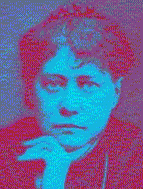
H
P Blavatsky
Glossary of
Theosophical Terms
Ab-e-Hyat, Water of Life, supposed to give eternal
youth.
Abhava, negation or non-being of individual objects; the
substance, the abstract objectivity.
Adam Kadmon, the bi-sexual Sephira of the
Kabalists.
Adept, one who, through the development of his spirit, has
attained to transcendental knowledge and powers.
Adhibhautika, arising from external
objects.
Adhidaivika, arising from the gods,
or accidents.
Adhikamasansas, extra months.
Adhishthanum, basis a principle in which some other
principle inheres.
Adhyatmika, arising out of the
inner-self.
Advaiti, a follower of the school of Philosophy
established
Ahankara, personality; egoism; self identity; the fifth principle.
Ahriman, the Evil Principle of the Universe; so called by the
Zoroastrians.
Ahum, the first three principles of septenary human constitution; the gross living body of man according
to the Avesta.
A’kasa, the subtle supersensuous matter which pervades all space.
Amulam Mulam (lit. “the rootless root”); Prakriti; the
material of the universe.
Anahatachakram, the heart, the seat of
life.
A’nanda, bliss.
A’nanda-maya-kosha, the blissful; the fifth sheath of the
soul in the Vedantic
system; the sixth principle.
Anastasis, the continued existence
of the soul.
Anima Mundi, the
soul of the world.
Annamaya Kosha, the gross
body; the first
sheath of the
divine monad (Vedantic).
Antahkarana, the internal instrument, the soul, formed
by the thinking principle and egoism.
Anumiti, inference.
Aparoksha, direct perception.
Apavarya, emancipation from
repeated births.
Apporrheta, secret discourses in Egyptian and Grecian
mysteries.
Arahats (lit.”the worthy ones”), the initiated holy men of the
Buddhist and Jain faiths.
Aranyakas, holy sages dwelling in
forests.
Ardhanariswara, (lit. “the
bisexual Lord”); the unpolarized
state of cosmic energy; the bi-sexual Sephira, Adam Kadmon.
Arka, sun.
Aryavarta, the ancient name of Northern India where
the
Brahmanical invaders first settled.
A’sana, the third stage of Hatha
Yoga; the
posture for meditation.
Asat, the unreal, Prakriti.
A’shab and Laughan, ceremonies for
casting out evil spirits,
so called among the Kolarian
tribes.
Ashta Siddhis, the eight consummations
of Hatha Yoga.
Asoka (King), a celebrated conqueror, monarch of a largeportion of India, who is called “the Constantine of
Buddhism,” temp. circa 250
B.C.
Astral Light, subtle form
of existence forming the basis of our material universe.
Asuramaya, an Atlantean
astronomer, well known in Sanskrit writings.
Asuras, a class of elementals
considered maleficent; demons.
Aswini, the divine charioteers mystically they
correspond to Hermes, who is looked upon as his equal. They represent the internal organ by which
knowledge is conveyed from the soul to the body.
Atharva Veda, one of the four
most ancient and revered books of the ancient Brahmans.
Atlantis, the continent
that was submerged in the Southern and Pacific Oceans.
Atmabodha (lit. “self-knowledge”),
the title of a Vedantic treatise by Sankaracharya.
Atman, &c Atma.
A’tma, the spirit; the divine monad; the seventh principle of the septenary human constitution.
A’ttavada, the sin of personality
(Pali).
Aum, the sacred syllable in Sanskrit representing theTrinity
Avalokitesvara, manifested wisdom, or
the Divine Spirit in man.
Avasthas, states, conditions, positions.
Avatar, the incarnation of an exalted being, so called among
the Hindus.
Avesta, the sacred books of the
Zoroastrians.
Avyakta, the unrevealed cause.
Baddha, bound or conditioned; the state of an ordinary human being
who has not attained Nirvana.
Bahihpragna, the present state of
consciousness.
Baodhas, consciousness; the fifth principle of man.
Barhaspatyamanam, a method of calculating time prevalent
during the later Hindu period in North-eastern
India.
Bhadrasena, a Buddhist king of Magadha.
Bhagats (or called Sokha
and Sivnath by the Hindus), one who
exorcises an evil spirit.
Bhagavad Gita (lit,
the “Lord’s Song”), an episode of the Maha-Bharata,
the great epic poem of India. It
contains a dialogue between Krishna and Arjuna on
Spiritual Philosophy.
Bhao, ceremony of divination
among the Kolarian tribes of Central India.
Bhashya, commentary.
Bhon, religion of the
aborigines of Tibet.
Bikshu, a religious mendicant and ascetic who suppresses all
desire and is constantly occupied in
devotion; a Buddhist monk.
Boddhisatwas, Egos evolving towards Buddhahood.
Brahma, the Hindu Deity which personifies the active cosmic
energy.
Brahmachari, a Bushman ascetic.
Brahmagnani, one possessed of complete illumination.
Brahman, the highest caste in India; Brahman, the absolute
of the Vedantins.
Brahmana period, one of the four periods into which
the Vedic literature has been divided.
Brihadranyaka Upanishad, one of the sacred books of the
Brahmins; an Aranyaka is a treatise appended to the Vedas, and
considered the subject of special study by those who have retired to the forest
for purposes of religious meditation.
Buddha, the founder of Buddhism; he was a royal
prince, by name Siddhartha, son of Suddhodhana, king
of the Sakyas, an Aryan tribe.
Buddhi, the spiritual Ego.
Buru Bonga, spirit of the hills
worshiped by the Kolarian
tribes of Central India.
Canarese, one of the Dravidian tongues, spoken in
Southern India.
Chandragupta, one of the
kings of Magadha, an ancient province of India.
Chandramanam, the method of
calculating time by the movements of the moon.
Charaka, the most celebrated
writer on medicine among the Hindus.
Chaturdasa Bhuvanam, the
fourteen lokas or states.
Chela, a pupil of an adept in occultism; a disciple.
Chichakti, the power which generates thought.
Chidagnikundum (lit. “the
fireplace in the heart”), the seat
of the force which extinguishes all
individual desires.
Chidakasam, the field of
consciousness.
Chinmatra, the germ of
consciousness, abstract consciousness.
Chit, the abstract consciousness.
Chitta suddhi (Chitta,
mind, and Suddi, purification),
purification of the mind.
Chutuktu, the five chief Lamas of
Tibet.
Daemon, the incorruptible part of man; nous; rational soul.
Daenam (lit. “knowledge”),
the fourth principle in man, according to the Avesta.
Daimonlouphote, spiritual illumination.
Daityas, demons, Titans.
Dama, restraint of the
senses.
Darasta, ceremonial magic practised
among the Kolarian
tribes of
Darha, ancestral spirits of the Kolarian tribes of
Deona or Mati, one who exercises evil
spirits (Kolarian).
Deva, God;
beings of the subjective side of Nature.
Devachan, a blissful condition in the after-life; heavenly
existence.
Devanagari, the current Sanskrit
alphabet.
Dharmasoka, one of the kings of
Dhatu, the seven principal substances of the human body
·
chyle, flesh, blood, fat, bones, marrow, semen.
Dhyan, contemplation.
There are six stages of Dhyan, varying in the degrees of abstraction of
the Ego from sensuous life.
Dhyan Chohans, Devas or Gods planetary
spirits.
Dik, space.
Diksha, initiation.
Dosha, fault.
Dravidians, a group of tribes inhabiting
Dravya, substance.
Dugpas, the “Red Caps,” evil magicians, belonging to the
left-hand path of occultism, so called in
Dukkhu, pain.
Dwija Brahman, twice born; the investiture with the sacred
thread constitutes the second birth.
Elementals, generic name for all subjective
beings other than disembodied human creatures.
Epopta, Greek for seer.
Fakir, a Mahomedan
recluse or Yogi.
Fan, Bar-nang,
space, eternal law.
Fohat, Tibetan for Sakti; cosmic force or
energizing power
of the universe.
Fravashem, absolute spirit.
Gaudapada, a celebrated Brahmanical teacher, the author of commentaries on the Sankhya Karika, Mundukya Upanishad, &c.
Gayatri, the holiest verse of
the Vedas.
Gehs, Parsi prayers.
Gelugpas, “Yellow Caps,” the true Magi and their
school, so
called in
Gnansaki, the power of true knowledge, one of the
six forces.
Gujarathi, the vernacular dialect
of Gujrat, a
Gunas, qualities, properties.
Gunava, endowed with qualities.
Guru, spiritual preceptor.
Ha, a magic syllable used in sacred formula; represents the
power of Akasa Sakti.
Hangsa, a mystic syllable standing for evolution,
it literally means “I am he.”
Hatha Yog, a system of
physical training to obtain psychic powers, the chief feature of this system
being the regulation of breath.
Hierophants, the High Priests.
Hina-yana, lowest form of
transmigration of the Buddhist.
Hiong-Thsang, the celebrated chinese traveler whose writings
contain the most interesting account of
Hwun, spirit;
the seventh principle in man (Chinese).
Ikhir Bongo, spirit of the deep of the Kolarian
tribes.
Indriya, or Deha
Sanyama, control over the senses.
“Isis” (“Isis Unveiled”), book written by Madame Blavatsky
on the Esoteric Doctrine.
Iswara, Personal God, Lord, the Spirit in man,
the Divine principle in its active nature or condition, one of the four states
of Brahma.
Itchasakti, will power; force of desire; one of the six forces of Nature.
Itchcha, will.
Ivabhavat, the one substance.
Jagrata, waking.
Jagrata Avasta, the
waking state; one
of the four aspects
of Pranava.
Jains, a religious sect in
Jambudvipa, one of the main
divisions of the world, including
Janaka, King of Videha, a celebrated character in the Indian epic of
Ramayana. He was a great royal sage.
Janwas, gross form of matter.
Japa, mystical practice of the Yogi, consisting of the
repetition of certain formula.
Jevishis, will; Karma Rupa; fourth principle.
Jiva or Karana Sarira,
the second principle of man;
life.
Jivatma, the human spirit, seventh
principle in theMicrocosm.
Jnanam, knowledge.
Jnanendrayas, the five channels of
knowledge.
Jyotisham Jyotih, the
light of lights, the supreme spirit,
so called in the Upanishads.
Kabala, ancient mystical Jewish books.
Kaliyuga, the last of the four ages in which the
evolutionary period of man is divided. It began 3,000 years B.C.
Kalpa, the period
of cosmic activity; a
day of Brahma, 4,320 million years.
Kama Loka, abode
of desire, the first condition through which a human entity passes in its
passage, after death, to Devachan. It
corresponds to purgatory.
Kama, lust, desire, volition; the Hindu Cupid.
Kamarupa, the principle of desire in man; the fourth
principle.
Kapila, the founder of one of the six principal systems
of Indian philosophy—viz., the Sankhya.
Karans, great festival of the Kolarian tribes in honour of the sun spirit.
Karana Sarira, the
causal body; Avidya;
ignorance; that which is the
cause of the evolution of a human ego.
Karma, the law of ethical causation; the effect of an
act for the attainment of an object of personal desire, merit and demerit.
Karman, action;
attributes of Linga Sarira.
Kartika, the Indian god of war, son or Siva and Parvati;
he
is also the personification of the power of
the Logos.
Kasi, another name for the
sacred city of
Keherpas, aerial form; third principle.
Khanda period, a period of
Vedic literature.
Khi (lit, breath); the spiritual ego; the sixth principle
in man (Chinese).
Kiratarjuniya of Bkaravi, a
Sanskrit epic, celebrating the encounters of Arjuna,
one of this heroes of the Maha-bharata
with the god Siva, disguised as a forester.
Kols, one of the tribes in
Kriyasakti, the power of thought; one of the six forces in
Nature.
Kshatriya, the
second of the four castes into which the Hindu nation was originally divided.
Kshetrajnesvara, embodied spirit, the
conscious ego in its highest manifestation.
Kshetram, the great abyss of the Kabbala; chaos; Yoni, Prakriti; space.
Kumbhaka, retention of breath, regulated according
to the system of Hatha Yoga.
Kundalinisakti, the power of life; one of the six forces of Nature.
Kwer Shans, Chinese
for third principle;
the astral body.
Lama-gylongs,
pupils of Lamas.
Lao-teze, a
Chinese reformer.
Macrocosm, universe.
Magi, fire worshippers; the great magicians or wisdom-
philosophers of old.
Maha-Bharata, the celebrated Indian
epic poem.
Mahabhashya, a commentary on the Grammar of Panini by
Patanjali.
Mahabhautic, belonging to the
macrocosmic principles.
Mahabhutas, gross elementary
principles.
Mahaparinibbana Sutta, one of
the most authoritative of the
Buddhist
sacred writings.
Maha Sunyata, space or eternal law; the great
emptiness.
Mahat, Buddhi;
the first product of root-nature and
producer of Ahankara
(egotism), and manas (thinking principle).
Mahatma, a great
soul; an adept
in occultism of the highest order.
Mahavanso, a Buddhist historical
work written by the Bhikshu Mohanama,
the uncle of King Dhatusma.
Maha-Yug, the aggregate of four
Yugas, or ages--4,320,000 years—in the Brahmanical
system.
Manas, the mind, the thinking principle; the fifth principle
in the septenary division.
Manas Sanyama,
perfect concentration of the mind; control over the mind.
Manomaya Kosha, third
sheath of the divine monad, Vedantic equivalent for
fourth and fifth principles.
Mantra period, one of the
four periods into which Vedic literature has been divided.
Mantra Sastra, Brahmanical writings on
the occult science of incantations.
Mantra Tantra Shastras, works on
incantation and Magic.
Manu, the great Indian legislator.
Manvantara, the outbreathing
of the creative principle;
the
period of cosmic activity between two pralayas.
Maruts, the wind gods.
Mathadhipatis, heads of different religious institutions
in
Matras, the quantity of a Sanskrit syllable.
Matrikasakti, the power of speech, one of six forces in
Nature.
Matsya Puranas, one of the Puranas.
Maya, illusion, is the cosmic power which renders phenomenal
existence possible.
Mayavic Upadhi, the
covering of illusion, phenomenal appearance.
Mayavirupa, the “double;” “doppelganger;” “perisprit.”
Mazdiasnian, Zoroastrian (lit. “worshiping
God”).
Microcosm, man.
Mobeds, Zoroastrian priests.
Monad, the spiritual soul, that which endures through all
changes of objective existence.
Moneghar, the headman of a
village.
Morya, one of time royal houses of
of a Rajpoot tribe.
Mukta, liberated; released from conditional existence.
Mukti. See Mukta.
Mula-prakriti, undifferentiated cosmic matter; the
unmanifested cause and substance of all being.
Mumukshatwa, desire for liberation.
Nabhichakram, the seat of the
principle of desire, near the umbilicus.
Najo, witch.
Nanda (King), one of the kings of
Narayana, in mystic symbology it stands for the
life
principle.
Nava
nidhi, the nine jewels, or consummation of spiritual
development.
Neophyte, a candidate for
initiation into the mysteries of adeptship.
Nephesh, one of the three souls,
according to the Kabala; first three principles in the human septenary.
Neschamah, one of the three souls,
according to the Kabala; seventh principle in the human septenary.
Nirguna, unbound; without gunas
or attributes; the soul in its state of
essential purity is so called.
Nirvana, beautitude, abstract spiritual existence, absorption into
all.
Niyashes, Parsi prayers.
Noumena, the true essential nature of being, as
distinguished from the illusive objects of sense.
Nous, spirit, mind; Platonic term, reason.
Nyaya Philosophy, a system of Hindu logic founded by
Gautuma.
Occultism, the study of
the mysteries of Nature and the development of the psychic powers latent in
man.
Okhema, vehicle; Platonic term for body.
Padarthas, predicates of existing things, so called
in the “Vaiseshikha,” or atomic system of philosophy,
founded by Kanad (Sanskrit).
Padma
Pahans, village priests.
Panchakosha, the five sheaths in which is enclosed the
divine monad.
Panchikrita, developed into the five gross elements.
Parabrahm, the supreme principle in Nature; the universal
spirit.
Paramarthika, one of the three states of existence
according to Vedanta;
the true, the only real one.
Paramatma, time Supreme Spirit, one of the six
forces of Nature; the
great force.
Parasakti, intellectual
apprehension of a truth.
Pataliputra, the ancient capital of the kingdom
Patanjali, the author of “Yoga Philosophy,” one of
the six orthodox systems of
Peling, the name given to
Europeans in
Phala, retribution; fruit or results of causes.
Pho, animal soul.
Pisacham, fading remnants of human beings in the
state of
Kama Loka; shells or elementaries.
Piyadasi, another name for Asoka
(q.v.)
Plaster or Plantal, Platonic term for the power which
moulds the substances of the universe into
suitable forms.
Popol-Vuh, the sacred book of the
Guatemalans.
Poseidonis, the last island submerged of the
continent of
Atlantis.
Pracheta, the principle of water.
Pragna, consciousness.
Prajapatis, the constructors of the
material universe.
Prakriti, undifferentiated matter; the supreme principle
regarded as the substance of the universe.
Pralaya, the period of cosmic
rest.
Prameyas, things to be proved, objects of Pramana or proof.
Prana, the one life.
Pranamaya Kosha, the
principle of life and its vehicle; the
second sheath of the Divine monad (Vedantic).
Pranatman, the eternal or germ thread on which are
strung, like beads, the personal lives. The
same as Sutratma.
Pratibhasika, the apparent or
illusory life.
Pratyaksha, perception.
Pretya-bhava, the state of an ego under the necessity
of
repeated births.
Punarjanmam, power of evolving objective
manifestation; rebirth.
Puraka, in-breathing, regulated
according to the system of Hatha Yoga.
Puranas (lit. “old
writings”). A
collection of symbolical Brahmanical writings. They are eighteen in number, and are supposed
to have been composed by Vyasa, the author of the
Mahabharata.
Purusha, spirit.
Rajas, the quality of foulness; passionate activity.
Rajarshi, a king-adept.
Raj Yoga, the true science of the development of psychic
powers and union with the Supreme Spirit.
Rakshasas, evil spirits; literally, raw-eaters.
Ramayana, an epic poem describing the life of Rama,
a
deified Indian hero.
Ram Mohun Roy, the well-known Indian
Reformer, died 1833.
Rechaka, out-breathing, regulated according to the
system of
Hatha Yoga.
Rig Veda, the first of the Vedas.
Rishabham, the Zodiacal sign Taurus, the sacred
syllable
Aum.
Rishis (lit. “revealers”), holy sages.
Ruach, one of the souls, according to the Kabala; second
three principles in the human septenary.
Sabda, the Logos or Word.
Saketa, the capital of the ancient Indian kingdom of
Ayodhya.
Sukshma sariram,
the subtile body.
Sakti, the crown of the astral light; the power of Nature.
Sakuntala, a Sanskrit drama by Kalidasa.
Samadhana, incapacity to diverge from the path of
spiritual
progress.
Sama, repression of mental
perturbations.
Samadhi, state of ecstatic trance.
Samanya, community or
commingling of qualities.
Samma-Sambuddha, perfect illumination.
Samvat, an Indian era which, is usually supposed to have
commenced 57 B.C.
Sankaracharya, the great expositor of the monistic
Vedanta Philosophy, which denies the personality of the Divine Principle, and
affirms its unity with the spirit of man.
Sankhya Karika, a
treatise containing the aphorisms of Kapila, the
founder of the
Sankhya system, one of the six
schools of Hindu philosophy.
Sankhya Yog, the system
of Yog as set forth by Sankhya
philosophers.
Sannyasi, a Hindu, ascetic whose
mind is steadfastly fixed upon the Supreme Truth.
Sarira, body.
Sat, the real, Purusha.
Sattwa, purity.
Satva, goodness.
Satya Loka, the abode of Truth, one of the subjective
spheres in our solar system.
Shamanism, spirit worship; the oldest religion of
Siddhasana, one of the postures enjoined by the
system of
Hatha Yoga.
Siddhi, abnormal power obtained by spiritual development.
Sing Bonga, sun spirit of the Kolarian tribes.
Siva, one of the Hindu gods, with Brahma and Vishnu, forming
the Trimurti or
Trinity; the principle of destruction.
Sivite, a worshipper of Siva, the name of a sect
among the Hindus.
Skandhas, the impermanent elements which
constitute a man.
Slokas, stanzas (Sanskrit).
Smriti, legal and ceremonial
writings of the Hindus.
Soham, mystic syllable representing involution; lit. “that
am I.”
Soonium, a magical ceremony for the purpose of
removing a sickness from one person to another.
Soorya, the sun.
Souramanam, a method of calculating
time.
Space, Akasa;
Swabhavat (q.v.)
Sraddha, faith.
Sravana,
receptivity, listening.
Sthula-Sariram, the gross physical
body.
Sukshmopadhi, fourth and fifth principles (Raja Yoga.)
Sunyata,
space; nothingness.
Suras,
elementals of a beneficent order; gods.
Surpa, winnower.
Suryasiddhanta, a Sanskrit treatise on
astronomy.
Sushupti Avastha, deep sleep; one of the four aspects of
Pranava.
Sutra
period, one of the periods into which Vedic literature has been divided.
Sutratman, (lit. “the thread
spirit,”) the immortal individuality upon which are strung our countless
personalities.
Svabhavat, Akasa; undifferentiated primary matter;
Prakriti.
Svapna, dreamy condition,
clairvoyance.
Swami (lit. “a master”), the family idol.
Swapna Avastha, dreaming state; one of the four
aspects of
Pranava.
Tama, indifference, dullness.
Tamas, ignorance, or darkness.
Tanha, thirst;
desire for life, that which produces re-birth.
Tanmatras, the subtile
elements, the abstract counterpart of
the five elements, earth, water, fire, air and
ether, consisting of smell, taste, feeling, sight and sound.
Tantras, works on Magic.
Tantrika, ceremonies connected with the worship of
the
goddess Sakti, who
typifies Force.
Taraka Yog, one of the Brahmanical systems for the development of psychic powers
and attainment of spiritual knowledge.
Tatwa, eternally existing “that;” the different
principles in Nature.
Tatwams, the abstract principles
of existence or categories, physical and metaphysical.
Telugu, a language spoken in
Tesshu Lama, the head of the
The Laws of Upasanas, chapter in the Book
iv. of Kui-te
on
the rules for aspirants for chelaship.
Theodidaktos (lit. “God taught “), a school of
philosophers in
Theosophy, the Wisdom-Religion taught in
all ages by the sages of the world.
Tikkun, Adam Kadmon, the ray from the
Great Centre.
Titiksha, renunciation.
Toda, a mysterious tribe in
Tridandi, (tri, “three,” danda,
“chastisement”), name of
BrahmanicaI thread.
Trimurti, the Indian Trinity—Brahma, Vishnu and
Siva, Creator, Preserver and Destroyer.
Turiya Avastha, the state of Nirvana.
Tzong-ka-pa, celebrated Buddhist reformer of
instituted the order of Gelugpa
Lamas.
Universal Monas,
the universal spirit.
Upadana Karnam, the
material cause of an effect.
Upadhis, bases.
Upamiti, analogy.
Upanayana, investiture with the Brahmanical thread.
Upanishads, Brahmanical Scriptures
appended to the Vedas,
containing the esoteric doctrine of the Brahmans.
Upanita, one who is invested with the Brahmanical thread (lit. “brought
to a spiritual teacher”).
Uparati, absence of out-going desires.
Urvanem, spiritual ego; sixth principle.
Ushtanas, vital force; second principle.
Vach, speech;
the Logos; the mystic
Word.
Vaishyas,
cattle breeders
artisans; the third caste among
the Hindus.
Vakya Sanyama, control over speech.
Varuna or Pracheta, the Neptune of
Vasishta, a great Indian sage, one of those to whom
the Rig
Veda was revealed
in part.
Vata, air.
Vayu, the wind.
Vayu Puranas, one of the Puranas.
Vedantists, followers of the Vedanta School of
Philosophy,
which is divided into two branches, monists and
dualists.
Vedas,
the most authoritative of the Hindu Scriptures. The
four oldest sacred books—Rig, Yajur, Sama and Atharva—revealed to the Rishis by Brahma.
Vedic, pertaining to the Vedas.
Vidya, secret knowledge.
Vija, the primitive germ
which expands into the universe.
Vijnana-maya-kosha, the sheath of knowledge; the fourth
sheath of the divine monad; the fifth principle in man (Vedanta).
Viraj, the material universe.
Vishnu, the second member of the Hindu trinity; the
principle of preservation.
Vishnuite or Vishuvite, a
worshiper of Vishnu, the name of a sect among the Hindus.
Vrishalas, Outcasts.
Vyasa, the celebrated Rishi, who collected and arranged the
Vedas
in their present form.
Vyavaharika, objective existence; practical.
Yajna Sutra, the name of the Brahmanical
thread.
Yama, law, the god of death.
Yashts, the Parsi prayer-books.
Yasna, religious book of the Parsis.
Yasodhara, the wife of Buddha.
Yavanacharya, the name given to Pythagoras in the
Indian
books.
Yavanas, the generic name given by the Brahmanas to younger peoples.
Yoga Sutras, a treatise on Yoga philosophy
by Patanjali.
Yog Vidya, the science of Yoga; the practical
method of
uniting one’s own spirit with the universal
spirit.
Yogis,
mystics, who develop themselves according to the system of Patanjali’s
“Yoga Philosophy.”
Yudhishthira, the eldest of the five brothers, called Pandavas, whose exploits are celebrated in the great
Sanskrit epic “Mahabharata.”
Zend, the sacred language of
ancient
Zhing, subtle matter; Kama Rupa, or fourth principle
(Chinese).
Zoroaster, the prophet of the Parsis.
Theosophical Society,
Useful
Theosophy Links
Cardiff Lodge’s Instant Guide to Theosophy
Dave’s
Streetwise Theosophy Boards
The Theosophy Website that welcomes Absolute Beginners
A Free introductory Theosophy Course.
If you run a
Theosophy Study Group, please
feel free to use any material on this
Website.
The
Voice of the Silence Website
The Spiritual Home of Urban Theosophy
The Earth Base for Evolutionary Theosophy
Classic Theosophy Text
A Text Book of Theosophy By C
What Theosophy Is From the Absolute to Man
The Formation of a Solar System The Evolution of Life
The Constitution of Man After Death Reincarnation
The Purpose of Life The Planetary Chains
The Result of Theosophical Study
Try these if you are looking
for a local
Theosophy Group or Centre
UK Listing of Theosophical Groups
Worldwide Directory of Theosophical Links