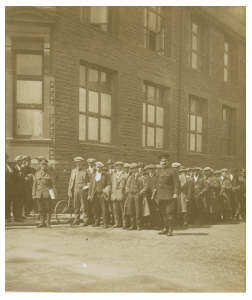
Cardiff
in March 1918
New
recruits form up outside the
at
the corner of
Theosophy and the Great War
To Those Who Mourn
by
C.W.Leadbeater
First Published 1918
Theosophy and The Great War
Index
Never the
spirit was born; the spirit shall cease to be never;
Never was
time it was not; End and Beginning are dreams!
Birthless and deathless and changeless remaineth
the spirit forever;
Death hath
not touched it at all, dead though the house of it seems!
--Sir Edwin
Arnold
__________________________
"Tis but as when one layeth
His worn-out
robes away
And taking
new ones, sayeth
"These
will I wear today!"
So putteth by the Spirit
Lightly its
garb of flesh,
And passeth to inherit
A residence
afresh
--Sir Edwin
Arnold
__________________
Friend: You
have lost by death one whom you loved dearly, one who perhaps was all the world
to you; and so to you that world seems empty, and life no longer worth the
living. You feel that joy has left you forever, that existence can be for you
henceforth nothing but hopeless sadness, naught but one aching longing for
"the touch of a vanished hand and the sound of a voice that is still."
You are thinking chiefly of yourself and your intolerable loss; but there is
also another sorrow. Your grief is aggravated by your uncertainty as to the
present condition of your beloved; you feel that he has gone, you know not
where. You hope earnestly that all is well with him, but when you look upward
all is void; when you cry there is no answer. And so despair and doubt
overwhelm you, and make a cloud that hides from you the sun that never sets.
Your feeling
is most natural; I, who write, understand it perfectly, and my heart is full of
sympathy for all those who are afflicted as you are. But I hope that I can do
more than sympathize: I hope that I can bring you help and relief. Such help
and relief have come to thousands who were in your sad case. Why should they
not come to you also?
You say:
"How can there be relief or hope for me?"
There is the
hope of relief for you because your sorrow is founded in misapprehension; you
are grieving for something which has not really happened. When you understand
the facts you will cease to grieve.
You answer:
"My loss is a fact. How can you help me, unless indeed you give me back my
dead?"
I understand
your feeling perfectly; yet bear with me for a while, and try to grasp three
main propositions, which I am about to put before you, at first merely as broad
statement, and then in convincing detail:
1. Your loss
is only an apparent fact, apparent from your point of view. I want to bring you
to another viewpoint. Your suffering is the result of a great delusion, of ignorance
of Nature's law; let me help you on the road towards knowledge by explaining a
few simple truths which you can study further at your leisure.
2. You need
be under no uneasiness or uncertainty with regard to the condition of your
loved one, for the life after death is no longer a mystery. The world beyond
the grave exists under the same natural laws as this which we know, and has
been explored and examined with scientific accuracy.
3. You must
not mourn, for your mourning does harm to your loved one. If you can once open
your mind to the truth, you will mourn no more.
You may
perhaps feel that these are only assertions; but let me ask you on what grounds
you hold your present belief, whatever it may be. You think you hold it because
some Church teaches it, or because it is supposed to be founded upon what is
written in some holy book; or because it is the general belief of those around
you, the accepted opinion of your time. But if you will try to clear your mind
from preconceptions, you will see that this opinion also rests merely upon
assertion for the Churches teach different views, and the words of the holy
book may be and have been variously interpreted. The accepted view of your time
is not based upon any definite knowledge; it is mere hearsay. These matters
which affect us so nearly and so deeply are too important to be left to mere
supposition or vague belief; they demand the certainty of scientific
investigation and tabulation. Such investigation has been undertaken, such
tabulation has been accomplished; and it is the result of these which I wish to
put before you. I ask no blind credence; I state what I myself know to be
facts, and I invite you to examine them.
Let us
consider these propositions one by one. To make the subject clear to you I must
tell you a little more about the constitution of man than is generally know to
those who have made no special study of the matter. You have heard it said
vaguely that man possesses an immortal something called a soul, which is
supposed to survive the death of the body. I want you to cast aside that
vagueness and to understand that, even if it were true, it is an understatement
of the facts. Do not say: : "I hope that I have a soul," but " I
know that I am a soul." For that is the real truth; man is a soul."
and has a body. The body is not the man; it is only the clothing of the man.
What you call death is the laying aside of a worn-out garment, and it is no
more the end of the man than it is the end of you when you remove your
overcoat. Therefore you have not lost your friend; you have only lost sight of
the cloak in which you were accustomed to see him. The cloak is gone, but the
man who wore it is not; surely it is the man that you love and not the garment.
Before you
can understand your friend's condition you must understand your own. Try to
grasp the fact that you are an immortal being, immortal because you are divine
in essence, because you are a spark from God's own Fire; that you lived for
ages before you put on this vesture that you call a body, and that you will
live for ages after it has crumbled into dust. "God made man to be an
image of His own eternity." This is not a guess or a pious belief; it is a
definite scientific fact, capable of proof, as you may see from the literature on
the subject if you will take the trouble to read. * [A list of books will be
found at the end of the pamphlet]
What you have
been thinking of as your life is in truth only one day of your life as a soul,
and the same is true of your beloved; therefore he is not dead. It is only his
body that is cast aside.
Yet you must
not therefore think of him as a mere bodiless breath, as in any way less
himself than he was before. As St Paul said long ago: "There is a natural
body, and there is a spiritual body." People misunderstand that remark,
because they think of these bodies as successive, and do not realize that we,
all of us, possess both of them even now. You, as you read this, have both a
"natural" or physical body, which you cannot see, that which
If that idea
is by this time clear to you, let us advance another step. It is not only at
what you call death that you doff that overcoat of dense matter; every night
when you go to sleep you slip it off for awhile, and roam about the world in
your spiritual body, invisible as far as this dense world is concerned, but
clearly visible to those friends who happen to be using their spiritual bodies
at the same time. For each body sees only that which is on its own level; your
physical body sees only other physical bodies. When you resume your overcoat
that is to say, when you come back to your denser body, it occasionally happens
that you have some recollection, although usually a considerably distorted one
of what you have seen when you were away elsewhere; and then you call it a
vivid dream. Sleep, then, may be described as a kind of temporary death, the
difference being that you do not withdraw yourself so entirely from your
overcoat as to be unable to resume it. It follows that when you sleep, you
enter the same condition as that into which your beloved has passed. What that
condition is I will now proceed to explain.
Many theories
have been current as to the life after death, most of them based upon misunderstandings
of ancient scriptures. At one time the horrible dogma of what was called
everlasting punishment was almost universally accepted in
The truth is
that the day of blind belief is past; the era of scientific knowledge is with
us, and we can no longer accept ideas unsustained by
reason and common sense. There is no reason why scientific methods should not
be applied to the elucidation of problems which in earlier days were left
entirely to religion; indeed, such methods have been applied by The
Theosophical Society and the Society of Psychical Research; and it is the result
of these investigations, made in a scientific spirit, that I wish to place
before you now.
We are
spirits, but we live in a material world, a world, however, which is only
partially known to us. All the information that we have about it comes to us
through our senses; but these senses are seriously imperfect. Solid objects we
can see; we can usually see liquids, unless they are perfectly clear; but gases
are in most cases invisible to us. Research shows that there are other kinds of
matter far finer than the rarest of gases; but to these our physical senses do
not respond, and so we can gain no information with regard to them by physical
means.
Nevertheless,
we can come into touch with them; we can investigate them, but we can do it
only by means of that "Spiritual body'' to which reference has been made,
for that has its senses just as this one has. Most men have not yet learned how
to use them, but this is a power which can be acquired by man. We know that it
can be, because it has been so acquired; and those who have gained it find
themselves able to see much which is hidden from the view of the ordinary man.
They learn that this world of ours is far more wonderful than we have ever
supposed; that though men have been living in it for thousands of years, most
of them have remained blankly ignorant of all the higher and more beautiful
parts of its life. The line of research to which I am referring has already
yielded many marvelous results, and is opening before us new vistas every day.
This information may be gleaned from Theosophical literature, but we are here
concerned with only one part of it, with the new knowledge that it puts before
us as to the life beyond what we call death, and the condition of those who are
enjoying it.
The first
thing that we learn is that death is not the end of life, as we have ignorantly
assumed, but is only a step from one stage of life to another. I have already
said that it is the laying aside of an overcoat, but that after it the man
still finds himself clad in his ordinary housecoat, the spiritual body. But
though, because it is so much finer, St Paul gave it the name of
"spiritual," it is still a body, and therefore, material, even though
the matter of which it is composed be very much finer than ordinarily known to
us. The physical body serves the spirit as a means of communication with the
physical world. Without that body as an instrument, he would be unable to
communicate with that world, to impress himself upon it or to receive
impressions from it. We find that the spiritual body serves exactly the same
purpose; it acts as an intermediary for the spirit with the higher and
"spiritual" world. But this spiritual world is not something vague,
faraway and unattainable; it is simply a higher part of the world which we now
inhabit. I am not for a moment denying that there are other worlds, far higher
and more remote; I am saying only that what is commonly called death has
nothing to do with those, and that it is merely a transference from one stage or
condition to another in this world with which we are all familiar. It may be
said that the man who makes this change becomes invisible to you; but if you
think of it, you will see that the man has always been invisible to you, that
what you have been in the habit of seeing is only the body which he inhabited.
Now he inhabits another and a finer body, which is beyond your ordinary sight,
but not necessarily by any means beyond your reach.
The first
point to realize is that those whom we call the dead have not left us. We have
been brought up in a complex belief which implies that every death is a
separate and marvelous miracle, that when the soul leaves the body it somehow
vanishes into a heaven beyond the stars, no suggestion being made as to the
mechanical means of transit over the appalling spaces involved. Nature's
processes are assuredly wonderful, and often to us incomprehensible, but they
never fly in the face of reason and common sense. When you take off your
overcoat in the hall, you do not suddenly vanish to some distant mountain-top;
you are standing just where you were before, though you may present a different
outward appearance. Precisely in the same way, when a man puts off his physical
body he remains exactly where he was before. It is true that you no longer see
him, but the reason for this is not that he has gone away, but that the body
which he is now wearing is not visible to your physical eyes.
You may be
aware that our eyes respond only to a very small proportion of the vibrations
which exist in nature, and consequently the only substances which we can see
are those which happen to reflect these particular undulations. The sight of
your "spiritual body" is equally a matter of response to undulations,
but they are of quite a different order, coming from a much finer type of
matter. All this, if it interests you, you may find worked out in detail in
Theosophical literature.
For the
moment all which concerns us is that by means of your physical body you can see
and touch the physical world only, while by means of the "spiritual
body" you can see and touch the things of the spiritual world. And
remember that this is in no sense another world, but simply a more refined part
of this world. Once more I say, there are other worlds, but we are not
concerned with them now. The man of whom you think as departed is in reality
with you still. When you stand side by side, you in the physical body and he in
the "spiritual" vehicle, you are unconscious of his presence because
you cannot see him; but when you leave your physical body in sleep you stand
side by side with him in full and perfect consciousness, and your union with
him is in every way as full as it used to be. So during sleep you are happy
with him whom you love; it is only during waking hours that you feel the
separation.
Unfortunately
for most of us, there is a break between the physical consciousness and the
consciousness of the spiritual body, so that although in the latter we can
perfectly remember the former, many of us find it impossible to bring through
into waking life the memory of what the soul does when it is away from the body
in sleep. If this memory were perfect, for us there would indeed be no death.
Some men have already attained this continued consciousness, and all may attain
it by degrees, for it is part of the natural unfolding of the powers of the
soul. In many, such unfolding had already begun, and so fragments of memory
come through, but there is a tendency to stamp them as only dreams and
therefore valueless, a tendency specially prevalent among those who have made
no study of dreams and do not understand what they really are. But while as yet
only a few possess full sight and full memory, there are many who have been
able to feel the presence of their loved ones, even though they cannot see; and
there are others who though they have no definite memory, wake from slumber
with a sense of peace and blessedness which is the result of what has happened
in that higher world.
Remember
always that this is the lower world and that is the higher, and that the
greater in this case includes the less. In that consciousness you remember
perfectly what has happened in this, because as you pass from this to that in
falling asleep, you are casting off a hindrance, the encumbrance of the lower
body; but when you come back to this lower life, you again assume that burden,
and in assuming it you cloud the higher faculties and so lapse into
forgetfulness. So it follows that if you have some piece of news that you wish
to give to a departed friend, you have only to formulate it clearly in your
mind before falling asleep, with the resolution that you will tell him of it,
and you are quite certain to do so as soon as you meet him . Sometimes you may
wish to consult him on some point, and here the break between the two forms of
consciousness usually prevents you from bringing back a clear answer. Yet even
if you cannot bring back a definite recollection, you will often wake with a
strong impression as to his wish or his decision; and you may usually take it
that such an impression is correct. At the same time, you should consult him as
little as possible, for, as we shall see later, it is distinctly undesirable
that the dead should be troubled in their higher world with affairs that belong
to the department of life from which they have been freed.
This brings
us to the consideration of the life which the dead are leading. In it there are
many and great variations, but at least it is almost always happier than the
earth life. As an old scripture puts it:: "The souls of the righteous are
in the hand of God, and there shall no torment touch them. In the sight of the
universe they seem to die, and their departure is taken for misery, and their
going from us to be utter destruction; but they are in peace." We must
disabuse ourselves of antiquated theories; the dead man does not leap suddenly
into an impossible hell, nor does he fall into a still more impossible hell.
There is indeed no hell in the old wicked sense of the word; and there is no
hell anywhere in any sense except such as a man makes for himself. Try to
understand clearly that death makes no change in the man; he does not suddenly
become a great saint or angel, nor is he suddenly endowed with all the wisdom
of the ages. He is just the same man after his death as he was the day before
it, with the same emotions, the same dispositions, the same intellectual
development. The only difference is that he has lost the physical body.
Try to think
exactly what that means. It means absolute freedom from the possibility of pain
or fatigue; freedom also from all irksome duties; entire liberty (probably for
the first time in his life) to do exactly what he likes. In the physical life
man is constantly under constraint; unless he is one of a small minority who have
independent means he is ever under the necessity of working in order to obtain
money, money which he must have in order to buy food and clothing and shelter
for himself and for those who are dependent upon him. In a few rare instances,
such as those of the artist and the musician, the man's work is a joy to him,
but in most cases it is a form of labour to which he would certainly not devote
himself unless he were compelled.
In this
spiritual world no money is necessary, food and shelter are no longer needed,
for its glory and its beauty are free to all its inhabitants without money and
without price. In its rarefied matter, in the spiritual body, he can move
hither and thither as he will. If he loves art he may spend the whole of his
time in the contemplation of the masterpieces of all the greatest of men; if he
be a musician, he may pass from one to the other of the world's chiefest orchestras, or may spend his time in listening to
the most celebrated performers. Whatever has been his delight on earth, his
hobby, as we should say, he has now the fullest liberty to devote himself to it
entirely and to follow it out to the utmost, provided only that its enjoyment
is that of the intellect or of the highest emotions, that its gratification
does not necessitate the possession of a physical body. Thus it will be seen at
once that all rational and decent men are infinitely happier after death than
before it, for they have ample time not only for pleasure but for really
satisfactory progress along the lines which interest them most.
Are there
then none in that world who are unhappy? Yes, for that life is necessarily a
sequel to this, and the man is in every respect the same man as he was before
he left his body. If his enjoyments in this world were low and coarse, he will
find himself unable to gratify his desires. A drunkard will suffer from
unquenchable thirst, having no longer a body through which it can be assuaged;
the glutton will miss the pleasures of the table; the miser will no longer find
gold for his gathering. The man who has yielded himself during earth-life to
unworthy passions will find them gnawing at his vitals. The sensualist still
palpitates with cravings that can never now be satisfied; the jealous man is
still torn by his jealousy, all the more than he can no longer interfere with
the action of its object. Such people as these unquestionably do suffer, but
only such as these, only those whose proclivities and passions have been coarse
and physical in their nature. And even they have their fate absolutely in their
own hands. They have but to conquer these inclinations, and they are at once
free from the sufferings which such longings entail. Remember always that there
is no such thing as punishment; there is only the natural result of a definite cause;
so that you have only to remove the cause and the effect ceases, not always
immediately, but as soon as the energy of the cause is exhausted.
There are
many people who have avoided these more glaring vices, yet have lived what may
be called worldly lives, caring principally for society and its conventions,
and thinking only of enjoying themselves. Such people as these have no active
suffering in the spiritual world, but they often find it dull, they find time
hanging heavy on their hands. They can foregather with others of their type,
but they usually find them somewhat monotonous, now that there is no longer any
competition in dress or in general ostentation, while the better and cleverer
people whom they desire to reach are customarily otherwise engaged and
therefore somewhat inaccessible to them. But any man who has rational
intellectual or artistic interests will find himself quite infinitely happier
outside his physical body than in it, and it must be remembered that it is
always possible for a man to develop in that world a rational interest if he is
wise enough to do so.
The artistic
and intellectual are supremely happy in that new life; yet even happier still,
I think, are those whose keenest interest has been in their fellow men, those
whose greatest delight has been to help, to succor, to teach. For though in
that world there is no longer any hunger or thirst or cold, there are still
those who are in sorrow who can be comforted; those who are in ignorance who
can be taught. Just because in western countries there is so little knowledge
of the world beyond the grave, we find in that world many who need instruction
as to the possibilities of this new life; and so one who knows may go about
spreading hope and glad tidings there just as much as here. But remember always
that "there" and "here" are only terms in deference to our
blindness; for that world is here, close around us all the time, and not for a
moment to be thought of as a distant or difficult of approach.
Do the dead
then see us? may be asked; do they hear what we say? Undoubtedly they see us in
the sense that they are always conscious of our presence, that they know
whether we are happy or miserable; but they do not hear the words we say, nor
are they conscious in detail of our physical actions. A moment's thought will
show us what are the limits of their power to see. They are inhabiting, what we
have called the "spiritual body," a body which exists in ourselves,
and is, as far as appearance goes, an exact duplicate of the physical body; but
while we are awake our consciousness is focused exclusively in the latter. We
have already said that just as only physical matter appeals to the physical
body, so only the matter of the spiritual world is discernible by that higher
body. Therefore, what the dead man can see of us is only our spiritual body,
which, however, he has no difficulty in recognizing. When we are what we call
asleep, our consciousness is using that vehicle, and so to the dead man we are
awake; but when we transfer our consciousness to the physical body, it seems to
the dead man that we fall asleep, because though he still sees us, we are no
longer paying any attention to him or able to communicate with him. When a
living friend falls asleep we are quite aware of his presence, but for the
moment we cannot communicate with him. Precisely similar is the condition of
the living man (while he is awake) in the eyes of the dead. Because we cannot
usually remember in our waking consciousness what we have seen during sleep, we
are under the delusion that we have lost our dead; but they are never under the
delusion that they have lost us, because they can see us all the time. To them
the only difference is that we are with them during the night and away from
them during the day; whereas when they were on earth with us, exactly the
reverse was the case.
Now this
which, following St. Paul, we have been calling the "spiritual body"
(it is more usually spoken of as the astral body) is especially the vehicle of
our feelings and emotions; it is therefore these feelings and emotions of ours
which show themselves most clearly to the eyes of the dead. If we are joyous,
they instantly observe it, but they do not necessarily know the reason of the
joy; if sadness comes over us, they at once realize it and share it, even
though they may not know why we are sad. All this, of course, is during our
waking hours; when we are asleep, they converse with us as of yore on earth.
Here in our physical life we can dissemble our feelings; in that higher world
this is impossible, for they show themselves instantly in visible change. Since
so many of our thoughts are connected with our feelings, most of these also are
readily obvious in that world; but anything in the nature of abstract thought
is still hidden.
You still say
that all this has little in common with the heaven and hell of which we are
taught in our infancy; yet it is the fact that this is the reality which lay
behind these myths. Truly there is no hell; yet it will be seen that the
drunkard or the sensualist may have prepared for himself something which is no
bad imitation thereof. Only it is not everlasting; it endures only until his
desires have worn themselves out. He can at any moment put a period to it, if
he is strong enough and wise enough to dominate those earthly cravings and to
raise himself entirely above them. This is the truth underlying the Catholic
doctrine of purgatory, the idea that after death the evil qualities have to be
burned out of a man by a certain amount of suffering before he is capable of
enjoying the bliss of heaven.
There is a
second and higher stage of the life after death which does correspond very
closely to a rational conception of heaven. That higher level is attained when
all lower or selfish longings have absolutely disappeared; then the man passes
into a condition of religious ecstasy or of higher intellectual activity,
according to the line along which his energy has flowed out during his
earth-life. That is for him a period of the most supreme bliss, a period of far
greater comprehension, or nearer approach to reality. But this joy comes to
all, not only to the specially pious.
It must by no
means be regarded as a reward, but once more only as the inevitable result of
the character evolved in earth life. If a man is full of high and unselfish
affection or devotion, if he is splendidly developed intellectually or
artistically, the inevitable result of such development will be this enjoyment
of which we are speaking. Be it remembered that all these are but stages of one
life, and that just as a man's behaviour during his
youth makes for him to a large extent the conditions of his middle life and old
age, so a man's behaviour during his earth-life
determines his condition during these after-states. Is this state of bliss
eternal? You ask. No, for, as I have said, it is the result of the earth life,
and a finite cause can never produce an infinite result.
The life of
man is far longer and far greater than you have supposed. The Spark which has
come forth from God must return to Him, and we are as yet far from that
perfection of Divinity. All life is evolving, for evolution is God's law; and
man grows slowly and steadily along with the rest. What is commonly called
man's life is in reality only one day of his true and longer life. Just as in
this ordinary life man rises each morning, puts on his clothes, and goes forth
to do his daily work,and then when night descends he
lays aside those clothes and takes his rest, and then again on the following
morning rises afresh to take up his work at the point where he left it, just so
when the man comes into physical life he puts upon him the vesture of the
physical body, and when his work-time is over he lays aside that vesture again
in what you call death, and passes into the more restful condition which I have
described; and when that rest is over he puts upon himself once more the
garment of the body and goes forth yet again to begin a new day of physical
life, taking up his evolution at the point where he left it. And this long life
of his lasts until he attains that goal of divinity which God means him to
attain.
All this may
well be new to you, and because it is new it may seem strange and grotesque.
Yet all that I have said is capable of proof, and has been tested many times
over; but if you wish to read all this you must study the literature on the
subject, for in a short pamphlet with a special purpose, such as this, I can
merely state the facts, and not attempt to adduce the proofs.
You may
perhaps ask whether the dead are not disturbed by anxiety for those whom they
have left behind. Sometimes that does happen, and such anxiety delays their
progress; so we should, as far as possible, avoid giving any occasion for it.
The dead man should be utterly free from all thought of the life which he has
left, so that he may devote himself entirely to the new existence upon which he
has entered. Those therefore who have in the past depended upon his advice
should now endeavour to think for themselves, lest by
still mentally depending upon him they should strengthen his ties with the
world from which he has for the moment turned. So it is always an especially
good deed to take care of children, whom a dead man leaves behind him, for in
that way one not only benefits the children, but also relieves the departed
parent from anxiety and helps him on his upward path.
If the dead
man has during life been taught foolish and blasphemous religious doctrines, he
sometimes suffers from anxiety with regard to his own future fate. Fortunately
there are in the spiritual world many who make it their business to find men
who are under such a delusion as this, and to set them free from it by a
rational explanation of facts. Not only are there dead men who do this, but
there are also many living men who devote their time during the sleep of the
body each night to the service of the dead, endeavouring
to relieve people from nervousness or suffering by explaining to them the truth
in all its beauty. All suffering comes from ignorance; dispel the ignorance and
the suffering is gone.
One of the
saddest cases of apparent loss is when a child passes away from this physical
world and its parents are left to watch its empty place, to miss its loving
prattle. What then happens to children in this strange new spiritual world? Of
all those who enter it, they are perhaps the happiest and the most entirely and
immediately at home. Remember that they do not lose the parents, the brothers,
the sisters, the playmates whom they love; it is simply that they have them to play
with during what we call the night instead of the day; so that they have no
feeling of loss or separation. During our day they are never left alone, for,
as here children gather together and play together, play in Elysian fields full
of rare delights. We know how a child here enjoys "making believe,"
pretending to be this character or that in history, playing the principal part
in all sorts of wonderful fairy stories or tales of adventure. In the finer
matter of that higher world, thoughts take to themselves visible form, and so
the child who imagines himself a certain hero promptly takes on temporarily the
actual appearance of that hero. If he wishes for an enchanted castle, his
thought can build that enchanted castle. If he desires an army to command, all
at once that army is there. And so among the dead the hosts of children are
always full of joy, indeed, often even riotously happy.
And those
other children of different disposition, those whose thoughts turn more
naturally to religious matters, they also never fail to find that for which
they long. For the angels and the saints of old exist, they are not mere pious
fancies; and those who need them, those who believe in them are surely drawn to
them, also find them kinder and more glorious than ever fancy dreamed. There
are those who would find God Himself, God in material form; yet even they are
not disappointed, for from the gentlest and the kindest teachers they learn
that all forms are God's forms, for He is everywhere, and those who would serve
and help even the lowest of His creatures are truly serving and helping Him.
Children love to be useful; they love to help and comfort; a wide field for
such helping and comfort lies before them among the ignorant in the higher
world, and as they move through its glorious fields on their errands of mercy
and of love they learn the truth of the beautiful old teaching: "Inasmuch
as ye have done it unto one of the least of these My brethren ye had done it
unto Me."
And the tiny
babies, those who are as yet too young to play? Have no fear for them, for many
a dead mother waits eagerly to clasp them to her breast, to receive them and to
love them as though they were her own. Usually such little ones rest in the
spiritual world but a short time, and then return to earth once more, often to
the very same father and mother. About these the mediaeval monk invented an
especially cruel horror, in the suggestion that the un-baptized baby was lost
to its friends forever. Baptism is a true sacrament, and not without its uses;
but let no one be so unscientific as to imagine that the omission of an outward
form like this can affect the working of Gods's
eternal laws, or change Him from a God of love into a pitiless tyrant.
We have
spoken so far only of the possibility of reaching the dead by rising to their
level during sleep, which is the normal and natural way. There is also, of
course, the abnormal and unnatural method of spiritualism, whereby for a moment
the dead put on again the veil of flesh, and so become once more visible to our
physical eyes. Students of occultism do not recommend this method, partly
because it often holds back the dead in his evolution, and partly because there
is so much uncertainty about it and so great a possibility of deception and personation. The subject is far too large to take up in a
pamphlet such as this, but I have dealt with it in a book called The Other Side
of Death. There also will be found some account of instances in which the dead
spontaneously return to this lower world and manifest themselves in various
ways, generally because they want us to do something for them. In all such
cases it is best to try and find out, as speedily as may be, what they require,
and fulfil their wishes, if possible, so that their
minds may be at rest.
If you have
been able to assimilate what I have already said, you will now understand that,
however natural it may be for us to feel sorrow at the death of our relatives,
that sorrow is an error and an evil, and we ought to overcome it. There is no
need to sorrow for them, for they have passed into a far wider and happier
life. If we sorrow for our own fancied separation from them, we are in the
first place weeping over an illusion, for in truth they are not separated from
us; and secondly, we are acting selfishly, because we are thinking more of our
own apparent loss than of their great and real gain. We must strive to be
utterly unselfish, as indeed all love should be. We must think of them and not
of ourselves, not of what we wish or we feel, but solely of what is best for
them and most helpful to their progress.
If we mourn,
if we yield to gloom and depression, we throw out from ourselves a heavy cloud
which darkens the sky for them. Their very affection for us, their very
sympathy for us, lay them open to this direful influence. We can use the power
which that affection gives us to help them instead of hindering them, if we
only will, but to do that requires courage and sacrifice. We must forget
ourselves utterly in our earnest and loving desire to be of the greatest
possible assistance to our dead. Every thought, every feeling of ours
influences them; let us then take care that there shall be no thought which is
not broad and helpful, ennobling and purifying.
If it is
probable that they may be feeling some anxiety about us, let us be persistently
cheerful, that we may assure them that they have no need to feel troubled on
our account. If, during physical life, they have been without detailed and
accurate information as to the life after death, let us endeavour
at once to assimilate such information ourselves, and to pass it on in our
nightly conversations with them. Since our thoughts and feelings are so readily
mirrored in theirs, let us see to it that those thoughts and feelings are
always elevating and encouraging. "If ye know these things, blessed are ye
if ye do them."
Try to
comprehend the unity of all. There is one God, and all are one in Him. If we
can bring home to ourselves the unity of that eternal Love, there will be no
more sorrow for us; for we shall realize, not for ourselves alone but for those
whom we love, that whether we live or die, we are the Lord's and that in Him we
live and move and have our being, whether it be in this world or in the world
to come. The attitude of mourning is a fruitless attitude, an ignorant
attitude. The more we know, the more fully we shall trust, for we shall feel
with utter certainty that we and our dead are alike in the hands of perfect
Power and perfect Wisdom directed by perfect Love.
Theosophy and The Great War
Index
Try these links for
more info about Theosophy

and there’s always a cup of tea afterwards
The Cardiff Theosophical Society Website
The
National Wales Theosophy Website
Theosophy Cardiff’s Instant Guide to Theosophy
Theosophy Cardiff’s Gallery of Great Theosophists
Dave’s Streetwise Theosophy Boards
The Theosophy Website that welcomes
If you run a Theosophy Study Group,
please
feel free to use any material on this
Website
This is for
everybody not just people in Wales
Independent Theosophy Blog
The Most Basic Theosophy
Website in the Universe
A quick overview
of Theosophy
and the Theosophical Society
If you run a
Theosophy Study Group you
can use this as an introductory handout.
One liners and quick explanations
About aspects of Theosophy
The Voice of the Silence Website
An
Independent Theosophical Republic
Links
to Free Online Theosophy
Study
Resources; Courses, Writings,
The main criteria
for the inclusion of
links on this
site is that they have some
relationship
(however tenuous) to Theosophy
and are
lightweight, amusing or entertaining.
Topics include
Quantum Theory and Socks,
Dick Dastardly and Legendary Blues Singers.
An entertaining introduction to Theosophy
It’s all “water under
the bridge” but everything you do
makes an imprint
on the Space-Time Continuum.
A selection of
articles on Reincarnation
Provided in
response to the large number
of enquiries we
receive on this subject
Within the
British Isles, The Adyar Theosophical Society has Groups in;
Bangor*Basingstoke*Billericay*Birmingham*Blackburn*Bolton*Bournemouth
Bradford*Bristol*Camberley*Cardiff*Chester*Conwy*Coventry*Dundee*Edinburgh
Folkstone*Glasgow*Grimsby*Inverness*Isle of
Man*Lancaster*Leeds*Leicester
Letchworth*London*Manchester*Merseyside*Middlesborough*Newcastle
upon Tyne
North
Devon*Northampton*Northern Ireland*Norwich*Nottingham
Perth*Republic of
Ireland*Sidmouth*Southport*Sussex*Swansea*Torbay
Tunbridge Wells*Wallasey*Warrington*Wembley*Winchester*Worthing
No
Aardvarks were harmed in the
The Spiritual Home of Urban Theosophy
The Earth Base for Evolutionary Theosophy
____________________________________
A B C D EFG H IJ KL M N OP QR S T UV WXYZ
Complete Theosophical Glossary in Plain Text Format
1.22MB
___________________________
Classic Introductory
Theosophy Text
A Text Book of Theosophy By C
What Theosophy Is From the Absolute to Man
The Formation of a Solar System The Evolution of Life
The Constitution of Man After Death Reincarnation
The Purpose of Life The Planetary Chains
The Result of Theosophical Study
_____________________
Preface to the American Edition Introduction
Occultism and its Adepts The Theosophical Society
First Occult Experiences Teachings of Occult Philosophy
Later Occult Phenomena Appendix
Preface
Theosophy and the Masters General Principles
The Earth Chain Body and Astral Body Kama – Desire
Manas Of Reincarnation Reincarnation Continued
Karma Kama Loka
Devachan
Cycles
Arguments Supporting Reincarnation
Differentiation Of Species Missing Links
Psychic Laws, Forces, and Phenomena
Psychic Phenomena and Spiritualism
Try these if you are looking
for a
local Theosophy Group or
Centre
UK Listing of Theosophical Groups

General pages
about Wales, Welsh History
and The History
of Theosophy in Wales
Wales is a
Principality within the United Kingdom
and has an eastern
border with England.
The land area is
just over 8,000 square miles.
Snowdon in North Wales is
the highest mountain at 3,650 feet.
The coastline is
almost 750 miles long.
The population of Wales as at the 2001 census is 2,946,200.