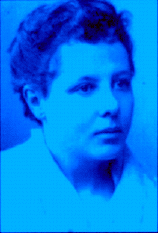
Annie
Besant
The Inner Government of the World
By
Annie Besant
Lectures delivered at the North Indian
Convention, T.S.,
held
at
Return to Annie Besant
Selection
CONTENTS
LECTURE I
Ishvara; the
Builders of a Cosmos; The Hierarchy of our World; the
Rulers; the Teachers;
the Forces
LECTURE II
The Method of
Evolution; The
Sub-Races; The Manus
LECTURE III
The Divine Plan; Its Sections; Religions and Civilisations;
The Present
Part of the Plan
LECTURE I
Ishvara; the
Builders of a Cosmos; Hierarchy of our World;
the Rulers;
Teachers; the Forces
FRIENDS:
I want to put before you, if I can in these three lectures, a
certain view of the world, and of the way in which that world is guided and
directed. As this meeting is a public meeting, there is one statement I think
that I ought to make, which it would not be necessary to make, if it were
composed of members of the Theosophical Society. It is important to remember
that in the Theosophical
Society we have no authority on matters of opinion. Every member is
free to work out his own theory of life, to choose his own line of thought, and
no one has the smallest right to dictate to any member what he should choose or
what he should think. In the Theosophical Society there is only one condition
which
binds a member,
namely, the recognition of Universal Brotherhood. Outside that
every member is
absolutely free. He may belong to any religion, or he may belong to no religion
at all. If he belongs to a religion, he is never asked to leave
it, to change
it, but only to try to live up to its teachings of spiritual life,
recognising the unity of
all, to live in harmony with people of his own faith
and people of
other faiths. When we speak of Theosophy,
we may take the word in one of two senses. The first, what it should be to the
individual. In that sense there is no difference between Theosophy and the ancient Brahmavidya of India, the Para Vidya,
and the Gnosis of the Greek - no difference at all. It is the
recognition that man can
realise God. It is called, in the Upanishad “the
knowledge of Him by
whom all things are known”. It is a difficulty rather of our
language that we
speak in that sense of “knowledge”, because knowledge implies a duality, or
indeed a triplicity - the Knower, the Known, and the
Relation
between them -
whereas when the Spirit of man, who comes forth from Ishvara,
realises his own
nature, it is no longer a case of thinking or of knowing. It is
a case of realising that identity. You know it is written again in
the
Upanishad: “He who says ‘I know’, he knows not,” because the very
word knowledge is an error in this realisation. In
that, we do not say, “I know”; we say, “I am”. This gives the primary meaning
of the word “Theosophy”.
Then it is also used in a secondary sense: a certain body of teachings. No one
of these
particular teachings is
binding on any member. The whole of these teachings
together are the
teachings the Society is formed to put forward in the world,
but it does not
make them binding on its members. That policy rests on a very
sure foundation.
The foundation is that no man can really believe a truth, until
he has grown to
the extent which enables him to see it as truth for himself. A
teaching is not
really a part of your spiritual life; it comes within the mental
life, into that
part of your nature which is said to be knowledge, the
intellect; and that is
able to see that which is akin to itself. The truth in
you recognises the truth outside you,
when once the inner vision is open. Hence,
in the Society, the study of the great fundamental truths of all
religions is
one of its objects. Members are not asked whether they believe in
them or not.
They are left to study them, in the full conviction that just as
when the eyes
are open the man who is not blind sees by the light of the sun, he
is not asked
to believe in the light, so is truth in the mental world. As soon
as the eyes of
the inner nature, the eyes of the intellect, are open, it is not a
question of
argument, but a question of sight. You recognise
the truth because the faculty
of truth in your own nature shows that it exists. You see by it, as
you see by
the light of the sun. As long as a man is blind, the sun to him as
light is
nothing. When the eyes are opened then no argument is necessary as
to the
existence of the light by which he sees. Truth is regarded in that
way, and
hence the student is left to study until for himself he knows the
truth of any
doctrine. The teachings which are spread by the Society are those
which you
find in every great religion. If, for instance, you take a book
published by the
They are given in the Hindi form. If you take the Theosophical
text-book, used for teaching in schools where all religions are taught, where
there are boys whose
parents hold particular religions, you have those truths given
which are common
to all religions. The only difference is that in the Theosophical
text-book, the
various Scriptures of the world in different religions are quoted
in support of
them, while in the Hindu text-book only the Hindu Scriptures are
quoted. That is
the only difference so far as the great ideas are concerned; the
ideas are
identical.
You will understand that in all that I say now, I am dealing with
things as they appear to me. They are not binding upon any particular member,
for the duty of each is to think for himself. They do not commit the Society as
a Society, because that only puts forward acceptance of Universal Brotherhood
as a condition of admission. That which I say, I am responsible for. What I say
is the result of my own study. It is for every one of you, Theosophists or
non-Theosophists, member or non-member, to use your own intellect, your own
judgment, your own conscience, in weighing every statement that I make. You
ought not to take them ready-made as truth for you. Everyone must use his own
thought, and not simply go by that of another. Especially is that so, because I
am going to deal with abstruse subjects. Speaking of them as truths, I am
speaking largely on my own knowledge and also, in addition to that, taking
certain statements congruous with what I know, but applied to a much larger
area of facts then I myself am yet able to reach. For I am going to say a few
things about the larger Kosmos of the solar systems, which I am not able to
examine for myself. I am only dealing with the subject before you as a whole,
and will deal with that part briefly.
But it is necessary, in order to give you as it were a fairly
complete view,
because there are many other solar systems about which I know
nothing. Most of us speak about many facts of science which we have not been
able to verify; for instance, I am unable in astronomy to verify the statements
of great astronomers as regards the situation and the relations of our vast
solar system. I have not studied astronomy. If I had studied, I could not have
attained to the knowledge of great experts in that particular science. But if I
find them teaching on the solar system the facts that they have observed and
collected by telescope and by the many other ways, like the spectroscope, that
they have of examining the composition of planets other than our own, I should
take this from them, if
their new facts were, generally speaking, congruous with what we
know as regards our own constitution, its relationship to certain other bodies
mathematically worked out, and so on. We are exactly in a similar position in
dealing with what are called occult statements; namely, statements of facts as
regards a particular order of existence, with some of which we can come into
contact in our own world, the existence of which to some extent we can find out
from the history of our own world; there are others as to which we find ourselves unable to make discoveries, to
gain first-hand knowledge; as to them, a large number of statements have been
made about them by far more highly
developed persons than ourselves. It is as true of occult science as it is true
of astronomy, that a large part of it is taken on trust from experts. Certain
parts of it may be found out by ourselves, by our own study; other parts
cannot. The conditions are similar to those in astronomy, or in any other
science. We must give to the study a large amount of time.
We must study along certain lines which have been verified over and
over again. We must go on to first-hand knowledge, which is the best but the
most laborious way of acquiring knowledge. This, however, demands, to begin
with, a certain amount of faculty for the particular science.
You may find, for instance, a man who could never become a great
astronomer - no matter how long he studied; a man who is deficient in
mathematical power could never become a really great astronomer, because the
higher mathematics are wanted in much of the astronomical study. If a man is by
nature very stupid in that science, he could never become a great astronomer.
So it is also with
occult study. There are a number of persons who have not got the
faculty to
begin with. It depends upon their past, upon the line of evolution
along which
they have come. Progress depends upon whether they have the
faculty, how much time they are ready to give to the study, how far they are
conforming to the rules laid down by experts for beginners in the study, and so
on. But admitting that there is a great difference between the reception given
to occult science and the reception given to astronomical statements made by
experts, everybody, practically every educated person, is willing to receive
the testimony of the greatest astronomers to facts which they are themselves
unable to observe or to verify. It is not a matter of life and death if they
are wrong. But when you
come to deal with statements of occult science, some of which you
find in the
great Scriptures of the world, some of which you find in the
ancient histories
of the world, there is much unfair scepticism
in modern thinkers. Histories are
thrown aside as legendary and mythical. Scriptures are thrown aside
as
superstition, though they contain the ideas of ancient peoples,
much more
learned than ourselves. Hence the difficulty of Occultism in
justifying itself;
a man must take it just on the lines I have put to you as to
astronomical
science. But the man of the day is ready to receive science which
are based on
apparatus. Where people make very elaborate apparatus, such as
telescopes,
spectroscopes, all kinds of things of extraordinary fineness and
delicacy, they
appeal to the mind of the day, especially in the West; they for the
moment are
most advanced, it is said, in ordinary sciences. That is the way
the mind works.
It looks out to the objects and builds up its theories by
observation,
comparison, classification, and so on. Anything that goes along
that line easily
justifies itself to the ordinary modern mind. They do not
challenge. Occultism
works in a different way. It works by the development of new organs
which are
within the man, instead of by the manufacture of apparatus which is
outside the
man. Now the development of the inner senses, the inner powers of
observation,
can only be done under certain rules, rules which affect the body
and the
conduct of the man. It is much easier to buy a telescope and look
at the moon
through it, than it is to develop your own nature along lines to
which evolution
has not as yet accustomed us. There lies the difficulty of occult
study. A
person will be willing to submit to a discipline, will not resent
it, if it is
carried on in the laboratory of science, but he does resent it if
it comes to
him with the authority of the great Knowers
of the past. It is along the line of
facts thus obtained that I am going to speak to you. Therefore you
must take
them from that standpoint, and understand that I am not asking you
to believe a
thing because I say it. I am only putting before you a theory of
the Government
of the World which has many facts to recommend it in history and in
religion,
but which may be challenged by those who do not accept ancient
history, who do not accept the great Scriptures of the world of religion - and
some which I am going to add from my own study, I will begin with that which I
am unable
definitely to verify. I can only put to you certain reasons for
accepting it.
Now broadly stated they are these. We have a solar system
consisting of certain
planetary bodies revolving round the central sun. These bodies are
studied, and
said by ordinary science to be moving under certain definite
forces, under
certain definite laws of nature, as we call them, which by
observation have been
established and re-verified over and over again. According to that
scientific
view, our solar system is to a certain extent a self-contained
body. The central
sun in a sense controls the movements of the planetary bodies which
circle round it. And outside the solar system you have space, practically empty
space.
But science tells us there are a great many solar systems. We are
only one out of a group. It tells us that the solar systems are in groups; and
that we belong to a
group - the whole group circling round another sun far, far, far
off in the
depths of space; so that we are not wholly self-contained. We are
under other
influences and are moving in obedience, as a whole group system, to
other laws.
We do not trouble much about that because we have little
opportunity of
observation. Any part of the argument of science there is
practically an
induction from certain ascertained facts. You make a theory that if
there were a
body exercising certain powers of attraction and repulsion, if your
particular
part moves in a way which is not accounted for by anything you can
discover,
then there must be something as yet unknown to you causing these
other
movements which you cannot trace to any force existing within our
own solar
system. I know very little about that, and do not want to say
anything more
about it.
I come down to our own solar system; which is quite difficult
enough for us. We find there the sun and the planets. We know, so far, that the
sun and these planets are composed of certain kinds of matter. It has been
found out by science that the constitution of the matter of every planet
contains substances which we find in our own. But they are in very different
conditions. One or two may be man-bearing, may have humanity developing upon
them. Others obviously cannot have anything like humanity such as we know it
here. These vague statements are made as all that experts are able to give even
about our own solar system. When we come to the great Scriptures of the world,
we find a very definite assertion that all
these forms of matter, the globes in the planetary system, are emanated
from a Mighty Being who goes by the name, among Hindus, of Ishvara,
as we should say in English, the Lord, the Ruler. Indeed the Being, the
existence of that Being, cannot be definitely proved except along the way that
I have mentioned in the beginning - the gaining of knowledge of Him by finding
Him in yourselves. Religion tells us that all things around us, visible and
invisible, are forms in which One Life is found. As far as our own world is
concerned, the proof of that becomes more and more accessible and valuable to
us. We may almost guess, looking at other human beings, that the life in each
is very much the same as the life in ourselves. We all think, we all feel, we
all act, we have similar passions, similar emotions, similar divisions of
thought, similar faculties and capacities of the mind, and so on, differing in
degree but not differing in essentials. Now science begins to tell us that
there is One Life in all things that science has recognised
as being alive. That has been shown very largely in our own time. Science has
long recognised that the nature of life in the animal
is the same as the nature of life in the man. It has been recognised
in the West only very lately that the life in the vegetable again differs in
degree, but not in kind. That wonderful discovery is due, as you know, to an
Indian, Sir Jagadish Chandra Bose, once a professor
in the
Never forget that Jagadish Chandra Bose
asserted this in his first great lecture
in
and in man-he asserted it there in the face of the Royal Society;
in the face of
all the materialistic thinkers of
concluded that famous lecture with the sentence that he was only
proving what
his ancestors had sung on the banks of
One Life and people call it by many names. Over and over again in
the Upanishads and in all that great literature of
The same One Life manifests in the vegetable, and there it
manifests as ichchha, desire. In the animal the same One Life shows out much more strongly as
ichchha and also as chit, thought; but the whole
shows itself forth in man, who sees before and after and becomes self
conscious. That has been there for hundreds of years, for centuries, for
millennia, but not put in the scientific form that suits scientists of the
twentieth century. Based on that, following that direction, accepting that
great truth from the past Rshis, Jagadish
Chandra Bose went to work and proved it on the physical plane, showed it by
physical apparatus, showed experiments that demonstrated it beyond the
possibility of doubt. It was not accepted at first; he was not believed. The
world of science of the West was not prepared to say that an Indian scientist,
moving on the lines of his own great Scriptures, had proved a thing that none
of them had discovered, much less proved. But the day of his triumph arrived. His
facts were accepted.
His conclusions were shown to be true. As you know he is now a
Fellow of the Royal Society - the highest recognition of scientific genius,
that
give. That grew out of the Scriptures. These facts we may now take
as
scientifically proved, but it is not yet sufficiently worked out in
minerals.
Only a beginning of truth is there indicated. In the minerals,
fatigue is found.
When the mineral rests; the fatigue disappears. Your machine gets
tired. The
workman will tell you so. It does not want mending, it only wants
rest. Then it
recovers its elasticity and goes on again. The proof that it has
life, and not
only what they would call lifeless reaction, is not yet complete.
Personally I
am prepared to take it from the old teachings, and also from my own
knowledge of the evolution of mineral life.
So far you are dealing with very large questions. As to the sun
there is much discussion going on. Does the sun lose or gain energy? Does it
lose it, by giving out continual heat to other things, or is that recuperated
by things that fall upon the sun, and so build it up faster than it decays? We
are ready to accept temporarily the theory adopted by the astronomers on that.
I believe the sun is the garment of a Great Being, is a centre of Life, a
mighty Self-Conscious Life. So do Hindus. Generally Narayana
is spoken of as the great Being in the Sun. The Sun in that sense is the
manifestation, the body, of the Ishvara of the
system.
You find in Theosophical teachings, which go along the lines of
these ancient
faiths, the term Logos (Word) is used for the Deity, the Ishvara of the system.
Many Theosophists, who have studied, accept this view regarding the
Sun of our
system as the body of our Logos, Ishvara,
but no stress is laid on it, nor is it
often mentioned. We speak sometimes of the Solar Logos, making that
distinction, because we believe, as the Hindus believe, that there are many Ishvaras of higher and higher rank, culminating in One.
Remember how the Bhagavata speaks about that, of the
great ranks of Ishvaras rising one above the other.
We confine ourselves for all practical purposes to the Ishvara
of our own system, and, as you know, the great mantra of Gayatri
is an appeal to God in the Sun. That is the reason, of course, why, in so many
religions, people turn to the
East in their prayers. It is not at all peculiar to the Hindus, the
turning to
the rising sun, worshipping, not the outer body as a sun, but God
in the Sun.
Everything in our solar system depends upon the Sun’s Life, heat
and light. It
is the fount of all the energy by which the solar system exists,
and has in it
the unfathomable energy of the Divine.
When you come to ask how the solar system originated, you will find
that the occult teaching goes somewhat beyond the verbal teaching of the sacred
books. Some of these use the word which signifies Ichchha,
Desire. Sometimes you find the word Breath, Prana, which is a very accurate
term. The Highest Ishvara emanates the root of
matter. The Ishvara of our solar system working on
what science calls that which is before the nebula, Ether, the Ether of Space,
isolates a portion of that by a Ring He makes round it, and within that
Ring-enclosed space our solar system is formed, His Breath going into this
Ether forms the primary bubbles - there are no better words to express the
action - and out of these the atoms of the solar system are formed by
aggregation. I am only stating that fact because it has to some extent been
verified by observation; that aggregations, which are pre-atomic aggregations,
of these bubbles exist. We need not go further into it.
Who is it who, gathering up the material brought into existence by
the Life-Breath of the Logos, the Life-Breath of Ishvara,
builds it into aggregations? Primarily again the action of Ishvara
Himself, in the Aspect of Brahma.
Now we come to the division of the divine Life into three great
forms of manifestation, and it is Brahma who, taking this rough material,
shapes it by several stages, which we call sub-planes, into what ultimately
become chemical atoms. We come now quite down to our own world. After an
immense amount of formed material is thus brought into existence by the thought
of Brahma, we say that the Creative Activity is at work. Then there comes
another great wave of Life which shapes the atoms into forms, not merely
molecular forms, but forms like minerals, like vegetables, like animals, like
savage, mindless men. All that goes on through ages, that building of the
planes and their inhabitants by Those mentioned in the rough outline printed on
the first page of this lecture, who are called the Builders of a Cosmos. Now
these Builders of the system are the mighty Beings who come out of another, a
previous Cosmos, and have been united to Ishvara,
have gained moksha of the highest description, have
entered as it were into the body of the Ishvara
Himself, and become one with Him. All the first Builders of a Cosmos are those
great and mighty Devas, who are brought over by the Ishvara of the Cosmos as Builders of His worlds. Here again
we speak on the authority of the great Scriptures, and on other occult
teachings.
I am for the moment concerned with our own solar system. Now, in
the highest sense of the word, the Occult Hierarchy of the Cosmos would mean Ishvara and the great Builders of the whole system, the
great Beings who rule and guide and sustain and direct the whole of our solar
system. We cannot reach Them at all. We have to come down much lower. We have
to come down to our own world. As soon as we come to our own world, we come to
a manageable sphere of knowledge given in outline in the great books, and this
is largely verifiable, by study, by those of us who have a turn of mind that
way - just as we speak of a turn of mind in mathematics or geology - and who
are willing to undergo the discipline which makes it possible to obtain
first-hand information. So we come to the Occult Hierarchy of our own world,
composed of the Rulers, the Teachers, and the Forces.
You notice those triple divisions. They are related to the triple
nature
of Ishvara, which, in all the things
which come forth from Him, appears in the
life-side which animates the forms. You must always be on the
look-out for that
triplicity. You have it
in yourself, in your own consciousness. You know very
well it has three ways of working, no more, no less. You have Jnanam, Ichchha
and Kriya. You have Awareness, which recognises things outside itself, and
evolves into Jnanam, Knowledge. Then Ichchha, Desire in the lower form, and
Will, Power, in the higher. Then, Kriya,
Activity. And only when these three are
developed, do you find the self-conscious being. Thus he analyses
his own
consciousness. He finds in himself the triplicity
which shows the presence of
Ishvara in his own
nature. That triplicity is recognised
everywhere. Western
science recognises it in its analysis of
the mind. No one who has studied the
subject can possibly deny it, whether in the ancient books or in
the modern
books of psychology. The West is rather more vague, because the
western
languages are not as adapted to the subtler forms of study as the Samskrt. You
must remember that a language is built up by the thoughts of the
people who use
it. In the West, in dealing with the subtler side of science, they
have to fall
back upon other languages, and create new words for the new things
they find out in psychology. So you get a long list of words which the
psychologist who keeps himself level with the science of the day must know and
understand. So the English language is becoming enriched. Many of the words in
it are words adopted from Samskrt, and also from
Greek and Latin, which are the classical languages of
We thus come; down to our own world. Only one other point we have
to notice in passing, because I spoke of only two great waves of Life - the one
working on the material given by the Breath of the Logos, and the second which
forms that material into the shapes of the forms which we find in our own
world. The third great Life wave is that which in man, and in man alone; brings
the higher and the lower together, the Spirit which is brought into direct
contact with the
matter of the lower sub-planes; this is the result of the third
great impulse
from Ishvara, in which the Spirit, which
is a fragment of Himself, takes
definite possession of the body through which it has to work, not
only on the
physical but on all the lower planes, the larger worlds within which
our world
exists. These are, as you know, the physical plane, the astral
plane - I call it
the emotional - and half of the mental plane, the worlds of the
lower bodies.
Then the higher mental world, or the world of the Intellect, the
world of
Buddhi, of self-realisation, of
intuition, and that of Atma, the reproduction of
the divine Spirit in ourselves, are the higher of the fivefold
universe. That is
the man in the perfection of his parts, the stages of his
consciousness and the
bodies in which they work. I need not dwell on this, but merely
recall to you
the well-known facts. You know the various categories of the bodies
- the Sthula
Sharira and the Sukshma Sharira, and then the Koshas, given in the Vedanta, the
subdivisions of the bodies.
We are not concerned today with that organism of man, though you
must bear it in mind, but with the existence on our globe of an Occult
Hierarchy, showing out the three great groups. That Hierarchy came to us from
elsewhere.
Here as I speak, I hesitate for a moment. I was going to say that I
spoke from my own knowledge. But I had better explain. It is perfectly possible
to develop a faculty of “looking backwards”, and to read what are called the
“Occult Records” of the world far beyond ordinary history; going back to those,
to that which science is beginning to call the “memory of the world”, it is
beginning to
recognise it as a
reality that all events remain in that memory
of the world;
science makes what seems at first the rather startling statement
that if you
could go out to a certain distance from our world to some other
globe; you might
there see the events which happened in our world thousands of years
ago. It
sounds a little startling if you happen to hear it for the first
time. Sight
depends on the travelling of light. But vision, as we know it,
could not cross
the huge spaces required. But if it could, a person on a distant
globe would see
events which had happened here long after they had happened. Why do
you hear the sound of gun-fire an appreciable time after you see the flash,
since flash and sound are simultaneous? Because sound travels more slowly than
light. Light travels so swiftly that we do not appreciate the time between the
gun-fire and its flash a mile or so away. Still light travels at a certain
definite rate. A
“light-year” is the distance in miles over which light travels
during a year.
Astronomical distances are so great that they are measured in
light-years.
Suppose you took a thousand light-years, and that you were able to
see from the
huge distance traversed into the state of the globe a thousand
years ago, when
the light left it, then looking at our world you would see what was
happening a
thousand years ago. To understand this you only want a little
thought, a little
imagination. It is quite plain and simple, if you think. The events
are all
there all the way along. But to see them at any point there must be
an organ of
vision. If you can only get that, then you can see the history of
the world by,
as it were, travelling back towards the world along the light-ray
looking at the
records in this light. That is, in effect, exactly what the
Occultist does
although it is not done in that way, but from a point by which the
records pass
like a cinematographic film. It is a clumsy analogy, but it will
serve. The
Occultist calls it the Akashic Record. Science groping after it
says it must be
there, but it cannot deal with it. Naturally. It can be dealt with
only by the
development of certain faculties in man. In that way I speak of
what I have
“seen”. In that way I said that I knew that the Hierarchy came from
elsewhere,
because I have seen the coming to our world of those great Lords of
Light; I am
told They came
from Shukra, Venus, which gave to our world the
beginnings of its Occult Hierarchy. That is beyond my powers of research I saw
only the arrival. There are certain traditions in some of your books which
speak about the coming
of the great Lords. You read in them, for instance, of the four Kumaras. Where
did They come from? Who were They? They came to the world from
somewhere. The Occult Records and Hindu books say of the great Ones that. They
came from Shukra. They came to our world because our
world was ready, was at a stage of the evolution of men capable of receiving
that great wave of Life which made the intellect of man possible. And They came because, without guidance from higher Beings, the
intellect would have gone wrong, plunged amid a world of passion and animal
nature, with which it was filled, to the great destruction of the forward
evolution of human beings.
Now in the Theosophical books that period of the Coming is called
the middle of the Third Race. We are now in the Fifth Race, your own Root-Race.
The Fourth Race, as you know, includes the Chinese, the Japanese, the
Mongolians, and so on. Those belong to the Fourth Race, which exceeds the Third
and Fifth in numbers. The Third Race people are dying out, save where they have
intermarried with later Races. In ordinary ethnology they are spoken of as
Lemurian. We use that word in the Theosophical books also. The Lemurians, the
Third Race, went through the subdivisions, or sub-races, and in the middle of
the evolution of that Race came the Sons of the Light, the Sons of the Fire, as
They are called in some of the books. They founded the Occult Hierarchy of our
world. The greatest of your Rshis belong to that
Body. I just spoke of the Four Kumaras.
They were of Those who originally came to our world for its helping,
and who are still with us. Of Them it is that you read as living in the
Then we come to the great Group of the Teachers of mankind. In that
you find all the Founders of the great religions, the Buddhas Religious, as you
find the Manus in the first. We shall go more fully into that - the Buddhas,
the Founders of world-faiths, the Teachers. They all belong to that great
Group. Then there comes the third Group which I have called here the Forces.
The reason why I use that word is that each of these Groups uses a particular kind
of force for its work. The Rulers use a particular kind of force, the Teachers
use a particular kind of force, and the others comprise all, the remaining
forces that carry on the activities of the world. The first great group of
Rulers act by Will-Power. This, as I said, in the lower form is Ichchha, in the higher form, Will. Will or Power is the
natural characteristic of the Rulers. It is that force, the force of the Will,
by which the Rulers, the Occult Rulers, of the world work. Then when you come
to the great teaching Group, there you find that they work by Jnanam, Knowledge. They, as Teachers, have the detailed
knowledge of our world, so that just when a new religion is to begin, then we
shall see a new type of man has been formed. When the new type is formed by the
Rulers, the Teachers step in to teach that new type, and to help it to evolve.
The third great Group, the Group of Kriya, Activity,
which I shall simply call here the, Forces - for want of a better word perhaps
- these bring about all the activities of our world, and they again are
directed by a Group of great Beings, so that you may think of this Occult
Government of the World as divided into three Groups according to the
qualities, or the Aspects, of Ishvara Himself.
The Groups are the same in their nature as you will see, or as you
may see, in your Shastras; so that if you look at the
names in the Hindu Shastras, you will see Mahadeva, in whom the characteristic is Ichchha
(Will); then Vishnu, whose great characteristic is Jnanam
(Wisdom); and then Brahma, whose great characteristic is Kriya
(Action). You see how orderly the whole thing is - Ishvara
at the centre of all with his triple manifestation; the copy of Saguna Brahman, the Sachchidananda
Brahman, manifested in the totality of the universe.
Then you come by a long descent, as it were, to the Ishvaras of systems, and there the great triplicity comes in of what you may call specialised forms, the Ishvaras
there showing out the three Aspects in the three corresponding Gunas. It is the Government of a World in the system.
Coming down much lower, there you will find these three again, separated for
the work that is to be done. Thus we have the Rulers characterised
by Will, the Teachers characterised by Wisdom, the
Forces characterised by Activity - all in perfect
order of sequence, so that if you learn the arrangement of the inner world, you
will be able to ascend step by
step, and realise that the arrangement
that you find in the great Scriptures of
the world is the highest. There is then that in the lower, the
lower being
fashioned after the likeness of the higher, the Supreme reflecting
Himself
downwards and downwards, till you come to the single globe. The
analogy is
perfect. So it is written: “As above, so below”. We come thus to
our own Occult Hierarchy, whom you think of as Rshis,
the mighty Ones who appear from time to time in your Puranas
and Itihasas, in the early days walking among men,
consoling men, helping men, when each Race is being founded. Of course the
lecture of tonight is one as to which, for most of you, verification is
impossible, but the sketch of these things is necessary in order
that you may
have a big picture, and then come down through that picture to our
own little
spot of world - quite an insignificant place in the enormous
universe. Here we
should be able to study more closely. Here we should be able to
find out really
what is going on, the Forces behind those who are apparently the
rulers, the
teachers and the actor in our world, the true Inner Government of
the World, by
Power, by Wisdom, by Activity, as manifested in the Occult
Hierarchy of our
world, with the Four Kumaras at its head.
LECTURE II
The Method of Evolution; The Building of Man;
The Building of Races and Sub-Races; The Manus.
FRIENDS:
You will remember that last night we left off, at the point where
we were considering the especial Government of our own world, the Occult
Hierarchy as it is called, the Beings composing that having come to our earth in
the middle of the third human Race from the planet Shukra
(Venus). I pointed out to you that you will find in the Hierarchy the threefold
division which is the reflexion of Ishvara Himself in the three aspects in which He reveals
Himself. Thinking for a moment of the Supreme Brahman, the Brahman with
qualities, the Saguna Brahman, we notice that there
we had this triple division that reappears all the way down on the Life-side,
the Consciousness-side, of beings in the Kosmos, so far as we know anything about
it, and presumably it would be found outside our Cosmos in the same way, as the
inevitable result of the Unity of the Supreme with His three Aspects, neither
more nor less. Then thinking of the Ishvara of a
single system, a single solar system like our own, we recognise
the same triplicity, and then speaking of the Occult
Hierarchy itself, we find that in that Hierarchy also we find the same triplicity. Looking at it for a moment from the outside
standpoint, as we sometimes call the personifications, the anthropomorphic
Deity, we have in all the Trinities of the religions, just as in the Trimurti here, the recognition of the three Aspects in One.
We think of the Brahma, Who creates the universe. We think of the Vishnu, who
supports and maintains it. We think of the Mahadeva,
the Mighty Being who gives to man that immortal spark of Divinity, which is the
source of all evolution in the human race as in the sub-human. So we come to
see that it was a natural thing that in the Hierarchy itself - the direct Governors
of our world, embodying in that Inner Government of the World the divine
qualities - it was natural that we should
find this same triple division as we had found it in the larger Cosmos
outside. And so I put it to you, that we found in that the Rulers, that we
found the Teachers, that we found all the Activities which I summarised under the name of the Forces, remembering that
in that word “Forces” we have the spring of all the activities in the Cosmos
outside the ruling and the teaching; so that we may think for a moment of a
great picture, as it were, in which as the head of the Rulers there stands the Mahadeva, the One Ruler behind all who exercise the
function of rule. So again we may think of the Teachers as
distributing to the
world the Wisdom Aspect, which is incarnate, as it were, in Vishnu,
that Wisdom that the Hebrew Scriptures speaks of as “mightily and sweetly
ordering all things”. And then in Brahma, Activity, the Third Aspect, activity
carried on by all the forces distributed under their own heads, we have the
expression of the Love of the Supreme shown in His own manifestation in the
emanation of the
world. Among the legends and tales in sacred books we find one
answer to the
question so often heard and so seldom answered: “Why did God
emanate, or create, the world?” We find the answer given: “Because the Supreme
Love, God, desired to be loved”, and as the lives that came forth from Him were
the fragments of His own Life, by that very unity of origin, there was the love
to Him from whom they came of the intelligent beings thus emanated. That is
only one of the many answers, a beautiful and poetical one, containing a
profound truth, that the great mark of the Love of the Deity is shown in His
Activity.
You will find in the different religions of the world that they all
recognise this Activity and Power and Wisdom on the
part of the Supreme Lord of the Universe; but some, with regard to the
Activity, prefer to call it Love, creation being the great sign of love,
looking at it from the standpoint of ourselves; then the Aspects are called
Power, Wisdom and Love. You will find in other religions, as for instance the
Greek, the idea that one of the three great qualities of the Deity is Beauty
rather than Love. To the Greek Beauty most appealed, so that it struck him as
the characteristic of the divine manifestation. And that view of Divinity has
been repeated and reiterated by modern science. The more science investigates
into the innumerable beings that are the embodiments of the divine Love in our
world, the more does science find that Beauty is their inevitable sign of
manifestation. You may go beyond the power of human sight.
You may call upon the microscope to help you in studying that which
is too minute for the unassisted human eye to see. The higher the power of the
microscope the more wondrous is the detail in the manifestation of the Beauty.
So that in these invisible objects which no eye of man can see
without this mechanical magnifying power, you wilt find beautiful forms traced
on the surface of the body, living creatures with wonderful forms of curves,
angles and lines delicately arranged in admirable perfection, so that when the
Greek tells us
that “God manifests as Beauty”, we find that manifestation in His
universe
bears out well the old Greek idea. It is right that we should not
forget that,
because in the more modern religion of Christianity, there was a
great revolt
against this idea of the loveliness of the universe and the beauty
of the human
body, which was part of the inspiring thought of the Greek world.
We find in
that view that beauty is a thing that leads man away from God,
instead of being
the manifestation of His innermost nature. We know that the Puritan
idea in the
Protestant side of Christianity disliked objects of beauty as
temptations,
instead of accepting them as the manifestation of the supreme
Beauty. On account of this idea of beauty, men lost that side of Divinity characterising all the
activities of the Supreme.
Coming to our Hierarchy, divided in this triple fashion, let us pause for a moment on this
grouping in order to take it up a little more closely; let us take it up in two
words that I have used in speaking of today’s lecture at the end of the subjects
that will be treated - the Manus and the Buddhas. The Manus come under the line
of Rulers. I want to pause for a moment on this great manifestation of Power or
Will. There is very much in your Puranas that throws
great light on these more obscure subjects, and because the phrases used have
not been always understood, much that was given for the helping and teaching of
men has slipped out of the minds of those to whom these great Scriptures were
given as a treasure for the helping of the world. There are in all religions,
in fact in all the organisations, whether called
exactly religions or not, which grew out of the impulse of the Hierarchy, a
certain number of symbols, of names and analogies, which seem to have been utilised by the great Knowers of
the past, so that, putting them into the teaching for the helping of the world,
that might remain, even when their meaning was forgotten owing to the efflux of
time: so that they might remain as witnesses to the depth and the fullness of
the original teaching given to the great Aryan Race; so that in the later days
there might be one more witness of the ancient knowledge. Thus they might see
that all through the millennia of their history, that knowledge was really
imbedded in their sacred books, and that they had their witnesses ever ready to
come forward into the light, when the evolution of that Race, having gone
forward from the time when as children it learnt from its teachers, as in its
youth and young maturity it threw away much of the knowledge, as then, growing
into maturer manhood, it should regain the knowledge
of the past, and realise that there was the whole
trend of its evolution, that throughout the whole of it that teaching remained
from its early days. We find, then, in the Puranas
that name that I mentioned yesterday as connected with this first great group
of Rulers, the name of the four Kumaras. There is not
very much said about Them. Not many explanations are given. But they are spoken
of as “the Four”, the “One and the Three”. He who is spoken of as the Eldest
among Those - as to whom time may be said only to be a name, for They are
beyond its illusions - He is called Sanat Kumara, the
Eternal, the Ancient; in later days He is thought of as the Eldest, but it is
better to think of Him as the Eternal, to whom and in whom time is not.
Time is but one of the ways in which the limited consciousness
tries to measure by itself, in order to gain more clarity in its thought, tries
to measure out intervals by which and in which it is able to think; for the
order in time is only a succession of the true measure of time in moods of
consciousness, not the
movement of the Sun, the Moon and the Stars. These are only adopted
by the human
mind in order that they may have a fixed measure, but one to which
the truth
does not correspond. And so we have this idea of the Eternal, who
is beyond
time, and to whom all succession is simultaneity, who is sometimes
spoken of as
the “Eternal Now”. Their conception is one. We have to try, however
feebly, to
grasp it with this limited consciousness of ours, which speaks of a
past, a
present and a future. It is not realised
that there is a possibility of the
whole three being really simultaneous, and mutually affecting each
other, the
future affecting the past, as the past is said also to influence
the future. But
that is a thing more for us to think out for ourselves in
contemplation than to
try to explain to each other. Our language, which has been founded
on the very
idea of succession, cannot express in any intelligible fashion that
where
succession is not. And the Eternal is the only word we have
practically, which
conveys, however dimly, however poorly, that great thought of
“Now”. So that
that word Eternal is never to be confused with everlasting,
Remember that word
is the word rightly given to that great Being beyond our knowing,
who is spoken
of in the Puranas as the Eldest Kumara,
the great Being we call Sanat Kumara,
The Eternal. Then the Three who are with Him, dwellers in that
mystic City of
Shamballa, the White
Island Youth, are the remaining Kumaras, called the
Pupils of Him who is the Head of the Inner Government of our World.
H.P.B. speaks of the Three, and of Their name derived from
Buddhism, which speaks of Them as the Pratyeka
Buddhas, the “Solitary Buddhas”. It is not at all a good name; it is a name
which has been given a connotation wholly inapplicable to that great height of
super-human existence. But They are given the name, because the word Buddha has
been applied specially to the Supreme Teacher. And because They did not teach,
Their work being that of the Rulers and not of the Teachers, men in their
blindness, dimly groping after the fact of this great existence, spoken of Them
as solitary Buddhas - alone, isolated, and even went so far as to apply to them
the monstrous adjective “selfish”. So foolish, so childish, are human beings in
trying to judge of Lives so far exalted beyond their own. The Secret Doctrine
uses the phrase: “Higher than the Three is only One, in Heaven and in Earth”.
Many students wonder what the phrase means. H.P.B. often took her words from
statements made by Hindu and Buddhist friends. It was simple enough in reading
of the Four Kumaras, that They were the Heads of all
power and Rulers in our world, to realise that we were
really face to face with the Mighty Four at the head of the Group of Rulers,
and the Three and One is only the obvious division between the Head and the
Three who come next to Him in the Inner Government of the World.
Leaving those Four and coming, as it were, downwards, we then come
to the great sub-group of the Manus. They come nearer to our possibility of
understanding. Their work is very clearly laid down. They are specially related
to the evolution of Races. Wherever a great Race is to be born into the world -
Root-Race we call it because so many sub-races spring from it - then we see a
Manu at work. The two with whom we are chiefly concerned at the present stage
of the evolution of our globe, are the Manu of the Fourth Race and the Manu of
the Fifth Race. There is only one Manu to a Race. We have to remember that from
the beginning. There are certain great Beings marked out in the Occult
Hierarchy who are to be the Fathers of the Races. As I said, the two with whom
we are now most concerned are the Manu of the Fifth and Fourth Races. Vaivasvata Manu, as you know, is the Manu of the Fifth, or
the great Aryan Root-Race, that Race which is sometimes spoken of as the “Sons
of Manu”. You have for instance the stotras which
specially speak of the sons of Manu because there is this peculiarity about the
work of a Manu, that the whole of the Root-Race takes origin in him. He is
literally the Father of His Race. About the very early days of the fourth
Root-Race we do not know as much as we do about the early days of
the Fifth.
We only know of a great Being spoken of generally as the Manu of
the Fourth Race, and as still charged with the care of the larger part of the
population of the
globe. He looks after those hundreds of millions of Asiatic
peoples, of whom the chief are the Chinese and the Japanese, the Japanese
comparatively small in
number, but great in development and in power. The Japanese caught
hold of
western ideas, sucked them dry, and then threw them away again,
having utilised
all that was useful for themselves in those ideas, and every one
that they
accepted they stamped with their own mark, just as you might stamp
coin made of gold from any mint. If you want to coin it, you send it to the
mint, and have it
stamped with the image of your own Nation. So the Japanese have
done with
western thought and organisation. They, under the direction of their Manu, the
impulse that He sent to them through their earthly ruler sent all
over the
western world numbers of their cleverest men, sent them on a great
mission to
the West, to learn how they managed their affairs, how they organised, and how
they worked. They travelled far and wide
in the world, looked into the ways of
all Nations, their industry, their education, their political
institutions, and
all other things that make up the outer life of a Nation, and they
came back to
instead of their own beautiful garments. I remember talking to Mr. Swinburne one
day, the great poet in
drawling. He said in this kind of dreamy drawling way: “There is
only one thing
that God on the Day of Judgment will never forgive the Japanese”. I
said in
answer: “What is that, Mr. Swinburne?”
because I knew he did not believe in the
Day of Judgment. I rather wondered what he was driving at. He half
shut his eyes
in the queer dreamy way that I have just mentioned, and spoke of
the Japanese
adoption of the western dress. Swinburne
was a great lover of beauty. The thing
that disgusted him in the new Japanese civilisation
was this phase of it. They
put aside their own beautiful men’s and women’s dress, and dressed
in the
fashion of
disgusted with them. There was a truth in his quaint remark,
because
persistence in that would have denationalised
the Japanese, and they would have
no longer struck their own note in the chord of the music of the
world. But they
soon threw aside all that outside folly, and utilised
what they had learnt in
the West. The Chinese having learnt less, being a people too
self-contained, too
shut off from the rest of the world, were not ready for the work
which was then
wanted, which was the saving of the eastern ideals. This was
assigned to Japan,
because India - which was the heart and home of eastern ideals,
from whom the
Japanese had learnt their eastern thought, their eastern beauty -
because India
was then at the moment of her greatest peril, which now, thank God,
has passed
away, when there was the danger that she would become westernised, taking the
outer appearance instead of anything which was valuable in western
thought and
culture. Then her young graduates were more proud of their
knowledge of Spencer
and Huxley than of the knowledge of their own maturer
philosophers and
scientists; then there was the danger that Indian religion, that
sublime faith
of Hinduism, given to the Root-stock of the Aryan Race for the
helping of the
whole world, that that should be looked on as childish babblings;
when that
moment came, it was the only moment that really threatened her true
life. It was
not menaced by the dangers through which she has passed. She has
had many
invasions, she has had partial conquests, she has had many
foreigners coming
within her borders; but she has conquered and assimilated them all,
no matter
how they came, or she cast them aside. You all know that the Greeks
came and
went away, but they have left India richer for the traces of the
art that they
had imprinted on hers. The Musalmans came
and conquered parts of
they were assimilated, and today are Indians by right of a thousand
years of
residence. None of these was a danger to India, for India was
stronger than
they. It was only when she began to be really westernised
that the moment of her
peril came; in the other cases she had taken advantage of her
conquerors, had
remained herself and added something from them to her own great
National wealth.
But in this case she was trying, as it were, unconsciously, to
change her very
life, to take western ideals instead of eastern, to follow western
customs
instead of eastern, to look to western teachings instead of to
eastern, in a
word to denationalise herself, losing her
hold on the treasures for which she
was the trustee for humanity, instead of only taking whatever was
valuable and
incorporating it into her own system. In that hour of peril her
Manu came to
save her from that which would have made her cease to be a Nation,
she, eldest
but one of all living
Nations. Just then Theosophy
was sent to her, sent to
make Hindus realise that they had a
treasure, and that it was from the Hindus
that the rest had learnt, There was resentment in many quarters
about this and
especially one writer, Sir Valentine Chirol,
said that Indians were being taught
by western people that their religion was the greatest in the
world, and that
they were the teachers of religion, and not learners of religion
from the West.
Then it was that, in that moment of peril, our Manu could not find
in the Indian
people a people who could guard their own ideals from being
submerged under the flowing tide of western civilisation.
So he turned to his Brother Manu, who had the Chinese and the Japanese in His
charge, and - because
inspired them with His Life, stimulated them with His Power, and
then flung them against the western Russian people and made them conquerors, in
order that eastern ideals might be saved through them, and preserved for the
future helping of the world. You do not look on wars as you should, as you
would do if you read your own Puranas. You look on
them as due to one Nation coveting the land of another, one Nation desiring to
dominate over another. I am asking you to look behind the outer governors to
the Inner Governors of the World, the Rulers who balance the various
developments in the world one against the other, in order that nothing that is
precious shall be lost, in order that every gain shall be preserved, and gradually, East and West, North and
South, shall all contribute to the perfect humanity of the days that are yet
unborn, and make that mighty Federation of the World, of which the poor League
of Nations is a beginning in the ideal world, which shall yet be realised in the world of men, and become the Great Peace
with the blessing of the Supreme upon it. So the Fourth Race Manu did that
piece of work for the Fifth Race.
There is one thing which you may as well remember, which is a very
interesting sidelight which shows that all the planets of our solar system are
linked together in successive evolutions. They are not all of the same age,
they are all evolving, but one is behind the other, one is younger, one older
than the other. And so from the great Kosmic
Hierarchy which sends forth the Guides for the whole system, as on the first
planet humanity grew up to the stage where the Inner Government of the world
was wanted, that originally had to be supplied from the reservoir, and that
reservoir was Ishvara Himself. From planet to planet
an Heir to the Crown of the Ruler is handed on, and as an older planet develops
more and more, and its humanity grows higher and higher, some of that humanity
pass on into the Occult Hierarchy, and there are evolved and disciplined; and
thus some are always ready, in every step of the rank of that Hierarchy, to
pass over to another planet when that other planet is evolving its humanity,
just as the Sons of the Fire came to us in the middle of the Third Root-Race.
So also in our turn our world has sent the Heads of another Hierarchy to the
next planet in the order of evolving humankind. And Those who came in that
wonderful wave, Themselves to be the Rulers of our planet, are not to be
thought of as though They were Themselves Gods, mighty as They are. A passage
was mentioned to me today by our General Secretary, in a commentary written by Goswami, a disciple of Chaitanya
of Bengal one of the minor avataras. He speaks of
these Kumaras as not being Ishvaras,
but Aishvarik, not Themselves Gods, but divine in
Their nature, not yet Kings, but of the blood royal, as one might say. But in
the evolution of human-kind, the Elders, as we hereafter shall come to be, as
we climb up that long, long ladder of evolution, become a glorified humanity, a
Divine Humanity, into whose hands may safely be trusted the governing of a
world.
Just as we find the group of Manus Themselves looking after the
Races by which mankind evolves, so do we find that all the great catastrophes,
the seismic catastrophes in our globe, are under the rule of these Four
Highest, who appoint the time and the seasons when these tremendous changes
shall take place. So with every new Root-Race there comes a change in the
configuration of the globe, of the disposition of land and water. Our Third
Race began in what the scientists call Lemuria. That
was a great continent stretching through what we now call the
island of
the great waves of Pacific seas, and the Indian Peninsula had not
emerged. Then
Lemuria was
stretching where the Pacific now is, and Australia is the end of the
land before you come to the southern Pole. Australia and New
Zealand both belong
to this ancient continent, destroyed by earthquake, by fire and by
flood. And
then the Third Race gradually dwindled and dwindled, although some
remains are
still left. Another great continent arose as Lemuria
was broken up, right over
in the West, where the Atlantic is. That is called the continent of
Atlantis,
where the Atlantic is now rolling. On that continent was the great
city, the
capital of a mighty Empire, the City of the
Chinese Classic of Purity. That City was the centre of Atlantean
power, and
there grew up the Atlantean Toltec Empire. They spread as far as
You may still read in Plato how the remains of that continent were
submerged, and the great civilisation which he
mentions, that was on the last fragment of Atlantis itself. Now when they sound
the depths of the Atlantic, they find hilltops and valleys; some islands are
left, some of the highest peaks are now islands, like the Canary Islands, just
as you have here, where the great stretch of the
Lemurian continent existed, Java, the East Indies Islands, the
Spice Islands and
so on, that are dotted over the Pacific. Atlantis was the land of
the Fourth
Race. Myriads upon myriads of that Race perished in the mighty
cataclysm and
went down beneath the flood. But one part in Asia was left. North
of the
Himalayas a large stretch of land formed part of the ancient
Atlantis. The
sacred City of Shamballa, the
imperishable, is there.
Now disturbances are beginning to take place in the Pacific again,
where the next great continent is to arise. There you find the “earthquake
ring” that science talks about as a source of danger to the present world. From
the submarine volcanos there are flung, through the
mass of the water above them, great eruptions of earth and minerals of all
kinds, piling up great peaks as they force their way. Then an island appears.
Where there was no island before an island appears, and the charts that the
captains have do not show those islands.
Sometimes ships are wrecked for lack of that knowledge. Not very
long ago the
British Association in its Geographical Section discussed this
building up of a
new land, spoke of the dangers that would come, of the possibility
of one
tremendous eruption that should dash the ocean into great tidal
waves, sweeping
across the United States, drowning all the people. They spoke of a
world
catastrophe in which humanity might perish. When they talked in
that
panic-stricken way, well-read Hindus and well-read Theosophists
smiled to
themselves; for they said: “Continents have been destroyed before,
and humanity did not perish. This new continent we now hear about is mentioned
in the Puranas. Its name is given to it, and the race
that will live upon it is a race
unborn. Why should we be afraid? Humanity has survived these
catastrophes before and will survive them again. And a seventh continent will
come, the last
continent of this phase of the evolution of our globe. There are
hundreds of
thousands of years before that will happen, probably hundreds of
thousands of
years before the sixth continent will be ready for its children,
and those
tremendous catastrophes that change the whole surface of the world
in its
configuration, those are the work of the Great Kumaras,
the Supreme Rulers in
the Inner Government of our World. Under Their direction the Manus
work.” I
shall try to put before you tomorrow how the plan of all these
changes is known
to the Head of the Occult Hierarchy, and how sections of it are
distributed
among those who have to carry them out in detail. Into that I will
not go today.
The Manus, then, are those who build up Races, and the plan of
evolution is to build up successive Races, Root-Races, characterised
by particular qualities that are wanted in humanity. If you look at the
constitution of your own body you have a picture of the evolution of the Races.
You have a physical body. That was the first to be gradually evolved through
the mineral, vegetable and animal kingdoms into savage mind-less men. Then you
know that that physical body shows out two subdivisions, sthula,
dense, and sukshma, etheric. The first two Races
evolved these, and the Third built the human form; with lower astral and
germinal mental by its middle stage. These were linked to the higher three, and
man was embryonically complete. You find all this in
your own teachings. You ought to know it better than I do. Those, however, were
only known to the learned and slipped out of the minds of the people. There is
a very simple reason for this.
That is, that the old way of teaching was very different from the
modern. When
we begin to teach a subject, we try to get a grasp of the whole
subject, and we
try to present it to those we are teaching in a clear form. That is
the modern
way of teaching. It makes people rather lazy, because too much is
done for them, and the result is that the memory is very much more, and the
reasoning much less exercised than they ought .severally to be. The teachers
take all the trouble, and present an already cooked and digested teaching to
save the pupils from the trouble of exercising their mental faculties. So that
they have quite a large amount of second-hand knowledge and very little
first-hand knowledge.
The old ways were different. The teacher came along, threw one
great truth to his pupils and said: “Go and think about it”. The result is that
in the eastern books you do not get a clear presentment of a doctrine as a
whole. It is scattered over the books. A careful student can gather the whole
teachings. But he has not now the patience and industry required for the task.
In the old days men had to work out results; so they grew into great thinkers,
because they exercised their minds.
Hence it is very difficult for the Hindu to find out the details of
the
teachings of his religion in this enormous library, this immense encyclopaedia
of the Shastras. Hence the convenience of
Theosophy, which gives way
to human weakness in modern days and which presents all those teachings in a
form which is very easy to grasp. Theosophy accommodates
itself to the ways of the present day. It gives you in a more scientific form
those great teachings given to the Rootstock. When you read the Puranas after studying the Theosophical books, you will
find them full of information, crowded with information, and the opinion that
you held that they were all childish vapourings
disappears. You will find they give the most valuable teachings. That is almost
the only outer use of Theosophy
to the instructed Hindus.
Under these conditions, then, you find how your Manu works. You
find named in the Puranas the seven different
continents and the Races that inhabit them. We are now on the fifth continent.
Do not think of continents in the way geographical people use the word, because
it here means the whole land surface of the globe as distinct from the water.
So you have your Fifth Race continent, and the sixth continent is beginning to
come up in the Pacific. Now there is one interesting point we come to. The Manu
is not only busy in developing a great Race, but He picked the families of His
Race ages ago out of the fifth sub-race of the Atlantean people. Every
Root-Race sends out sub-races like branches of a tree. He picked his people out
of the fifth sub-race of the Fourth Root-Race.
He led them by the Sahara, then a sea, to Egypt and on into Arabia.
After a long stay, He took them across Mesopotamia up into Northern Asia, and
then a little again downwards, and settled them near the White Island. Later,
after many troubles and massacres, He settled them round the White Island in
the City of the Bridge.
A long journey, because all the time He was working to improve the
type that He
had selected. Now taking the Fourth and Fifth Races you will find
the Fourth
Race predominantly emotional and passional.
If you take the fourth and the fifth
sub-races you will be able to see exactly what is meant by that.
Your Root-Stock sent out westwards four great groups of emigrants, each of a
somewhat
different type. Your own Root-Stock had ultimately to come down
from Central
Asia to India, and is spoken of as the first sub-race. Before that
the second
sub-race, the first emigration, went along the borders of
Mesopotamia into
ancient Egypt, and along Northern Africa and the Islands of the
Mediterranean.
They left a very fine civilisation behind
them, which decayed away, but in Egypt
and in the Island of Crete you find traces of it. The remains in
Crete, the
story of which was regarded as mythical, showed traces of a
greatness which was regarded with wonder by the white people of the nineteenth
century. The third sub-race, or second emigration, went to
If you want to move the Irish, you have to appeal to their higher
emotions, and then you can do anything in the world with the Irish race. If you
appeal to them with cold logic, it leaves them cold and uninfluenced, and very
often they get very angry. Because the English are not imaginative enough to
understand them, because in them the concrete scientific mind is the dominant
thing, they can never understand an emotional impulsive people. So they try to
keep them by force. There is the explanation of the endless feuds. They have
not the common sense to rule people according to their own type, and not
according to a different type. The fifth sub-race people have strength of mind
and high intellect.
You have in the Root-Stock, the germs of all the various qualities
of Fifth Race mankind, embodied and balanced in your Root-Race, and these had
to be developed one after another - those great qualities and capacities; and
so the sub-races were dominated by one of these chiefly, and had to develop
that very strongly for the final enriching of humanity as a whole. Thus you
have the capacity to develop along those lines and assimilate them together.
That is one part of
building up of the type of the whole Fifth Race. I cannot go far
into that. The
whole subject is of profound interest. If you realise
that evolution in the
sub-races is for the enriching of the typical Fifth Race Man, then
you will
understand a little more of the way in which migrations go out and
some of each
come back to the Motherland, and how
whole, or Fifth, Race. The sixth sub-race is only now being born.
And the
seventh is still on the far, far-off horizon of the future. The
sixth sub-race
will give birth to the Sixth Root-Race in the future. It will
develop some of
the qualities of Buddhi, that spiritual intuition which illuminates
the
intellect. That will be the characteristic of the sub-race, and, in
fuller
development, of the Sixth Root-Race; for which the continent is to
prepare
itself through thousands of years yet unborn. Evolution goes on in
this regular
way: a Race embodying the germs of several special qualities; a
sub-race
developing specially one of these, dominating the other qualities,
which are
also necessary in the man, as I said, separated for that purpose.
And so you
gradually come to realise how mankind
evolves, how all these Races and sub-races
are needed, and how every one of them has its place in the ultimate
perfect
humanity which shall evolve on our globe; how all these antagonisms
are to be
outgrown, all these prejudices are to be eliminated, and when
sub-races are
thrown together in antagonism or in friendship, they are thrown
together by the
Inner Government of the world, in order that they may begin to
assimilate each
other. Every antipathy grows out of ignorance, and the less you
know of a people
the more you are prejudiced against them, when you come across
them. They are
developing one side of a quality, while you are developing another
side. You
are thrown together to get rid of prejudice and narrowness, and the
Motherland
has been the melting pot of all these sub-races. They all keep
coming here, some
go away again and some remain. You have the fourth sub-race people
here, the
Portuguese, the French. You have had in the old days the Greeks.
You had the
fifth sub-race people, the Dutch and the English. They have come
and will go,
each giving something and having made a little tie between the
Nations, which
gradually will grow stronger and stronger, if we follow the impulse
of the Inner
Rulers, and do not fling against each the racial hatred that destroys.It is a very practical subject. The more you know
it, the more you realise how practical it is.
The whole unrest and trouble of the world today are the marks of
the transition period through which we are passing, where one civilisation is beginning to pass away, where another civilisation is getting ready to be born, and where you,
the Heart of the World, the Mother of the great Aryan Race, whose children are
scattered everywhere, have its immediate fate in your hands; you will decide
whether evolution shall go onwards and upwards, or be thrown backwards for
centuries to come. The Great Work cannot stop. The evolution of humanity must
inevitably proceed; but it can proceed either by destruction of what is already
existing and beginning again at the very beginning of civilisation;
or, for the first time in the history of our Races, it may begin by gradual
transition into a higher and nobler condition, if the Sons of the Fire can gain
full Victory over the Brothers of the Shadow.
LECTURE III
The Divine Plan; Its Sections; Religions and Civilisations;
Present Part of the Plan; The Choice of the Nations.
FRIENDS:
In speaking yesterday, I had to leave out the last word of my
original programme of the second lecture. I said nothing about the Buddhas. I
must pause for a moment on that, for the Buddha-to-be, or the Bodhisattva, is
the Head of the Teaching Group. You remember how in the first lecture we had
Rulers, Teachers and the Forces, the Activity. Now the Buddha-to-be holds to
the great group of Teachers the same position that the Manu holds to the great
group of Rulers.
Just as the whole of the Inner Government of the world dealing with
the evolution of Races, the configuration of continents, etc., of which I spoke
yesterday, as the whole of that, is worked out by the great group of Rulers, of
whom the Manu is the representative in every Root-Race, so we find in
connection with the group of Teachers that one great figure stands out, the
Buddha-to-be. Now He is not the Teacher of a Race, as the Manu is the Ruler of
a Race. The last Buddha-to-be, for instance, the Lord Gautama,
who became the Buddha in that incarnation, came to the world, as you know, in
the fifth century before the Christian era, and that did not coincide with
either a Race or a sub-race.
He came in the middle, as it were, of a great Race period, for the
finishing up. of His teacher-hood upon earth, and His position as Teacher - as
the Bodhisattva - as the Buddhist call Him, as the Jagatguru
as he would be called among the Hindus - His positions as Jagatguru
stretches back right into the civilisation of the
Fourth Root-Race. In this way then the Manus and Buddhas-to-be do not wholly
coincide in time. The one specially deals with His own Race evolution of the
type of men, and the other with the inner evolution, the unfolding of the Spirit
in man through the founding of some great faith. Now looking back over the
previous life of the One who became a Buddha in His last earthly incarnation,
we see Him appearing as a great Teacher right back, as I say, to the Fourth
Race. I have no time to go into the incarnations. It is enough for me here just
to remind you that He appeared here, as the Teacher of the Root-Stock, where
the religion of the Hindus reigned, in the form known as that of the great
Rishi Vyasa. It was His work, the division of the
Vedas; His work the compiling of the Puranas and so
on. And He is the one who outlined the religious side of Hinduism, just as the
Lord Manu outlined the social and political side, the work, as you see,
corresponding to the Group to which each
belonged. Now the Bodhisattva comes not at regular intervals, if you measure by
years, but at certain periods in the evolution of the Race; whenever a sub-race
appears in the Race, the Jagatguru, the Bodhisattva,
appears in the very early days of that sub-race. Vyasa
then came to the Hindus for the outlining of their great religious polity, and
then retiring into the Himalayas, to the great Brotherhood of the Rishis. He came out publicly again in Egypt, as the Founder
of that great scientific religion which made Egypt for some time the Light of
the then world. He gave that religion of science which, like that of Hinduism, centred as it were in the Sun, but not so much in the Sun
as the Life-giver as the Sun as the Light-bringer.
So you find the central imagery in that religion turning round the
divine Light. It is Ra, or Osiris - names of the
Sun-God - that is thought of as the indweller in the hearts of men. He is “the
Light that lighteth every man that cometh into the
world”, to quote the phrase which is found in the “fourth gospel”, and is found
there because that Gospel is Graeco-Egyptian,
belonging to that great stock of Mystics who united, under the name of the
neo-Platonic School, the wisdom of Egypt and the wisdom of Greece. He was known
among the Egyptians as Thoth. But he is better known
in the Greek form Hermes, Hermes Trismegistos, the
Thrice-Greatest, as He is named. In that capacity, embodied as that
great
Egyptian, He became the Founder of the magnificent Egyptian
religion, whose
remains are still being unburied, full of Occultism, written on the
papyrus of
as the Book of the Dead. That great scientific and occult wisdom of
from Him who was Thoth, the Messenger, Graecised into Hermes, the Messenger.
Then He came again to
Founder of the splendid Zoroastrian Religion, the Religion of the
Fire. As
regards the antiquity of this religion, it is rather interesting
that lately
among the Parsis there arose a Parsi
historian, who studied the history of his
ancient religion and the polity that grew out of that religion, and
he put the
date of the Empire of Persia as about twenty thousand years before
the Christian
era - a date which is regarded as accurate in the Occult Record,
which had been
given by some of our own students before, on a historical basis, it
was worked
out by this Bombay Parsi. Then He came again as Orpheus to
of the Orphic Mysteries, whence the later Mysteries were derived;
always the
founding of Mysteries comes out in connection with the Jagatguru. In giving a
religion, He always gives the inner hidden life, which is His Life,
which keeps
it in touch with the invisible world, which in the early days at
least is the
heart and strength of the religion. That was His last appearance as
Jagatguru,
until He has born in
know He was born as the young Prince Siddhartha, who became Gautama the Buddha,
and after He attained Illumination at Gaya,
He taught for forty years up and
down the land of India, doing the great work of a Buddha, turning,
as they call
it, the Wheel of the Law, proclaiming the Four Noble Truths, the
Noble Eightfold
Path, and the Triple Gem. Strangely enough, it may seem, this
religion was not
intended chiefly for the land of His birth. For there was no reason
why a new
form of religion should be given here in India; and it appears that
it was
intended to spread chiefly among other Nations, who would not take
up the
metaphysics and philosophy of Hinduism, which need the peculiar
subtlety of
brain which belongs to the first sub-race, or the Rootstock of the
Aryans.
Buddhism has also a splendid metaphysical and philosophical side,
not studied by many of the Nations dwelling in
carry on the great treasure of moral knowledge to those who
belonged to the
earlier Race, the Fourth. So His practical religion is specially
based on and
intended to spread the great laws of morality, and the Right
Thinking on which
He laid such stress; hence you find His teaching spreading over
fundamental moral truths of religion in a form in which they appeal
to the
Fourth Race brain, rather than to the subtle Fifth Race brain of
the Hindu. The
Hindu did not need any new religion. He had everything in his own.
It must not
be forgotten that the Lord Buddha was a Hindu, the glory of
Hinduism, verily the Light of Asia, as He is called, but even more truly the
Light of the World. So
He lived spreading his exquisite teachings among the people, with
many a simile
and illustration drawn from their daily life, and after forty years
He passed
away. But He has never quite left our world as former Buddhas had
done,
perchance because He was the first of all the Buddhas who was born
of our
humanity; and that seems to have made closer and tenderer the tie between Him
and the earth that He loved and taught. And so we find that even
still at the
time of His great festival, what the Buddhists call the “Shadow of
Buddha”
appears for the blessing of the world; up in the far north, up near
the Chinese
frontier in Northern Tibet beyond the Himalayas, there, still once
a year, the
Buddhists tell us, the Shadow of Lord Buddha is yet seen. It is
during the time
of the great Vaishakha Festival, and
many, many bodies of people travel to the
place, in order that they may take part in that festival at that
particular
spot. And other incidents less well known, show that the Lord
Buddha is still
interested in the evolution of this globe.
Then there followed him as Jagatguru a
great Rishi of India, the Rishi Maitreya. You may
read about Him in your own books, appearing from time to time, ever endeavouring to keep peace, ever working through love. Then
you have Him coming to the earth for the founding of a great religion, and he
came to
The Red Indians of North America are of that type, and they can
undergo a wound
that would lay an Aryan prostrate and helpless and doomed to
certain death; and
yet two or three days after, they will be able to go into the
battle-field
again. This is very strongly marked in several sub-races of the
Fourth, and some
regard it as a great racial superiority. It is on that nervous
difference that
the special evolution of the Fifth Race depends. The inner texture
of the brain,
as it were, the capacity of the brain to receive impressions, and
then of the
mental forces to work on and carry them out in all directions, to
argue upon
them, make inductions and deductions, all these things are
characteristic of the
Fifth Race; it has a highly developed and unstable nervous system,
and it has
immense power in the concrete mind. All these differences
necessarily govern the
form of religion which is given by the Jagatguru,
and hence the difference of
religions. Sometimes people say: “Why should there not be one
religion for all?”
The answer is because of the great variety of the human types,
because of these
fundamental differences between man and man, because in the
evolution of mankind
you have to evolve together the physical, the emotional and the
mental nature of
the man, and then, corresponding with that and largely depending
upon it, the
spiritual unfolding of each Race in turn.
And so looking at the great religions founded within the whole
sweep of the Aryan Race, you find in your Hinduism what you may fairly call an
all-embracing religion, although it has been, by its methods, practically
confined to Hindus. But the peculiarities of all later religions are found in
Hinduism. The same ideas that are brought out prominently in them are found
also in Hinduism, less
prominently. In every religion you have some special characteristic
that is
brought out by the World-Teacher, in order that on that a civilisation may be
founded suitable for the evolution of the particular qualities
which that
sub-race is to contribute to the coming perfection of human-kind.
You remember
what I said yesterday about the different qualities which must be
developed in
different human types, if they are to be developed to the full,
just as in the
difference of sex. You recognise that in
the two types of body, the masculine
and the feminine, you find physical bases for different emotional
and
intellectual developments. So is this, in this question of Races
and sub-races.
If you ask physiologists what is the fundamental difference between
the
masculine and feminine bodies, they will tell you that the feminine
body has a
much larger development of the glandular system, while in the man
there is a
much greater development of the muscular system. And these
fundamental
physiological differences between man and woman are necessary, in order
that the
qualities corresponding to these may be developed in the Race.
Remember the
words of the Manu: “For fathers were men created, as for mothers
women”. That is
the mark of difference which governs the body of each. When you
come to the
emotional development, that goes with the glandular system, which
nourishes; you
find it greater than the corresponding system in man. Hence the
great modern
mistake of trying to make women into men, to carry her along
exactly the same
lines, to forget the difference and the value of the difference.
You cannot make
the man a woman, nor the woman a man at present. The effeminate man
is no more
attractive than the masculine woman. Now what are those
differences? How do they
show? In what you may call Motherhood and Fatherhood, the fundamental
difference there of type; the woman the nourishing, the protecting,
the helping,
that is the special quality of the Mother - tender, gentle, patient
and enduring
- so that even if you take the masculine quality, the quality of
courage,
woman’s courage is very different from the courage of man. The
courage of a man
is the great impulse of his nature to assert himself as against
opposition. The
courage of woman springs from love, devotion, and she will be as
brave, braver
sometimes, than the bravest man; but it will be in defence of some one or some
thing which she loves, and not with the mere desire of
self-assertion, rivalry
against an opponent. That runs all through. It is quite true that
gradually
those qualities will blend. It is quite true that sometimes you
will find some
of the opposite qualities developed in each - in the noblest man
you will find
much compassion, and you will find in the noblest woman great
strength and
courage. But still it is a blending of the opposites, where they
are come
together in order that the perfect human being, in whom all the
qualities are
developed, may gradually appear on our earth. But no premature
attempt to force
that is desirable. We have not yet reached the perfection of
qualities. That
awaits further evolution. Similarly, then, every sub-race has its
own quality
dominant in it. I have often pointed out in dealing with religions,
how the
religion of each sub-race brings out a particular tendency that is woven
into
the civilisation, and the qualities
brought out by religion are the qualities
that are wanted in the civil polity of the people. It is fairly
familiar to most
of you. Take your own great root-religion and you will find in it
two ideas,
which are really one, which stand out above all others. One of
these is the
Immanence of God. “I established this universe with one fragment of
Myself” - so
spake Shri Krsna. God in everything,
one life pulsing in every form, one life at
the back of every object. I used the western phrase, “Immanence of
God”. That is
gradually coming back to the West. They have had there a form of
Pantheism, God
in everything, which has never attracted any except the highest
thinkers of the
West, like Spinoza; he was only half western, for he was a Jew.
There was no
room for worship, no room for devotion, no room for enthusiasm;
because the
presence of God in everything, God immanent in the world, that can
only become
real when the Inner God is realised. So
it is with the devotee, that he is not
worshipping the Inner God, Brahman, but he worships some divine
manifestation.
It may be Vishnu, it may be Shiva, Mahadeva,
or it may be Shri Krsna.
Always a
form is necessary for the growth of devotion. Hence it is necessary
that, in
order to realise that idea of the
immanence of God, He must be worshipped in
many forms, loved in many forms, and it is that which gives the
warmth of
devotion to Hinduism, because not alone for the philosopher but for
the devotee
God is manifest through that sublime religion, and God shows
Himself in many
forms, so that He may attract the varying natures of men. So I must
finish the
shloka of the Gita,
which I half-quoted: “I established this universe with one
fragment of Myself, and I remain.”
He remains “transcendent”, as the philosophy of the West would say,
not only as the life in every form, but Himself a Life transcending the whole
universe; He, the higher Object of devotion, the Ishvara
of the worlds. So you find in this religion that idea predominant, the unity of
life, the Immanence of Deity, and as the other side of that, the Solidarity,
the Brotherhood, of Man. That is not a different doctrine, but another phase of
the same. The Will aspect of man is only the other side of the Immanence of
God, and it is expressed in the characteristic word of Hinduism, the
characteristic idea of Dharma. You cannot translate that word. No western
language can translate it. You may call it, as you do, sometimes religion,
sometimes duty, sometimes obligation, but no one word of a foreign tongue can
convey everything that that word conveys to the Hindu. It is that great idea
which it is the work of Hinduism to preach and to establish in the whole world,
the binding nature of Duty; and that for a reason which you will see in a few
minutes.
Leaving Hinduism and coming to the religion of Egypt there you had
a religion of
science, a religion of deep study of the outer world, of the
phenomena of
nature, and the “magic” of Egypt, based on that scientific study,
was the wonder
of its day. Egypt has passed away, and her remains must be sought
in her
sepulchres. No one now
worships Thoth, or Hermes, the Greek name of that
mighty Jagatguru. The civilisation
of
I ask you to mark that disappearance, for it is vital for the
appreciation of
our subject. If you go to Persia, there you will find another note,
that of
Knowledge and Purity. That has come down to our own day - pure
thought, pure word pure deed. You must not defile the elements of nature. You
must not defile the Earth, the Water, or the Fire. So thewill
not bury or burn or drown his dead, because it will be polluting one of the
elements. So he leaves his dead to be torn into pieces and be carried away by
the birds. It also has perished save for the modern Parsis.
The old Persia has disappeared. The modern Persia is feeble compared with that
mighty kingdom which spread over large parts of Asia in the far-off days of its
glory. When you come to the fourth sub-race, where is Greece? Gone. Greece gave
such wonderful Beauty to the world, beauty of music, beauty of form, beauty of
colour, beauty of language, all embodied
in the civil polity of the Nation. Humanity to the Greek consisted of the
Greeks and thebarbarians, and everything outside
Greece was to him savage. To him the supreme duty was his duty to the State.
His religion sacrifices to the State, his civil polity was his all. Then came
Christendom, with Christianity as its creed, the religion of the concrete mind
and the individual. It was with the fifth sub-race that the value of the
individual was imprinted on the mind of humanity. That was the work given to
Christendom, to develop the concrete mind, and show the value of the
individual, the worth of the individual. Therefore from Christianity was
gradually withdrawn the key-doctrine of reincarnation, because reincarnation
lessens the value of the individual - the individual life, how small a part of
the long, long, series that stretches behind us and stretches in front of us;
one life seems so little, so small, so insignificant; what does it matter what
happens to it? So that key-doctrine was withdrawn from Christendom and hidden
away for a time, and all stress was laid on the value of the one life. Has it
ever struck you how extraordinarily exaggerated it is that so much stress
should be laid upon one little life, and the everlasting future of man be made
to depend on that one life? If in that life he believed in Christ, it was well,
everlasting Heaven was his reward; and if in that life he was an unbeliever,
then everlasting hell was his doom - the most irrational doctrine ever heard.
For so many centuries people believed it; people seem able to believe in an
absurdity, when, so to speak, the Spirit of the Time forces it upon them. They
lose their reason and sense of proportion. All Christendom believed quite
comfortably in it. Such things are not rational, and can never recommend
themselves to the keen intellect of thinkers. So educated men gradually slipped
out of Christianity and the word Agnostic became the favourite
word of the scientists and thinkers. But Christianity had an enormous value. It
developed the vigour and strength of the individual
which are necessary for the further progress of the human race. It also
developed competition and strife everywhere, strife between Nation and Nation,
strife between class and class, the struggle between the rich and the poor,
between the learned and the ignorant - one great story of struggle is the
history of Europe. It thus developed strength, developed vigour
and strength of mind as well as strength of body, and progress in scientific
thought. It has done its work and its share in human evolution. It has had its
natural consummation in a world-war. And slowly has been arising the second
great teaching of Christianity - forgotten at that earlier period. “He that is
strong should bear the infirmities of the weak.” “Let him that is greatest be
as he that doth serve; behold, I am among you as he that serveth.”
That is the second great inspiration of Christianity, the yoking of the strong
to the service of others; that is beginning to show itself amid all the
struggles. You will find in Christendom that what is called public spirit is
much stronger than here: the willingness to help others, altruism as they call
it. The duty of service has been recognised there,
however partially.
Now the point that I want to bring out of all this is that, up to
the present time, every religion and every civilisation
born of religion has perished; until now, except Hinduism, the root-stock,
everything has disappeared. Contemporary with Babylon and Egypt, it is
contemporary today with England, France and America. Take the civilisations that existed. Where is Egypt? Where is the civilisation of Egypt? Dead. The civilisation
of Persia? Dead. The civilisations of Greece and
Rome? Dead. Nothing remains but their ruins, and their literature and their
art. And Christendom had a thousand years of ignorance behind it before it took
up the discoveries of Greece and Egypt, and carried them on afresh. That is
what has happened through all the past. The question is: “Is it going to happen
over again? Is this fifth sub-race civilisation to be
swept away as the other civilisations have been?” Why
did they perish? Because they had exhausted all their strength, and were
confined to the old forms instead of passing to the new. They were destroyed,
and ignorance followed. Is that to be the same in Europe? That is the, as yet,
unanswered problem of today.
Now in the great Plan, the Plan of Ishvara
for His solar system, its seven sections are divided among the Rulers of the
system. Those are sometimes spoken of as the “Seven Spirits before the Throne”,
or the “Planetary Logoi”. Each of these superintends the evolution of seven
successive Chains, in each of which the component parts, the seven globes,
evolve, the wave going round them in order seven times, or making seven Rounds.
The Ishvara is like a great Architect. He gives a
section of His Plan to each of His Overseers the Planetary Logoi. Each Logos
subdivides His section into seven successive stages or Chains, and each globe
in the Chain has its own part of the Plan to work out. Thus a subdivision comes
down to the Lord of a world, the Head of the Ruler Group, for His particular
phase of the world-story, and that given to Him He divides up among the Manus,
so that every Manu shall carry out His own Race in consonance with the general
Plan, which is the evolution of humanity as a whole in the solar system. The
Lord Vaivasvata Manu has His section to work out in
the Fifth
Root-Race. In that Plan there has been empire after empire, which
has risen,
flourished and fallen, has been destroyed and brought to an end. Is
the present
to follow that Plan, which has been worked out all through by
destruction,
before a new step forward could be taken? That has been the problem
of our own
day and the problem of the War. Why did that world-shaking war
break out in our
own day, breaking out about so small a thing and yet entailing
principles and
changes so vast? Some of you must have wondered when you saw in the
news coming
from Europe all the thrones of Europe crumbling one after another
in a brief
space of time, except the throne of Britain. They all broke down
one after
another. There was a regular breaking and falling down of Kingdoms
and kings.
The German Emperor, where is he? The Austrian Emperor died, and
then all those
small kingdoms in Europe which had him as a crowned head over them
- all fell.
We could not open a newspaper without seeing some King becoming an
exile. It is
an extraordinary thing when you see it day after day. It may not
even strike you
as a big picture of destruction. Now we find the outcome of it, the
destruction
of that form of Government characteristic of the fifth sub-race,
but the form
whose work is over. So it is to be broken to pieces. War was the
easiest way to
do it. It broke into pieces before a higher form of Government, a
Government
where freedom was the ideal. And so you have had at intervals the
Republic of
France, the free United Italy, the limited Monarchy of the Italian
Kingdom,
Great Britain with its constitutional King, a King hedged in on
every side with
restrictions, and a people growing stronger and stronger every day;
so you have
The United States, the great Republic of the West, and everywhere
in the world
Freedom, Liberty, is the breath of the New Era and the death-stroke
of the old.
So far as the war went, the question is over. There autocracy is
slain. The new
sub-race, which is coming to birth and being born, received an
immense
reinforcement in the war by that great slaughter of the young that
took place,
those that were willing to give even their lives in order that the
people of the
world might live - a magnificent spectacle, if you think of it from
that
standpoint, the youth of all Nations going to death, and to
mutilation worse
than death, for the sake of a splendid ideal. And among these, Lord
Vaivasvata
Manu found the souls that He needed for His sixth sub-race-those who cared for
an ideal more than for self, those who cared for the liberty of the
people more
than for the triumph of individual rulers. That splendid vision of
the war has
been very much blurred in the later struggle. Much of the spirit
that has been
destroyed in Germany seems to have come over to the victors, and
they have been
contaminated by the military spirit which is at present very high
in the West.
The present part of the Plan that is working out is the passage
towards what men
call Democracy,
the rule of the people, to pass on later not into the Socialism
of Hate that
was preached by Karl Marx, but into the Socialism of Love, which
expressed itself in
that famous maxim in which the State was again seen as
founded on the
family, of which the rule is, “From everyone according to his
capacity, to every
one according to his needs”. That is the rule of the higher
Socialism. It is only
the family extended to the Nation. Part of the work of
world the ideal of
the Nation as the family, enlarged civic virtues as the
virtues of the
family, made general and permanent. In that remarkable book of
Babu Bhagavan Das Sahab,
The Science of the Emotions, he dealt, practically for the first time, with the
two great root emotions of Love and Hate, and showed how the love in the
family, which grows out of kinship and blood, turns in the State into virtues
and the State becomes a great family. That is the right idea, the old Indian
idea that the family is the unit, and not the individual. This is
one of the parts
of the work which
stage of the Plan
at the moment is practically this:
You have the European countries in a state of wild unrest; wherever
there has been tyranny there has been revolution, and the revolution of the
ignorant and angry people can only work out in a dictatorship, which takes the
place of the autocracy which they destroyed. Looking over the Nations of
Europe, there is one Nation which is in a peculiar position of advantage, and
that Nation is
When I was last in
[1] The Buddhas are treated in Lecture III.
Return to Annie Besant
Selection
Try these links for
more
info about Theosophy

Cardiff Theosophical Society meetings
are informal
and there’s always a cup of tea afterwards
The Cardiff Theosophical Society Website
The
National Wales Theosophy Website
Theosophy Cardiff’s Instant Guide to Theosophy
Theosophy Cardiff’s Gallery of Great Theosophists
Dave’s Streetwise Theosophy Boards
The Theosophy Website that welcomes
If you run a Theosophy Study Group,
please
feel free to use any
material on this Website
Independent Theosophy Blog
The Most Basic
Theosophy
Website in the Universe
A quick overview
of Theosophy
and the Theosophical Society
If you run a
Theosophy Study Group you
can use this as an introductory handout.
One liners and quick explanations
About aspects of Theosophy
The Voice of the Silence Website
An
Independent Theosophical Republic
Links
to Free Online Theosophy
Study
Resources; Courses, Writings,
The main criteria
for the inclusion of
links on this site is
that they have some
relationship (however
tenuous) to Theosophy
and are lightweight,
amusing or entertaining.
Topics include
Quantum Theory and Socks,
Dick Dastardly and Legendary Blues Singers.
An entertaining introduction to Theosophy
For everyone everywhere, not just in Wales
It’s all “water
under the bridge” but everything you do
makes an imprint on
the Space-Time Continuum.
A selection of
articles on Reincarnation
Provided in
response to the large number
of enquiries we
receive on this subject
No
Aardvarks were harmed in the
The Spiritual Home of Urban Theosophy
The Earth Base for Evolutionary Theosophy
The Birmingham Annie Besant Lodge
_________________________
The Theosophy
The Theosophy Cardiff Guide to
The Theosophy Cardiff Guide to
The Theosophy Cardiff Guide to
The Terraced Maze of Glastonbury Tor
Glastonbury and
Joseph of Arimathea
The Grave of King Arthur & Guinevere
Views of Glastonbury High Street
The Theosophy Cardiff Guide to
_____________________
Camberley Surrey England GU15 2LF
Tekels Park to be Sold to a Developer
Concerns are raised about the fate of the wildlife as
The Spiritual Retreat, Tekels Park in Camberley,
Surrey, England is to be sold to a developer
Future
of Tekels Park Badgers in Doubt
Magnificent
Tekels Park to be Sold to a Developer
____________________
A B C D EFG H IJ KL M N OP QR S T UV WXYZ
Complete Theosophical Glossary in Plain Text Format
1.22MB
___________________________
Classic Introductory
Theosophy Text
A Text Book of Theosophy By C
What Theosophy Is From the Absolute to Man
The Formation of a Solar System The Evolution of Life
The Constitution of Man After Death Reincarnation
The Purpose of Life The Planetary Chains
The Result of Theosophical Study
_____________________
Preface to the American Edition Introduction
Occultism and its Adepts The Theosophical Society
First Occult Experiences Teachings of Occult Philosophy
Later Occult Phenomena Appendix
Try these if you are looking
for a
local
Theosophy Group or Centre
UK Listing of Theosophical Groups

General pages
about Wales, Welsh History
and The History of
Theosophy in Wales
Wales is a
Principality within the United Kingdom
and has an eastern
border with England.
The land area is
just over 8,000 square miles.
Snowdon in North Wales is
the highest mountain at 3,650 feet.
The coastline is almost
750 miles long.
The population of Wales as at the 2001 census
is 2,946,200.