THEOSOPHY
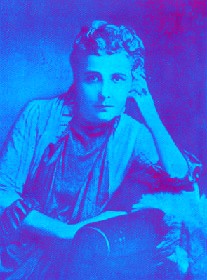
Annie
Besant
Theosophy
By
Annie Besant
Contents
Introduction
Theosophy as a Science
Theosophy as morality and art
Theosophy as Philosophy
Theosophy as Religion
Theosophy applied to Social Problems
A few details about Systems and Worlds
The Theosophical Society
Theosophy
is derived from two Greek words –Theos , God; Sophia, Wisdom –and
is therefore God-Wisdom, Divine Wisdom. Any dictionary will give its meaning :
“A claim to a direct knowledge of God and of Spirits”, a definition which is
not inaccurate, though it is scanty and affords but a small idea of all that is
covered by the word, either historically or practically.
The
obtaining of “a direct knowledge of God” is –as we shall see in dealing with
the religious aspect of Theosophy –the ultimate object of all Theosophy, as it
is the very heart and life of all true Religion; this is “the highest
knowledge, the knowledge of Him by whom all else is known”; but the lower
knowledge, that of the knowable "all else”, and the methods of knowing it,
bulk largely in Theosophical study.
This is
natural enough, for the supreme knowledge must be gained by each for himself,
and little can be done by another, save by pointing to the way, by inspiring to
the effort, by setting the example; whereas the lower knowledge may be taught
in books, in lectures, in conversation, is transmissible from mouth to ear.
THE MYSTERIES
This
inner, or esoteric, side of religion is found in all the great faiths of the world,
more or less explicitly declared, but always existing as the heart of the
religion, beyond all dogmas which form the exoteric side. Where the exoteric
side propounds a dogma to the intellect, the esoteric offers a truth to the
Spirit; the one is seen and defended by reason, the other is grasped by
intuition –that faculty “beyond the reason” after which the philosophy of the
West is now groping. In the religions that have passed away it was taught in
the “Mysteries”, in the only way in which it can be taught –by giving
instruction how to pursue the methods which unfold the life of the Spirit more
rapidly than that life unfolds in natural and unassisted evolution; we learn
from classical writers that in the Mysteries the fear of death was removed, and
that the object aimed at was not the making of a good man –only the man who was
already good was admissible –but the transforming of the good man into a God.
Such
Mysteries existed as the heart of the religions of antiquity, and only
gradually disappeared from Europe from the 4th to the 8th
centuries, when they ceased –for want of pupils.
We may
find many traces of the Christian Mysteries in the early Christian writers,
especially in the works of S. Clement of Alexandria and of Origen, under the
name of “The Mysteries of Jesus”.
The
condition of high morality was made here, as in the Greek Mysteries: “Those who
for a long time have been conscious of no transgression … let them draw near”.
Indications of their origin and existence are found in the New Testament, in
which the Christ is said to have taught His disciples secretly –“Unto you it is
given to know the mysteries of the Kingdom of God, but to others in parables”
–and these teachings, Origen maintains, were handed down in the Mysteries of
Jesus; S. Paul also declares that “we speak ‘wisdom’ among them that are
‘perfect’ –two terms used in the Mysteries.
Islam
has its secret teachings –said to have been derived from Ali, the son-in-law of
the Prophet Mohammed –to be found by meditation and a discipline of life,
methods taught among the Sufis.
Buddhism
has its Sangha, within which again by meditation and a discipline of life, the
inner truth is to be found.
Hinduism,
both in its scriptures and its current beliefs, asserts the existence of the
supreme and the lower knowledge, the latter to be gained by instruction, the
former, once more, by meditation and a discipline of life. It is this which
makes the supreme knowledge “esoteric”; it is not deliberately veiled and
hidden away, but it cannot be imparted; it can only be gained by the unfolding
of a faculty, of a power to know, of a mode of consciousness, latent in all
men, but not yet developed in the course of normal evolution.
This
shows itself sporadically in the Mystic, often in erratic fashion, often accompanied
with hysteria, but even then, is none the less an indication –for the
clear-sighted and unprejudiced –of a new departure in the long evolution of
human consciousness. It is brought to the surface sometimes by exceptional
purity: “the pure in heart …shall see God”.
Startling
eruptions of it into ordinary life are seen in such cases of “sudden
conversion” as are recorded by Prof. James. [Varieties of Religious
Experience]. The spiritual consciousness is a reality; its witness is found
in all religions, and it is stirring in many today, as it has stirred in all
ages. Its evolution in the individual can only be gently and deliberately
forced, ahead of normal evolution, by the meditation and the discipline of life
alluded to above. For esotericism in religion is not a teaching, but a stage of
consciousness; it is not an instruction, but a life. Hence the complaint
made by many, that it is elusive, indefinite; it is so to those who have not
experienced it, for only that which has been experienced in consciousness
can be known to consciousness.
Esoteric
methods can be taught, but the esoteric knowledge to which they lead, when
successfully followed and lived, must be won by each for himself. We may help
to remove obstacles to vision, but a man can only see with his own eyes.
THE PRIMARY MEANING
Theosophy
is this direct knowledge of God; the search after this is the Mysticism, or
Esotericism, common to all religions, thrown by Theosophy into a scientific
form, as in Hinduism, Buddhism, Roman Catholic Christianity, and Sufism.
Like these, it teaches in a quite clear and definite way the methods of
reaching firsthand knowledge by unfolding the spiritual consciousness,
and by evolving the organs through which that consciousness can function
on our earth –once more, the methods of meditation and of a discipline of life.
Hence
it is the same as the Science of the Self [Atma-vidyä], the Science of the
Eternal [Brahma-vidyä] which is the core of Hinduism; it is “the Knowledge of
God which is Eternal Life” which is the essence of Christianity. It is not a
new thing, but is in all religions, and hence we find the late eminent
Orientalist, Max Müller, writing his well known work on Theosophy, or
Psychological Religion.
THE SECONDARY MEANING
Theosophy,
in a secondary sense –the above being the primary –is the body of doctrine,
obtained by separating the beliefs common to all religions from the
peculiarities, specialities, rites, ceremonies and customs which mark off one
religion from another; it presents these common truths as a consensus of
world-beliefs, forming, in their entirety, the Wisdom-religion, or the
Universal Religion, the source from which all separate religions spring, the
trunk of the Tree of Life from which they all branch forth.
The
name Theosophy, which as we have said, is Greek, was first used by Ammonius
Saccas, in the third century after Christ, and has remained ever since in the
history of religion in the West, denoting not only Mysticism, but also an
eclectic system, which accepts truth wherever it is to be found, and cares
little for its outer trappings.
It
appeared in its present form in America and Europe in 1875, at the time when
Comparative Mythology was being used as an effective weapon against Christianity,
and, by transforming it into Comparative Religion, it built the researches and
discoveries of archaeologists and antiquarians into bulwarks of defence for the
friends of religion, instead of leaving them as missiles of attack for its
enemies.
COMPARATIVE
MYTHOLOGY
The unburying of
ancient cities, the opening of old tombs, the translation of archaic
manuscripts of both dead and living religions, proved to demonstration the fact
that all the great religions which existed and had existed resembled each other
in their most salient features. Their chief doctrines, the outlines of their
morality, the stories which clustered round their founders, their symbols,
their ceremonies, closely resembled each other. The facts were undeniable, for
they were carved on ancient temples, written down in ancient books; the further
research was carried, the bulkier grew the evidence.
Even among the
most degraded tribes of savages, traces were found of similar teachings,
traditions of sacred truths overlaid by the crudities of animism and fetishism.
How to explain such similarities? What their bearing on Christianity?
“Evolution” was
then the “open sesame” of Science, and the answer to these questions was not
long delayed. Religion had evolved; from the dark ignorance of
primal savages, who personified the powers of the Nature they feared, had
evolved the inspiring religions and the splendid philosophies which had
enthralled and civilised mankind.
The medicine-men
of savages had been glorified into Founders of religions; the teachings of the
Saints and Prophets were the refining of the hysterical babblings of
half-epileptic visionaries; the synthesis of natural forces –a synthesis
wrought out by man’s splendid intellect –had been emotionalised into God. Such
was the answer to Comparative Mythology to the alarmed questionings of men and
women who found their houses of faith crumbling into pieces around them,
leaving them exposed to the icy winds of doubt.
At the same time
Immortality was threatened, and though intuition whispered: “Not all of me
shall die”, physiology had captured psychology, and was showing the brain
as the creator of thought –thought, which was born with the brain, grew with
it, was diseased with it, decayed with it; did it not finally die with it?
Agnosticism grew
and flourished; what could man know, beyond what his senses could discover,
beyond what his intellect could grasp? Such was the condition of educated
thought in the last quarter of the 19th century. The younger
generation can scarcely realise that veritable “eclipse of faith”.
COMPARATIVE
RELIGION
Into that Europe
Theosophy suddenly came, asserting the Gnosis as against Agnosticism,
Comparative Religion against Comparative Mythology. It declared that man had
not exhausted his powers in using his senses and his intellect, for that beyond
these there were the intuition and the sure witness of the Spirit; that the
existence of these powers was a demonstrable fact; that the testimony of the
spiritual consciousness was as indubitable as that of the intellectual and the
sensuous.
It admitted all
the facts discovered by archaeologists and antiquarians, but asserted that they
were susceptible of quite other explanation than that given by the enemies of
religion, and that while the facts were facts the explanation was only a
hypothesis.
It set over
against this hypothesis another, equally explanatory of the facts –that the
community of religious teachings, ethics, stories, symbols, ceremonies, and
even the traces of these among savages, arose from the derivation of all
religions from a common centre, from a Brotherhood of Divine Men, which sent
out one of its members into the world from time to time to found a new
religion, containing the same essential verities as its predecessors, but
varying in form with the needs of the time, and with the capacities of the
people to whom the Messenger was sent.
It was obvious
that either hypothesis would explain the admitted facts. How should a decision
between them be reached? Theosophy appealed to history: it pointed out that the
palmy days of each religion were its early days, and that the teachings of the
Messenger were never improved on by the later adherents of the faith, whereas
the contrary must have been the case if the religion had been produced by evolution;
the Hindūs founded themselves on their Upanishads—[their most ancient
literature, a part of the Vedas ], the Zoroastrians on the teachings of
the Prophet, the Buddhists on the sayings of the Lord Buddha, the Hebrews on
Moses and the Prophets, the Christians, the Mohammedans on those of their great
Prophet.
Later religious
literature consisted of commentaries, dissertations, arguments, not of new
departures, more inspiring than the original. Inspiration is ever sought in
later days in the sayings of the Founder, and in the teachings of His immediate
disciples.
Manu, Vyäsa,
Zarathushtra, the Buddha, the Christ –these Figures tower above humanity, and
command the love and reverence of mankind, generation after generation.
There are many
Messengers, the religions are their messages. Theosophy points to all of these
as proofs that its hypothesis is the true explanation of the facts, is no
longer a hypothesis, indeed, but is a truth affirmed by history. Against this
splendid array of Messengers with their messages, Comparative Mythology cannot
bring one single proof from history of a religion that has evolved from
savagery into spirituality and philosophy; its hypothesis is disproved by
history.
The Theosophical
view is now so widely accepted that people do not realise how triumphant was
the opposing theory. When Theosophy again rode into the arena of the world’s
thought in 1875, mounted on its new steed the Theosophical Society. But
any who would realise the conditions then existing should turn to the literature
of Comparative Mythology, published during the preceding century, form the
voluminous works of Dulaure and Dupuis [On phallic and sun worships.], through
Higgins’ Anacalypsis, to the books of Hargrave Jennings, Forlong, and a
dozen others, speaking with a positiveness that led the reader to believe that
the statements made were based on facts, which no educated person could deny.
Those
who plunged into that labyrinth of discussions in their youth, who lost
themselves in its endless and intricate windings, who saw their faith devoured
by the Minotaur of Comparative Mythology, they know –and only they can know in
its fullness –the intensity of the relief when the modern Ariadne –the much
misunderstood and much maligned Helena Petrovna Blavatsky –gave them a clue which guided them
through the mazes of the labyrinth, and armed them with the sword of “The
Secret Doctrine” [Mme. Blavatsky’s monumental work, published in 1889.] with
which to slay the monster.
It may
be interesting to note, in passing, that old-fashioned Christianity –which
believed that all mankind had descended from Adam, created 4004 B.C. –had
preserved a tradition of a primeval revelation, given to Adam and carried by
his posterity to all parts of the world; man, inheriting original sin from his
ancestor, had corrupted this, but traces of it were to be found in the grains
of truth hidden by the husks of “heathen” religions. This view, however,
despite the germ of truth it contained, was quite out of court with educated
people, who knew that the human race had existed for hundreds of thousands of
years, at least, instead of for a span of six thousand.
UNITY OF RELIGIONS
The
outcome of the whole position is that the fact of the community of religious belief
is destructive to any religion which claims for itself a unique and isolated
position; in such a position it is exposed to attack from all sides, and its
claim is easily disproved. But this same fact is a defence, when all religions
stand together, when they present themselves as a Brotherhood, children of one
ancestor, the Divine Wisdom.
This
view becomes the more satisfactory as we notice that each religion has its own
special note, makes its own special contribution to the forces working for the
evolution of man. As we notice their differences, in addition to their
similarities, we feel that they reveal a plan of human education, just as when
we hear a splendid chord we feel that a master-musician has combined the notes,
with a full knowledge of the value of each.
Hinduism
proclaims the One Immanent Life in everything , and hence the solidarity of
all, the duty of each to each, enshrined in the untranslatable word Dharma—
[translated
as religion, duty, obligation, is more than these. It indicates the sum of
man’s past evolution –all that has made him what he is –and the next
steps which he must take in order to ensure his further evolution with the
least possible delay and difficulty.]
Zoroastrianism
strikes the note of purity –purity of surroundings, of body, of mind. Hebraism
sounds out Righteousness. Egypt makes Science its word of power. Buddhism
asserts Right Knowledge. Greece breathes of Beauty. Rome tells of Law.
Christianity teaches the value of the Individual and exalts Self-sacrifice.
Islam peals out the Unity of God. Surely the world is the richer for each, and
we cannot spare one jewel from our chaplet of the world’s religions.
Out of
the fair spectacle of their varied beauty and the spiritual value of the
variety, grows in our minds the sense of the reality of the great Brotherhood,
and its work in the guidance of spiritual evolution. So deep a unity, so
exquisite and fruitful a diversity, cannot be mere chance, mere coincidence,
but must be the result of a plan deliberately adopted and strongly carried out.
METHOD OF STUDY
As the
Theosophical system of thought is an immense, an all inclusive, synthesis of
truths, as it deals with God, the Universe, and Man, and their relations to
each other, it will be best to divide its presentation under four heads,
corresponding to a very obvious and rational view of Man. Man may be regarded
as having a physical body, an emotional nature and intellect; and through these
he, an eternal Spirit, manifests himself in this mortal world. These three
departments of human nature, as we may call them, correspond to his great
activities: Science, Ethics and Æsthetics, Philosophy.
1]
Through his senses Man observes the phenomena around him, and verifies his
observations by experiments; through his brain he records and arranges
his observations, makes inductions, frames hypotheses, tests his hypotheses by
devising crucial experiments, and arrives at knowledge of Nature and
understanding of her laws: thus he constructs sciences, the splendid results of
intelligent use of the organs of the physical body on the physical world. We
must study Theosophy as SCIENCE.
2]
Man’s emotional nature shows feelings and desires –feelings caused by contacts
with the outside, contacts which give pleasure or pain; these arouse in him
desires –cravings to re-experience the pleasure, to avoid the recurrence of
pain. W e shall see, when we come to deal with these, that the deep-rooted
yearning for Happiness, planted in every sentient creature, spurs him to place
himself at last in harmony with law, that is, to do the Right, to refuse to do
the Wrong. The expression of this harmony in life, in our relations with others
and in the building of ourselves, is Right Conduct. The expression of this same
harmony in matter is Right Form, or Beauty. We must study Theosophy as
MORALITY-ART.
3]
Man’s intellect demands that his surroundings, both as regards life and matter,
shall be intelligible to him; it demands order, rationality, logical
explanation. It cannot live in a chaos without suffering; it must know and
understand, if it is to exist in peace. We must study Theosophy as PHILOSOPHY.
4]
But these three, Science, Morality-Art, Philosophy, do not perfectly satisfy
our nature. The religious consciousness persistently obtrudes itself in all
nations, all climes, all ages. It refuses to be silenced, and will feed on the
husks of superstition if denied the bread of Truth. The Spirit who is Man will
not cease his search for the Universal Spirit who is God, and God’s answers
–partial but with the promise of more –are religions. We must study Theosophy
as RELIGION.
Under
these four heads all the Theosophical teachings most important to human life
and conduct may be presented. There remain: a few indications of the practical
application of these to social problems, and a mere statement –for within the
brief compass of this little book no more is possible –of the larger vistas of
the past and the future opened up to us by Theosophy.
All
divisions which seek to divide the really indivisible Spirit –the spark from
the universal Fire –are unsatisfactory, and tend to veil from us the unity of
the consciousness which is our Self. Senses, emotions, intellect, are but
facets of the one diamond, aspects of the one Spirit. Spiritual life, Religion,
should be a synthesis of Science, Morality –Art and Philosophy –they are
but facets of religion. Religion should permeate all studies, as Spirit
permeates all forms.
Our
Self is one, not multiple, albeit his overflowing life expresses itself in
multitudinous ways. So although, for the sake of clarity, I divide my subject
into parts, I would pray my reader to remember that classification is a means
and not an end; that classifications are many, while consciousness is one; and
that while, for lucid explanation, we may avoid confusing the persons, we
should ever bear in mind that we must also avoid dividing the substance.
SECTION I
THEOSOPHY
AS SCIENCE
The old
ways of study was to state universals, and to descend from them to particulars,
and it remains the best way for serious and philosophic students. The modern
way is to begin with particulars, and to ascend from them to universals; for
the modern reader, who has not yet made up his mind to a serious study of a
subject, this is the easier road, for it keeps the most difficult part
for the last. As this little book is meant for the general reader, I follow
this way.
Theosophy
accepts the –method—of Science –observation, experiment, arrangement of
ascertained facts, induction, hypothesis, deduction, verification, assertion of
the discovered truth but immensely increases its area. It sees the sum
of existence as containing but two factors, Life and Form, or, as some call them,
Spirit and Matter, others Time and Space, for Spirit is God’s motion, while
Matter is His stillness; both find their union in Him. Since the Root of Spirit
is His Life, and the Root of Matter is the universal ether, the two aspects of
the One Eternal, out of Space and Time. [See section III].
While
ordinary science confines Matter to the tangible, Theosophical science extends
it through many grades, intangible to the physical, but tangible to the
superphysical senses. It has observed that the condition of knowing the
physical universe is the possession of a physical body, of which certain parts
have been evolved into organs of sense, eyes, ears, etc., thought which
perception of outside objects is possible, and other parts have been evolved
into organs of action, hands, feet, and the rest, through which contact with
outside objects can be obtained.
It
sees that, in the past, physical evolution has been brought about by the
efforts of life to use its nascent powers, and that the struggle to exercise an
inborn faculty has slowly shaped matter into an organ through which that
faculty can be more fully exercised.
To
reverse Büchner’s statement: We do not walk because we have legs; we have legs
because we wanted to move. We can trace the growth of legs from the temporary
pseudopodia of the amœba, through the development of permanent protrusions from
bodies, up to the legs of man, and they were all gradually formed by the
efforts of the living creature to move. As W.K. Clifford said of the huge
saurians of a past age: ‘Some wanted to fly, and they became birds”. The
“Will to live” –that is, to desire , to think, to act –lies behind all
evolution.
The
Theosophist carries on the same principle into higher realms, if such exist;
and if consciousness is to know any other sphere [ I use the word “sphere”
to indicate the whole extent of matter belonging to a definite type, i.e..,
built of atoms of one sort. See under “Atoms” in Section VI. There may be
several worlds in a sphere; thus the heaven-world is in the mental sphere. The
word plane has been used in this sense, but it is found that people do not
readily grasp its meaning.] than the physical, it must have a body of matter
belonging to the sphere it wants to investigate, and the body must have senses,
developed by the same want of the Life to see, to hear, etc. That there should
be other spheres, and other bodies through which those spheres can be known, is
no more inherently incredible than that there is a physical sphere, and that
there are physical bodies through which we know it. The Occultist –the student
of the workings of the divine Mind in Nature –asserts that there are such
spheres, and that he has and uses such bodies.
The
following statements –with one exception which will be noted in its place –are made
as results of investigations carried on in such spheres by the use of such
bodies by the writer and other Occultists; we all received the outline from
highly developed members of our humanity, and have proved it true, step by
step, and have filled in many gaps, by our own researches. We , therefore, feel
that we have a right to affirm, on our own firsthand experience –stretching
over a period of twenty-three years in one case, and twenty five in another
–that superphysical research is practicable, and is as trustworthy as physical
research, and should be carried on in similar ways; that investigators are
subject to errors, both in physical and superphysical spheres, and for similar
reasons, and that these errors should lead to closer research and not to its
discontinuance.
A TABLE OF CORRESPONDENCES
The following
table presents a view of the spheres related to and including our earth, of the
bodies used in investigating them, and of the states of consciousness
manifested through them by their owner, the Man. The Eternal Man, a fragment of
the Life of God, is called the Monad, a “oneness”; [ This is the statement,
including what is said farther on about the Monad, noted above, as not having
been verified by the writer’s own observation. This highest Self is only made
manifest to such as we are on rare occasions in a great down flow of dazzling
light: in his own nature, in his own world, he is beyond the reach of any
vision yet attained by any of us. Yet what we call our life is his, since he is
the highest Self in each of us, “the hidden God” –as the Egyptians used to
say.] he is verily a Son of God, made in His image, and expressing his life in
three ways: by the aspect of Will, the aspect of Wisdom, the aspect of Creative
Activity. He lives in his own sphere, a spark in the divine Fire, and
sends down a ray, a current of his life, which embodies itself in the five
spheres of manifestation.
This
ray, appropriating an atom of matter from each of the three higher of these
spheres, appears as the human Spirit, reproducing the three aspects of the
Monad, of will, Wisdom, and Creative Activity, and reveals himself, at a
certain stage of evolution, as the human ego, the individualised Self ; he
begins his long journey as a mere seed of life, and, never losing his identity,
moves through that long journey, unfolding all the powers of the Monad, that
lie hidden within him, as the tree within the seed.
As he
conquers his kingdom of matter, his Parent-Monad pours down into him more and
more life, and draws from him more and more knowledge of the worlds in which he
lives. But the passing into the three highest manifested spheres is not enough
for gaining full knowledge and full power in our Solar System; two yet remain,
and the process of dipping down into matter goes on.
The
Spirit strengthens himself for his work by appropriating a molecule of the
coarser matter of the lowest sphere he has so far entered, and links on to
this, an atom from the fourth manifested sphere of denser matter, and one from
the fifth, the lowest our physical sphere. He is to obtain bodies, formed round
these permanently appropriated particles of matter, by which he may be able to
know and act upon the five manifested spheres.
We
shall see that his lower bodies, forming what is called his Personality, are
cast off at and after what we call death, and are renewed for each successive
birth, while the higher, forming his Individuality, remain through this long
pilgrimage –an important fact as bearing on the possibility of remembering the
past. The above facts are tabulated hereafter.
|
SPHERES |
BEINGS |
|
STATES OF
CONSCIOUSNESS |
BODIES |
|||
|
Unmanifested |
1 |
Divine |
Adi |
Logos |
|
Divine
Triplicity (1) |
.................. |
|
2 |
Monadic |
Anupädaka |
Human Monad |
|
Monadic Triplicity
(2) |
.................. |
|
|
Manifested |
3 |
Spiritual |
Atma |
Man who is |
[A] |
Spirit,
individualized as Will |
Atom |
|
4 |
Intuitional |
Buddhi |
Spirit,
individualized as Intuition |
Intuitional |
|||
|
5 |
Mental (higher) |
Manas |
spirit,
individualized as Intellect |
Causal |
|||
|
5 |
Mental (lower) |
Manas |
Man who has |
[B] |
Mind |
Mental |
|
|
6 |
Astral (or
Emotional) |
Käma |
Desires and
Emotions |
Astral |
|||
|
7 |
Physical |
Sthula |
Vitality (3) |
Physical |
|||
|
[A]- An immortal Individuality [B] -A
mortal Personality |
|||||||
|
[The Student
may find the Sanskrit terms useful, as they have been much employed in
Theosophical literature, and the above are my own English equivalents: 1. Adi;
2-Anupâdaka; 3-Atmâ or Nirvâna; 4.Buddhi; 5. Manas (adjective, mânasic); 6.
Kâma; 7. Sthula. The Buddhists use for Adi, Mahäparinirväna, and for
Anupädaka, Parinirväna.] |
|||||||
|
(1) The Trinities of religions, the Three
Persons of Christianity. As manifested in a Solar System. They appear three
by difference of function, seen from below. The whole Solar System may be
called the Body of the Logos, and the Sun His physical Body, but they only
embody a fragment of Him. |
|||||||
|
(2) Man"made in the Image of
God". His aspects, Will, Wisdom, and Activity, or Power, Knowledge-Love,
and Creativeness are shown in the embodied reproduction of himself, as Will,
Intuition, and Intellect. |
|||||||
|
(3) The seven are named from below upwards:
solid, liquid, gaseous, etheric, super-etheric, sub-abtomic, atomic |
|||||||
As
vitality shows itself in two main forms in the Physical Body, the latter is
functionally divided into two : Energising Vitality works through the finer
part, called the etheric Double, composed of the four physical ethers, and
Automatic Vitality uses the denser part, composed of solids, liquids and gases.
These seven subdivisions of physical matter make up the physical sphere.
It may
be asked: “What is the object of this descent into matter? What does the Monad
gain by it? “ Omniscient in his own sphere, he is blinded by matter
in the spheres of manifestation, being unable to respond to their vibrations.
As a man who cannot swim, flung into deep water, is drowned, but can learn to
move freely in it, so with the Monad. At the end of his pilgrimage, he will be
free of the Solar System, able to function in any part of it, to create at
will, to move at pleasure. Every power that he unfolds through denser matter,
he retains forever under all conditions; the implicit has become explicit, the
potential the actual. It is his own Will to live in all spheres, and not only
in one, that draws him into manifestation.
THE PHYSICAL BODY
The
actual unfolding of consciousness is best traced from below, for the physical
body is the one which is first organised as its instrument for knowledge, and
it unfolds itself by this in the physical world we know. The emotional nature
stimulates the glands and ganglia of the physical body, and the mental
enthrones itself over the cerebrospinal system, and these proceed with their
evolution in the invisible spheres through the stimulus obtained from the
physical.
We
need not dwell on the evolution of the dense physical body, as they may be
studied as physical science. Human consciousness is here automatic, the Man
having no longer need to direct physical processes; they go on by habit, the
result of long pressure from consciousness.
The
finer part of the physical body, the etheric double, permeates the dense, and
extends a little beyond it over the whole surface; its proper sense-organs are
vortices on its own surface, situated opposite 1] the top of the head, 2] the
point between the eyebrows, 3] the throat, 4] the heart, 5] the spleen, 6] the
solar plexus, 7] the base of the spine, [8,9,10] in the lower part of the
pelvic basin; these last are not used, except in Black Magic.
These
vortices–technically called chakrams, wheels, from their appearance –are
aroused into activity in the course of occult training, and form a bridge
between the physical and astral spheres, so that the latter comes to be
included within the activity of the waking consciousness. The health of its
dense partner depends on the Vitality in the etheric double, which draws its
energy directly from the Sun, and, in the part in contact with the spleen,
divides this energy into streams, which it conveys to the different organs of
the dense body; the surplusage radiates outwards and energises all living
creatures within its range.
The
very neighbourhood of a vigorously healthy person vitalises, while a weak body
draws on all around it for Vitality, often seriously depleting those near to
it. Physical magnetism, the power of healing, etc., are ways in which this
surplus Vitality may be usefully expended.
Etheric
vision –physical vision keener than the normal –may be used for examining
minute objects, such as chemical atoms, or for studying such of the
nature-spirits as use etheric matter for their lowest bodies –fairies, gnomes,
brownies, and creatures of that ilk. Very slightly increased tenseness of the
nerves, caused by excitement, ill-health, alcohol, may bring these within
sight.
The
etheric part of the brain plays an active part in dreams, especially in those
caused by impressions from outside, or from any internal pressure from the
cerebral vessels. Its dreams are usually dramatic, and may embroider any memory
of past events, objects, or persons. [See the many cases given in Du Prel’s Philosophy
of Mysticism.]
In
normal healthy persons the etheric part of the physical body does not separate
from the dense, but the greater part of it may be driven out by anæsthetics,
and slips out easily in the case of persons who are mediumistic, often serving
as the basis for materialisations.
Death
is the complete withdrawal from its dense counterpart, in conjunction with the
consciousness in the higher bodies; it remains with these fro a varying
interval –usually about 36 hours after death –and then is thrown off by the Man
as of no further use; it decays away pari passu with the dense corpse.
THE EMOTIONAL OR ASTRAL SPHERE,
ITS WORLDS AND ITS INHABITANTS
The
astral sphere connected with our earth contains two globes with which we need
not here concern ourselves, also the astral world and its inhabitants, and the
intermediate or desire world, a part of the astral, the inhabitants of which
are normally under special conditions.
The
whole sphere belongs to the state of consciousness which shows itself as
feelings, desires, and emotions; these changes in consciousness are accompanied
with vibrations in astral matter, and as astral matter is fine and very rapid
in its vibratory motions, the vibrations are visible to astral sight as
colours.
The
passion of anger causes vibrations that yield a flash of scarlet, while a
feeling of devotion or love suffuses the astral body with a blue or rosy hue.
Each feeling has its appropriate colour, because each is accompanied by its own
invariable set of vibrations.
The
human astral body is, of course, composed of astral matter, and, when
accompanying the physical body, which it permeates and beyond which it extends,
it appears as a cloud, or as a defined oval, according as its owner is little
or much developed.
Clearness
and brightness of the more delicate colours, increased definiteness of form and
increase of size mark the higher evolution. When the Man in his higher bodies
draws away from the physical –as he does every night in sleep –then the astral
body assumes the likeness of the physical.
Astral
matter being very plastic under the influence of thought, a man appears in the
astral world in the likeness of himself, as he sees himself, wearing the
clothes of which he thinks. A soldier, slain in battle, and appearing in his astral
body to a distant friend, will bear his wounds; a drowned man will appear in
dripping clothes.
While
human beings in the astral world normally wear human forms, the inhabitants of
that world who have not had physical bodies –higher fairies, nature-spirits
connected with the evolution of plant and animal life, and the like –wear
bodies that are constantly changing their outlines and sizes.
Sportive
elementals –as nature-spirits are often called –will sometimes take advantage
of this plasticity of astral matter to swell themselves up into huge and
terrible shapes for the sake of terrifying untrained intruders into their
world. Some drugs, such as hashish, bhang, opium, and extreme alcoholic
poisoning, so affect the physical nerves as to render them susceptible to
astral vibrations, and then the patients catch a glimpse of some inhabitants of
the astral world.
The
horrors which torment a man suffering from delirium tremens are largely due to
the sight of the loathsome elementals that gather round places where liquor is
sold, and feed on its exhalations, and are attracted round him by the effluvia
of his own drink-sodden body.
All
feelings of pleasure and pain in the physical body are due to the presence of
the interpenetrating astral, and, if this be driven out by anæsthetics or
mesmerism, feeling disappears from the physical body.
In
sleep –during which the etheric double does not leave its dense counterpart
–the astral can be very quickly recalled by any disturbance of the physical
body; but where much of the etheric matter has also been driven out, the bridge
of communication is broken, and trance is produced; under these conditions the
dense body can be seriously mutilated without pain supervening. Pain will,
however, show itself as soon as the astral body slips again into the physical,
and “consciousness returns”.
It may
be said, in passing, that the normal centre of human consciousness at the
present stage of evolution is in the astral body, from which it works on the
physical. “Physical consciousness” is now subconscious –if such a bull may be
permitted to an Irishwoman.
The
condition of a person during sleep varies with his stage of evolution.
The
undeveloped man, in his higher bodies, leaving the physical body, hovers round
the places with which he is familiar; the average man drifts towards persons to
whom he is attracted, but his attention is turned inwards, and he communes with
his friends mentally only; at a stage a little higher, his mind is very active
and receptive, and can work out problems presented to it more easily than in
the physical body, as witness the common sayings: “sleep brings counsel”,
“better sleep on it”, and the like.
A
problem quietly placed in the mind on going to sleep will generally be found
answered in the morning. All these people do not work consciously in the astral
world; for this it is necessary that the attention should be turned outwards,
not inwards. Where a man is pure and self-controlled, and shows
helpfulness in the physical world, he is often “awakened” in the astral world
by a more advanced person.
The
process consists merely in inducing him to attend to what is going on around
him, instead of remaining immersed in thought ; his astral body has evolved and
has become organised by his mental and moral activities, and he has only to
wake up to his astral surroundings.
His
helper explains matters to him, and for a time keeps him near him ; he shows
him that astral matter obeys his thought, that he can move at will and at
whatever speed he wishes, that he can walk through rocks, dive into seas, pass
through raging fires, step over a precipice and hover in air, always provided
that he is fearless and confident ; if he loses courage, and only then, he is
in danger, and the imagined injury may “repercuss”, i.e.., show itself on the
physical body as a bruise, a scratch, a wound, etc.
When he
has learned these preliminary lessons, and can see and hear correctly in the
astral world, he is set to work to help the “living” and the “dead” ; he is
then what we call “an invisible helper”, and spends his night in succouring
those in trouble, teaching the ignorant, guiding those who have newly arrived
in the astral world through the gateway of death. To these last we must now
turn.
THE DESIRE WORLD, OR PURGATORY
This is
the part of the astral world in which conditions are specialised for discarnate
human beings, who, unless they have knowledge, are not free in the astral
world, but are “the spirits in prison” spoken of by St. Peter. They are held
prisoners by their desires, and hence the name of desire world is given to
their abode.
We have
seen that, at death, the Man, clothed in his finer bodies, draws himself out of
the physical garment worn during earth-life, the “coat of skin” with which “the
first man” was clothed after is “fall” into matter, caused by his seizure of
“knowledge”. “Which things are an allegory”, as St. Paul says of the
story of Abraham, Sarah, and Hagar.
Having
cast off his coat of skin, the Man is himself, just as he was while clothed
with it, and he “goes to his own place” in the astral world, the place for
which he has fitted himself. A rearrangement of the matter of his astral body
takes place automatically, unless he has knowledge enough to present it.
During
the life of the physical body, the astral particles from all the seven astral
subdivisions of matter move freely about among themselves, and some of all
kinds are always on the surface of the astral body ; sight of the whole astral
world depends on the presence on the surface of the astral body of particles
drawn from all the seven subdivisions, which answer to our solids, liquids,
gases, and the four states of ether.
These
particles are not gathered together and fashioned into an organ of vision, like
the physical eye ; when the Man turns his attention outwards he sees “all over
him”, through all these particles, or through such of them as are in the
direction of the object towards which his attention is turned. [ New
comers in the astral world always look through the astral simulacra of eyes,
because accustomed to turn their attention outwards in that way, just as they
move their legs for walking. Both are unnecessary.] If the rearrangement of the
matter of the astral body takes place, the matter of each subdivision is
gathered together, and a series of concentric shells is formed, the densest
being outside.
Hence
the Man can only see the subdivision of the astral world to which the outermost
shell belongs ; the amount of each kind of matter depends on the kind of
desires and emotions he has cultivated on earth.
If
these have been of a low order, the densest astral matter will be very strongly
vitalised, and this outermost shell, placing him in touch with the lowest
subdivision of the astral world only, will last for a long time; it
disintegrates by slow starvation, i.e.., by the deprivation of its accustomed
satisfactions. Hence a drunkard, a glutton, a sensualist, a man of violent and
brutal passions, having strongly vitalised by physical indulgence the densest
and coarsest combinations of astral matter, can only be conscious of his
surroundings through these, and sees only people like himself, and the worst
qualities of those who are of a better types ; his raging passions can find no
satisfaction, because he has lost the physical organs by which he erstwhile
gratified them ; moreover, these passions are much more violent than before,
for during his physical life most of the force of the astral vibrations was
used up in merely setting in motion the heavy physical particles of matter, and
only what was left over was felt as pleasure or pain ; hence all passions
are pale and weak on earth compared with their violence in the astral world,
where, after easily setting in motion the light astral particles, they show the
whole remainder of their force as pleasure or pain, as a rapture or an agony
inconceivable on earth.
This
last is what religions call “hell” –and a veritable hell, as to suffering, it
is, created by the man for his own dwelling place. But it is only temporary,
and might more fitly therefore, for orthodox Christians and Muslims, be called
“purgatory”.[ Both these religions, while ordinarily speaking of
hell as everlasting, have passages in their Scriptures which contradict the
idea. The New testament speaks of a time when “God shall be all in all”, and Al
Qurān declares: “All things shall perish save His Face”. ]
The thick layer
of densest matter wears away, and the man loses sight of this sphere of astral
life and begins to perceive the next, having learned, by the sad lesson of
bitter suffering, that the pleasures he valued on earth are verily “wombs of
pain”.
The average man
does not experience this unfortunate after-death condition, not having drawn
into his astral body while on earth much of the densest matter, and such of it
as he is not strongly vitalised, and it cannot hold him. If his interests on
earth have all been trivial – round of office or household drudgery or manual
labour, alternating with low, though not vicious, forms of amusement –and he
has cared nothing for larger interests, those of the community and the nation,
he will find himself shelled in by matter of the sixth subdivision of the
astral world, and will be surrounded by the astral counterparts of physical
objects, without the power to affect them or to take part in the earth-life led
among them ; he will, therefore, to use a colloquialism, find himself very much
bored, and be a prey to an intolerable sense of ennui.
It may be said
that this is hard, as most people have to spend their lives in drudgery of some
kind; are they to be bored after death, having drudged before? True; but a
little knowledge will prevent this, and for this very reason Theosophy is being
spread far and wide.
The work which
carries on the world need not be drudgery, and to deeply religious people is
not drudgery even now; for all useful work is part of the Divine activity, and
all workers are organs of that Activity, the Hands wherewith the divine Worker
accomplishes His work. Production and distribution –agriculture, mining,
manufactures, commerce, the pettiest trade –are God’s ways of nourishing
humanity, and are the means of evolution.
When a man, a
woman, see their little daily tasks as integral portions of the one great work,
they are no longer drudges but co-workers with God. [See Application of
Theosophy to Social Problems, Section V., p. 77]
As George
Herbert sang:
“A servant in this cause
Makes drudgery divine
Who sweeps a room as for Thy laws
Makes that and th’action fine”.
Those who thus work will find no boredom
after death, but fresh and joyous activity. For the rest, they gradually adapt
themselves to the new conditions, and are helped to do so, and they find that
they are rid of many of the discomforts of earth, and may lead a quite pleasant
life; they are in touch with their friends on earth, and find that these are
quite companionable during earth’s nights, though provokingly indifferent
during its days ; as Mr. Leadbeater pithily says :”The dead are never for a
moment under the impression that they have lost the living”, however much
the latter lament the loss of the dead they loved.
The man passes
on through the sixth, fifth, and fourth subdivisions, enjoying more and more
association with those he loves, until he passes into the higher subdivisions
–the material heavens of the less instructed religionists of all faiths, the
region for art, literature, science, philanthropy, and the large interests of
life, followed on earth with some selfishness, and here pursued along the
habitual lines and with the use of astral reproductions of physical means and
apparatus. These same pursuits, carried on for unselfish motives, lift the Man
into the heaven-world, their proper home, and thither also those who followed
them more selfishly pass, for when they are weary of them in the astral world
they fall asleep, to wake in heaven.
The astral body
has been cast off, shell after shell, and in due time goes back to its
elements, like the physical. Some pure and lofty souls pass through the astral
world without attending to it, their minds set upon higher things. Others,
fully awake, do not allow the matter of their astral bodies to be rearranged,
but retain their freedom and perform useful service. Omitting this last class,
whose stay in the astral world will depend on other causes, the general rule is
that the astral after-death life is long for the undeveloped and short for the
well-developed, while the heavenly is long for the latter and short for the
former.
THE MENTAL
SPHERE, ITS WORLDS AND INHABITANTS
The mental sphere
connected with our earth contains two globes with which we are not now
concerned. It contains also two worlds, the higher and lower, each with its
inhabitants, and a part of the lower is placed under special conditions, for
the use of discarnate human beings; this is the heaven-world. The whole sphere
belongs to the state of consciousness denominated thought, or mental activity,
and its matter answers to the changes in consciousness that are caused by
thinking; it seven subdivisions, though so much finer, again correspond to
those of the physical and astral worlds.
And the mental
world is, like the physical, divided into two, a lower and an upper, the former
consisting of the four denser subdivisions and the latter of the three subtler;
two bodies belong to it: the mental, composed of combinations of the denser,
and the causal, composed of those of the finer. This world is of peculiar
interest, not only because Man spends here nearly all his time, after the
mind is fairly developed, only dipping down into the physical world for brief
snatches of mortal life as a bird dives into the sea after a fish, but because
it is the meeting place of the higher and the lower consiousnesses.
The immortal
Individuality, descending from above –after the Monad has formed the Spirit by
sending out his ray –waits in high heaven, while the lower bodies are being
formed round atoms attached to him, brooding over then through long ages of
slow evolution; when they are sufficiently evolved, he flashes down and takes
possession of them, to use them for his own evolution. The habitat of the
Spirit as Intellect –of him “whose nature is knowledge” –is the causal world,
the three higher levels of the mental sphere; these give him his body, the
causal, the body which remains, ever evolving, throughout his long series of
incarnations in denser matter. This world and body are so named because all the
causes, the effects of which are seen in the lower worlds, reside in them. The
causal body begins, with the above-named flashing down, as a mere film of
matter, egg-shaped, like a shell round the lower bodies, formed within it, as
the chick in the egg.
The delicate
network radiates from the permanent atom of the causal body to all parts of
this egg-like film, the atom glowing like a brilliant nucleus; with it are
associated the permanent atoms of the physical and astral bodies and the
permanent molecule-unit of the mental.
During life, it
encloses the whole bodies, and at the death of each it preserves this permanent
germ of each, with all the vibratory powers enshrined within it, the “seed of
life” for each successive body. For ages it is little more than this subtle
network and surface, for it can only grow by the higher human activities, by
such as arouse in its subtle matter a faint vibratory response; as the
personality grows more thoughtful, more unselfish, more engaged in right
activities, its harvest for its owner grows richer and richer.
The
personalities are like the leaves put forth by a tree; they draw in material
from outside, transform it into useful substances, send it down the tree as
crude sap, drop off and wither; the sap is changed into tree-food, and
nourishes the tree, which sends out new leaves, to repeat the same cycle.
The
consciousness, in the mental, astral, and physical bodies, gathers experience;
casting off the physical and astral bodies as dead leaves, it transmutes these
experiences into qualities in the mental body, during its heavenly life; it is
in drawn into the causal body with its harvest, casting away the mental body,
like the others, and is blended with the Spirit, who puts it forth, enriching
him with its harvest; it has served the Spirit as a hand, put forth to take
food.
The enriched
Spirit, the Man, forms round the old permanent atoms, another mental and astral
body, capable of manifesting his enhanced qualities; the physical permanent
atom is planted through the father in the body of the mother who is to provide
the physical body required by the changeless law of cause and effect, and these
three lower bodies are nourished and coloured by her corresponding bodies; the
new personality is thus launched into the mortal world.
While Intellect
has, as its vehicle, the causal body, its copy in denser matter, the Mind, has
the mental body as its instrument; the one has abstract thinking as its
activity, the other concrete. The Mind acquires knowledge by utilising the
sense for observations, its precepts, and by working on these and building them
into concepts ; its powers are attention, memory, reasoning by induction and
deduction, imagination, and the like.
The Intellect knows,
by the assonance of the outside world with its own nature, and its power is
Creation, the arrangement of matter into bodies for its own natural products,
Ideas. When it sends a flash into the lower Mind, illuminating its concepts and
inspiring its imagination, we call the flash Genius.
Both the causal
and mental bodies expand enormously in the later stages of evolution, and
manifest the most gorgeous radiance of many-coloured lights, glowing with
intense splendour when comparatively at rest, and sending forth the most
dazzling coruscations when in high activity. Both interpenetrate the lower
bodies and extend beyond their surface, as has already been stated with regard
to the etheric double and the astral body. The parts of all these bodies of
finer matter which are outside the dense physical body form collectively the
“aura” of the human being, the luminous coloured cloud surrounding his
dense body.
The etheric
portion of the aura can be seen by Dr. Kilner’s [note-the reader is advised to
refer to the table]—apparatus; an ordinary clairvoyant usually sees this and
the astral portion; a clairvoyant more highly developed sees the etheric,
astral, and mental portions. Few are able to see the portion consisting of the
causal body, and fewer still the rare beauty of the intuitional, and the
dazzling light of the spiritual vehicles.
The clarity and
delicacy, and brilliance of the auric colours, or their opacity, coarseness,
and dullness, show the general stage of advancement of the owner. Changes of
emotion suffuse the astral portion with transitory colours, as with the rose of
love, the blue of devotion, the grey of fear, the brown of brutality, the
sickly green of jealousy. The pure yellow of intelligence, the orange of pride,
the brilliant green of mental sympathy and alertness, are equally familiar.
Striations, bands, streaks, flashes, etc., give a multiplicity of forms for
study, all expressive of certain qualities in the mental and moral character.
The child’s aura, again, differs much from that of the adult. But we must pass
on, as space is limited.
The Mind,
working in the mental body, produces results –thoughts –in the astral and
physical bodies, in the latter by using as its instrument the cerebrospinal
system. In its own world it sends out definite “thought-forms”, thoughts
embodied in mental matter, which go forth into the mental world and may
incorporate themselves in other mental bodies; its own vibrations, also, send
out undulations in all directions, that cause similar vibrations in others.
Comparatively few people, at the present stage of evolution, can function
freely in the mental world, clothed only in the higher and the mental bodies,
separated from the physical and astral.
But those who
can do so can tell about its phenomena –an important matter, since heaven --[
Called in the older Theosophical books—Devachan, or Sukhävati] -----is part of
the mental world, guarded from all unpleasant intrusions. The inhabitants of
the world are the higher ranks of the nature-spirits, called in the East,
Devas, or Shining Ones, and by the Christians, Hebrews, and Muslims , --Angels
the lowest Order of angelic Intelligences. They are glowing forms with changing
shades of exquisite colours, whose language is colour, whose motion is melody.
THE HEAVEN
WORLD
The heaven
portion of the mental world is filled with discarnate human beings, who work
out into mental and moral powers the good experiences they have garnered in
their earthly lives.
Here the
religious devotee is seen, rapt in adoring contemplation of the Divine Form he
loved on earth, for God reveals Himself in any form dear to the human heart;
here the musician fills the air with melodious sounds, cultivating his capacity
into higher power; here all that love are in close touch with their beloved,
and love gains new strength and depth by fullest expression; here the artists
of form and colour work out splendid conceptions in plastic material,
responsive to their thought; here philanthropists shape great schemes for human
helping, architects of plans to be wrought out when they return to earth.
Every high
activity followed on earth, every noble thought and aspiration, here grow into
flowers, flowers which contain within themselves the seeds which shall later be
sown on earth. Knowing this, men may in this world prepare the seeds of
experience which shall flower in heaven.
The cultivation
of every literary and artistic faculty, of patient and steadfast love, of
unselfish service to man, of devotion to God, make full and rich and fruitful
heaven. Those who sow sparingly reap sparingly; while everyone’s cup of
happiness will be filled to overflowing, we make our cups large or small here.
The length of our heaven depends on the materials we can carry through death,
and these materials are good thoughts and pure emotions. It may stretch to
fifteen hundred or two thousand years; it may be but a few centuries; in the
very little developed even less.
When the whole
of the experience has been worked up into faculty, the Man casts off his mental
body, and is then truly himself, living in the causal and the two higher
bodies. If highly developed, he may live awhile in the higher levels of the
mental worlds; generally his stay there is very brief, only sufficient to
allow him to see his whole past and to glance over his coming life, and he
quickly begins to put himself down again, driven by hunger for more experience.
The germs of the developed mental faculties are planted in mental matter, to
form a new mental body; those of the developed emotional and moral faculties in
astral matter, to form a new astral body, and these are the “innate faculties”,
the “character”, which the child brings with him into the world.
THE HIGHER
SPHERES
The two higher
spheres, the intuitional, in which the Christ-nature unfolds in Man, and the
spiritual, cannot be here fully described. The Intuition, the clear insight
into the nature of things –that sees the one Self in all and destroys the sense
of separateness –is the faculty of the Wisdom-nature, the supreme spiritual vision,
for which :Nature has no veil in all her kingdoms”. The spiritual sphere, in
which the unity of the human will, with the divine, is realised, is the last
and highest in the at present manifested system –the monadic and the divine
spheres being, as yet, unmanifested.
The wheel of
normal human evolution revolves in the three worlds –the physical, the
intermediate, and the heavenly ; in the first we gather experience; in the
second we suffer and enjoy according to our life in the first; in the third, we
enjoy unalloyed happiness, and transmute experience into faculty, past
suffering into power. These we bring back, and thus we grow and evolve, age
after age.
Each stage of
this æonian evolution may be studied by quickening the unfolding of the
consciousness, and the growth of the bodies belonging to the different worlds.
No statement made in this Section need be taken on trust –save that about the
Monad –but the study which enables verification to be fully made is as arduous
as that of the highest mathematics or astronomy. A slight development beyond
the normal will, however, enable etheric and astral facts to be examined , and
such experience may encourage the student to pursue the further task.
RELIGIOUS
CEREMONIES AND RITES
A great service
rendered by Theosophy as Science to the various religions is the explanation it
offers of their several ceremonies and rites. These were originally planned out
by great Occultists in order to convey to the devoted and the good the
influences of the higher spheres. A “sacrament” is well defined in the
Catechism of the Church of England as “the outward and visible sign of an
inward and spiritual grace”, and it is not only a sign that the grace is present,
but a means whereby it may be conveyed to the worshipper. By the old rules
there must be for a sacrament an outer physical Object, a Sign of Power, and a
Word of Power, and there must also be an Officiant duly qualified according to
the laws of religion.
Thus in
Christian Baptism, Water is the physical Object, the Sign of Power is the
Cross, the Word of Power is the baptismal formula: “I baptise thee in the Name
of the Father, and of the Son, and of the Holy Ghost”; the Officiant is the
duly ordained minister. The inward spiritual grace is the blessing poured out
on the child by the surrounding Angels, his admission to the community of
Christians in this and other worlds, and the welcome extended to him by the
invisible and visible Christian Church. In the Holy Communion the same
principle is followed, and any clairvoyant, watching the ceremony, will see a
blazing out of light, following the words of consecration, the light flashing
out through the church and bathing the worshipper, and being appropriated and
drawn in by the really devoted; it is because of the tradition of this “real
Presence” that the Host is preserved in Roman Catholic churches, and from it,
as a matter of fact, radiates a constant blessing.
Ceremonies
performed to help those who have passed on, the so-called “dead” are all based
on a knowledge of the facts of the intermediate world, though the persons who
take part in them today know very little of their real bearing on the one whom
they are done. The daily prayer and meditation, incumbent on every pious
Hindū, are intended to draw down and spread abroad gracious spiritual
influences, attracting the Devas –“the ministry of Angels” –to shed their
blessings on the neighbourhood, on its human, animal, and vegetable lives.
All these
things are looked upon as “superstitions” by the ordinary, modern man of the
world. Yet, since the visible world is interpenetrated and surrounded by the
invisible, it is not irrational that the influence of the latter should play on
the former. It was regarded as a superstition at the close of the eighteenth
century to believe that there was a force which made frog’s legs move when
hanging on a wire; Galvani was much laughed at for watching them dance as they
waited the frying pan, and was called “the frogs’ dancing master”. None the
less has the galvanic current linked continents together. Many a “superstition”
points the way to the discovery of forces unknown to the ordinary man. The wise
will observe and investigate, and will study before they reject.
Section II
Morality has
been well defined as “the science of harmonious relations” [Sanätana Dharma
Textbook, Part III, : Ethics.]—between all living things. Moral laws are as
much laws of Nature as are any laws affecting physical phenomena, are to be
sought in the same laborious way, and established by the same methods. As
physical hygiene was laid down by ancient legislators as part of religion, [ As
in the laws of Manu and of Moses], so did they lay down moral hygiene; both
have been accepted as part of “revelation” by their followers, but both are
based on the facts of Nature known to these highly developed men, though not to
their people.
THE
LIFE-SIDE –MORALITY
We have seen
that the teaching of one omnipresent Life is part of Theosophy; on this
Morality is based. To injure another is to injure yourself, for each is part of
a single whole. The body as a whole is poisoned, if poison be introduced into
any part of it, and all living things are harmed by harm which is done to one.
This one Life expresses itself in everything by seeking for happiness;
everywhere and always, without exception, Life seeks happiness; and no
suffering is ever voluntarily borne except as a road to a deeper and more
lasting joy.
None seeks
aimless suffering, for the mere sake of suffering; it is endured only as a
means to an end. All religions recognise God as infinite Bliss, and union with
God, i.e.., with perfect Bliss, is sought by all of them. Man’s nature, since
he is divine, is also fundamentally blissful, and he therefore accepts all
happiness as natural, and its coming to him is taken as needing no
justification; he never asks: “Why do I enjoy?” But his nature revolts against
pain as unnatural, and as needing justification, and he instinctively demands:
“Why do I suffer?” Deep unalloyed, enduring Bliss is the goal of life; the
perfect satisfaction of every part of the being. The fleeting will-o'’-the-wisp
of earthly pleasure is often mistaken for the glow of the Sun of Bliss, and
then man suffers –and learns.
“For
God has a plan, and that plan is evolution. [ At
The Feet of the Master, by J. Krishnamurti [Alcyone] p.
7] If the part sets itself against the whole, it must suffer,
and all the sufferings of men are due to their ignorance of their own nature,
and to disregard, also due to ignorance, of the laws of Nature in the midst of
which they live.
RIGHT AND WRONG
If
evolution is God’s plan, then we can gain a definite criterion of Right and Wrong.
The Scientist will say: That which helps forward evolution is Right; that
which hinders it is Wrong. The religionist will say: That which is according to
the divine Will is right; that which is against it is Wrong. Both are
expressing exactly the same idea, for the divine Will is evolution.
By
studying evolution we find that its first half has been developing an ever
greater and greater separation –the aim has been the production of the
Individual; we find that now, beginning the second half, we are moving towards
the integration of individuals into a Unity. The Hindūs call these
processes the Path of Forthgoing and the Path of Return, and there are no more
expressive names. Man’s deepest instincts, showing themselves in the foremost
of his race –and instinct is the Voice of Life –are now seeking for
Brotherhood, beyond which lies Unity, the building of many parts into a perfect
whole. Hence all that makes for unity is Right; all that makes against it is
Wrong.
EMOTIONS AND VIRTUES
The
next step is that Happiness is essentially a feeling; it is due to a
sense of the increase of life in us; we are happy when our life expands, when
it becomes more; we suffer when our life diminishes, when it becomes less.
[
On the whole of this subject there is no better book than The Science of the
Emotions, by Bhagavän Däs, a well known Theosophical writer.]
Love
brings about union, and thus moreness; hate causes separation, and hence
lessness. We have here the two Root Emotions, Love and Hate, both expressions
of Desire –the manifestation of the aspect of Will –which is seen throughout
the worlds as Attraction and Repulsion, the Builder and the destroyer of
universes, systems, and worlds, as well as of states, families and individuals.
Out of these two Root Emotions spring all the Virtues and Vices; every Virtue
is an expression of Love, universalised, and established by right reason as a
permanent mode of consciousness; every Vice is an expression of Hate,
universalised, and established by wrong reason as a permanent mode of
consciousness; “right” and “wrong” have already been defined.
This
will at once be understood by an illustration drawn from the family, and we may
premise that each of us, in Society as in the family, is surrounded by three,
and only three classes –his superiors, his equals, his inferiors, with each of
which he has relations. In a happy family, Love unites all the members; Love,
looking upwards to the heads of the household, is the emotion of reverence;
Love, looking round the circle of brothers and sisters, is the emotion of
affection; Love looking downwards on the group of dependants, is the emotion of
beneficence.
These
emotions spring up spontaneously in the “good” family, the family where “right”
feeling rules, and “love” is the fulfilling of the law”. Where Love rules, laws
are not needed. Outside the family, when men enter into relations with the
general public, the attitude taken spontaneously in the family by Love must be
reproduced outside deliberately , by Virtue. Looking upwards –as to God, the
King the Aged –the emotion of Love as reverence becomes the Virtues of
Reverence.
Obedience,
Loyalty, Respect, and the like, all fixed attitudes of mind, or permanent modes
of consciousness, towards the persons, whoever they may be, who are recognised
as superiors, spiritually, intellectually, morally, socially, physically.
Looking around on our equals, the emotion of Love as affection becomes the
Virtues of Honour, Courtesy, Fairness, Friendliness, Helpfulness and the like,
fixed attitudes of mind towards all, as before. To our inferiors, the emotion
of Love as beneficence becomes the Virtues of Protection, Kindness, Courtesy,
Readiness to assist, to share with, and the like. The principle once grasped,
the student can work out its myriad applications; Hate, with its three main
divisions of fear, Pride, and Scorn, may be similarly treated.
Every
human being, living in Society, is related inevitably, by the mere fact of his
being there, to all around him, and this makes him the centre of a web of obligations
and duties, to give each related person his due is to be a “good” man, and a
source of social unity; to refuse to any his due is to be a “bad” man, and a
source of social disunity. Hence to know Duty and to do it is goodness; to know
it intuitively and to do it spontaneously is perfection.
While
Life showing itself emotionally is Love, seen intellectually it is Truth. For
lack of understanding this, controversies have arisen as to whether Love or
truth should be the foundation of Morality. But they one essentially, as Life
is one. Bhisma, a Master of Duty, said that virtues are “forms of Truth”
and that is indubitably so; Truth is the very basis of intellectual character,
as is Love of moral character; as Love demands the presence of others for its expression
while Truth does not, it naturally rules the science of our harmonious
relations with others, and thus flowers into virtues. “God is Love”, says the
Christian; “Brahman is Truth” says the Hindū. Both speak the fact; seen
from below, Love and Truth may look different; seen from above, they are one.
THE RATIONALE OF MORAL PRECEPTS
The great
Teachers of humanity have formulated certain universal ethical precepts, such
as: “T do good to another is right; to injure another is wrong”. “Do to others
as you would that they should do to you; do not do to others as you would not
that they should do to you”. “Love one another”. “What doth the Lord thy God
require of thee, but to do justly, and to love mercy, and to walk humbly with
thy God?”[A large number of extracts from the Scriptures of great religions may
be found in the Universal Textbook of Religion and Morals, Part II.] All
moral teachings inspired by this spirit are parts of the Divine Wisdom, of
Theosophy. They need no justification to the mind, for they obviously tend to
promote happiness.
But
much light is thrown on the rationale of less obvious precepts by Theosophy;
thus to return good for evil is not, at first glance, reasonable. “How then
will you recompense good?” asked Confucius. But it is right. We have seen
that changes in consciousness are accompanied by vibrations of matter, and that
such vibrations are sympathetically reproduced by neighbouring bodies. If
a man is feeling angry, or depressed, or revengeful, his astral body will
vibrate in assonance with his mood. The astral body of anyone coming near him
will be impinged on by these vibrations, and will begin to vibrate in unison
with them, these vibrations then producing in the second person a feeling of
anger, or depression, or revenge, as the case may be. He will thus strengthen
the vibrations produced in his astral body and will return them reinforced,
strengthening those of the first, and this fatal interchange will go on,
increasing in evil.
But if
the second person, understanding the law, grips his astral body with his will,
prevents it from reproducing the vibrations which strike on it, and imposes on
it a contrary set of vibrations, those which accompany a feeling of gentleness,
cheerfulness, or forgiveness, he will quiet down the vibrations caused by the
evil emotion, and presently change them to their opposite. Therefore the Lord
Buddha taught: “Hatred ceaseth not by hatred at any time; hatred ceaseth by
love”. This is a certain as that a red ray of light will quench a green ray,
and leave stillness –absence of light vibrations. It is a law of Nature, and
one that can readily be verified by experiment. To follow this law is to
substitute a harmonious relation for an inharmonious, i.e.., to be moral.
Theosophy
asserts as an code the universal precepts of the great Teachers, and studies
their rationale scientifically, as above, and historically, in their effects,
on human evolution and human happiness. It sees their verification in the
disasters that follow the neglect of these precepts, as much as in the security
and comfort which follow their observance, even though that observance has
never been more than partial, expect in the example set by the great Teachers
Themselves. Its morality is therefore eclectic; in the garden of the world it
culls the fairest and most fragrant flowers, planted by the great Teachers, and
binding these into one exquisite bouquet, it names it “Theosophy as Morality”.
IDEALS
In
order to inspire moral conduct in Theosophists, it points to the great Teachers
as Examples, and inculcates the forming of a moral Ideal and the practice of
meditation thereon. An ideal is a synthesis of true fixed ideas, intended to be
an object of attentive and sustained thought, and thus to influence conduct. By
the laws of thought –to be treated in Section III –the effect of such thought
is to transform the thinker into the likeness of his ideal, and thus to build
up a noble character. Along this line of moral evolution Theosophists seek to
guide all aspirants, trusting “not to the law of a carnal commandment, but to
the power of an endless life”. We fix our gaze on the World-Teachers, and seek
so to live that some ray of Their moral splendour may take embodiment in us,
and that we also may, in our
humble measure, lighten the darkness of the world.
THE FORM-SIDE –ART
In the older
world the Beautiful was placed on a level with the Good and true, and the cult
of Beauty made fair the common lives of men. Pythagoras spoke of the Arts as
making “the difference between the barbarian and the man”, and Art and pure
Literature are the means of culture; they polish the stone, after Science and
Philosophy have hewn the rough product from the quarry into shape. Further East
than Greece, Beauty held a similar place in civilisation, as it did also in
Egypt and in the great Atlantean civilisations in the Americas.
In fact
no civilisation that the world has ever known, until that of the nineteenth
century, has set the Beautiful aside as a luxury for the wealthy, instead of
spreading it far and wide over the whole mass of the population as one of the
ordinary necessities for decent human life. In nearly every European country
the arts and crafts of the peasantry are almost killed out; their old dress,
suitable and comely, is being disused, and replaced by miserable copies of
grotesque fashions set in Paris and London.
The
result is that the manual labouring class has been entirely vulgarised, has
lost its inborn sense of beauty –to which its crafts taken up for pastime in
leisure hours in the past so eloquently testify –and , in the losing, has
become piteously coarse and ill-mannered. The spread of civilised ugliness is
threatening the Beauty which still remains to the world in the common life of
the further East, and the destructive change may be summed up in a single fact,
that the disused kerosene oil-tin is taking the place of the admirably wrought
brass or clay vessel for bringing water from the well to the house.
When
the village girl, who now carries this tin atrocity on her head, drops her
graceful säri with its exquisite vegetable dye, and puts on the ugly
aniline-dyed skirt and blouse of the West, she will have completed her own
vulgarisation, and the triumph of western civilisation.
BEAUTY AS THE LAW OF
MANIFESTATION
From
the standpoint of Theosophy, the sense of the Beautiful is a priceless part of
the emotional nature, and is to it what Truth is to the Intellect and Goodness
to the Intuition. It sees Beauty as the Law of Manifestation, to which all
objects conform. Ugliness is against Nature, unnatural, intolerable. Nature is
ever striving to hide it away in order to transform it. She covers all that is
ugly with her wealth of Beauty ; over a disused slag-heap she trails her
creepers; a broken wall she festoons with her honeysuckle vines, and tosses
over it a wreath of pink-faced roses; she plants the wayside ditch with
fragrant violets, and draws a sheet of anemones and wild hyacinths over the
neglected spaces of the woods. With her myriad voices she preaches that Beauty
is the essential condition of divine, and therefore of all perfect work.
Religion
has ever been the foster-mother of art; the Egyptian faith gave Philæ to the
world; [Modern civilisation has drowned it.]; Hinduism gave the mighty fanes of
Madura and Chidambaran; Greece gave the Parthenon and many another gem; Islam
gave the Alhambra, the Pearl Mosque, and the Täj Mahal; Christianity the noble
Gothic cathedrals –to say nothing of the music, painting, sculpture, oratory,
that have glorified the life of man. Art is unthinkable without religion; the
most exquisite architecture has been devised for temples, and on them other
buildings have been modelled. It is has decayed, it is because religion has
passed so much out of ordinary life, and with the lack of inspiration Art has
become imitative instead of creative. The new Theosophic impulse will bring
about a new blossoming of Art, and already its fragrance is borne on the breeze
blowing from the future.
CREATION, NOT IMITATION
Imitation,
however perfect and enjoyable, is not the highest Art, from the Theosophical
standpoint. Forms are built by nature-spirits and lower Angels out of the
matter penetrated with the Life of the Logos; they built round His
thought-forms, materialising His ideas. Looking at an exquisite flower, we, who
are human, can see a little more of the divine thought in it than the less
developed nature-spirit could see and embody. But the Artist –he can see far
more than we; he sees the many-sided thought of which the flower-form is only a
facet; he sees the ideal, and it is that which we ask him to show us.
Rafaelle painted a woman with a child in her arms; we have seen many women
carrying their infant sons. But the painter of the San Sisto Madonna saw the
ideal Mother and Child, infinite tenderness and protection in the Mother,
exquisite sweetness and candid simplicity in the Child.
He saw
not only mother and child, but Motherhood and Childhood, the eternal perfection
of the Idea, and he painted it for the wonder and the love of every succeeding
generation. And we blind ones can now see the Madonna and Babe in every mother
and child, and the whole world is fairer because Rafaelle lived and saw.
Unless
Theosophy can give a new inspiration to art, it will have failed in part of its
purpose; for beauty is one of the most potent instruments for quickening
evolution, and harmony, without which life cannot be happy, finds its natural
expression in Art. Perfection in form must accompany Perfection in thought.
SECTION III
Philosophy is an
explanation of Life, constructed by the Mind and accepted as true by the
Intellect. Without an explanation which satisfies the reason, a man remains
restless and discontented. The unintelligibility of life is torture to the
thoughtful; one cannot rest in midst of a whirl of forces and of events, a
seething chaos, which throws up fragments which cannot be fitted into a
rational whole. The Mind imperatively demands order, succession, causal
connections, the stately rhythm of purposeful movements, the relation of past
to present, of present to future. To understand is the deepest instinct in the
Mind of Man, and it can never rest satisfied until this understanding is
obtained. Man can suffer patiently, struggle perseveringly, endure heroically,
if he feels within him a purpose, sees before him a goal. But if he cannot see
his way, he does not know his end, is baffled by causes he does not understand,
and buffeted by forces which whirl out at him from darkness, strike him, and
then whirl into darkness once more, he is apt to break out into wild
revolt, into savage rebellion, and to waste his strength in aimless blows.
Ajax, fighting in the dark with his frantic appeal to the Gods:
“If our fate be death,
Give light, and let us die”,
is a symbol of humanity, struggling in the night of ignorance and passionately
crying out to “whatever Gods there be” to send him light, even though light
mean death.
THREE BASES FOR PHILOSOPHY
Men
have striven to understand the mysteries of existence by approaching them from
one of three mutually opposed viewpoints:
1]
All comes forth from matter, the One existence, and this, from it own inherent
energy, produces all forms, and give birth through them to life; as Professor
Tyndall said in his famous Belfast address, we must “see in matter the promise
and potency of every form of life”. Thought is the result of the activity of
certain arrangements of matter: “The brain produces thought,” said Karl Vogt,
“as the liver produces bile”. With the dissolution of the form, the life
vanishes, and it is as idle to ask where “it” is, as to ask where the flame is
when the candle burns out. The flame was only the result of combustion, and
with the ceasing of combustion the flame necessarily cease also. All
materialistic philosophies are built on this basis.
2]
All comes forth from Spirit, pure mind, the One Existence, and matter is merely
a creation of the Spirit engaged in thought. There is really no matter; it is
an illusion, and if the Spirit rises above this illusion he is free,
self-sufficing, omnipotent. He imagines himself separate, and is separate; he
imagines objects, and is surrounded by them; he imagines pain, and he suffers;
he imagines pleasure, and he enjoys. Let him sink into himself, and all the
universe will fade away as a dream, and “leave not a wrack behind”. All
idealistic philosophies are built on this basis, with more or less thoroughness
in carrying it out.
3]
Spirit and Matter are two aspects of One Existence, the All, coming forth from
the One together, united as inseparably during manifestation as the back
and front of the same object, merging into Oneness again at the close of a
period of manifestation. In the All exist simultaneously all that has
been, all that is, and all that can be, in one eternal Present. In this fullness
arises a Voice which is a Word, a LOGOS, God making Himself manifest. That WORD
separates out, from the All, such Ideas as he selects for His future universe,
and arranges them within Himself according to His Will’ He limits Himself by
His own thought thus creating the “Ring-Pass-Not” of the universe-to-be
–whether Solar System, congery of Solar Systems, congery of congeries etc.
Within this Ring, are the Ideas, ever-begotten eternally of the ceaseless
Motion, which is the One Life, within the stillness which is its opposite and
supports all. The Motion is the Root of Spirit, which will, when
manifest, be Time, or changes in consciousness; the stillness is the Root of
Matter, the omnipresent “Æther”, immobile, all-sustaining, all pervading, which
will, when manifest be Space. All Theosophic philosophies are built on this
basis, Spirit and Matter being regarded as two manifested aspects of the One
Absolute, out of Time and Space.
The
method of putting these truths will differ much with different thinkers. H.P.Blavatsky has presented them with great force, but
with some obscurity of language, in the beginning of the Secret Doctrine.
Bhagavän Däs makes a singularly profound and lucid statement of them in his Science
of Peace, where he postulates the Self, the Not-Self –or Spirit and
Matter –and the relation between them, as the great Trinity, the Ultimates of
Thought, collapsing into the One.
TRIPLICITY
The
Logos shows Himself in His universe or system under three aspects –the
“Persons” of the Christian Trinity –those of Will, Wisdom [or Knowledge-Love],
and Creativeness [or Activity]. The human Monad is a fragment of his divine
Parent, and reproduces these three aspects in Himself, manifesting them in Man
as Spirit. Hence the human spiritual Will, being part of the one Will, is
irresistible Power, when the Spirit realises his unity with the Logos. Hence to
the human spiritual Wisdom nothing in Nature can be veiled. Hence by the human
spiritual Creativeness all can be achieved.
In this
last aspect in the human Trinity which can build up all that Wisdom can
conceive and that Will can determine. As Intellect in the subtler worlds and as
Mind in the lower, it stretches out into the cosmos, to know, to understand. By
this, whose “nature is knowledge”, Man becomes aware of all which is outside
himself, the “Not-Self”, in the Hindū phrase. We have seen that by the use
of bodies Man may know the outer universe, and consciousness may become aware
of its environment; beginning – to borrow Myer’s terminology – with the
knowledge of its own earth, as the planetary consciousness, it may stretch out
to a knowledge of its universe, as the cosmic consciousness.
The
reason demands this as a necessary truth, not because it is testified to by the
giants of spiritual genius, but because there are growths in the planetary
consciousness which are unintelligible, causeless, and useless unless there is
a cosmic consciousness which they adumbrate, and towards which they strive.
Religion, Art, unselfish self-sacrificing Love are, as they have been called,
by-products and follies, if we are but gnats of a day, dancing in sunshine,
scattered in storm; if we build civilisations with infinite toil and suffering
only that they may perish; if all that will be left as blurred record of
humanity shall be a frozen planet whirling in space till shattered, the weary
purposeless labour to be ever renewed, and its results ever destroyed. To the
Theosophic philosophy Man is an eternal spiritual Intelligence, whose root is
in God, and his countless activities develop his own inherent powers, which
none can annihilate unless he himself casts any away as of no further use to
him, and even then they remain in the Eternal Memory.
To such
a Being, universes are but instructive toys, serving his education, and they
may crash into splinters without disturbing his serene equanimity, for they are
only means to an end. The universe as a treadmill, grinding out nothing, makes
existence a burden, life a perpetual punishment, leaving us not even an imposer
of the burden whose pity we might move, or a judge to whose clemency we might
appeal to mitigate the punishment. Theosophy sees Man as an unfolding Power,
going from strength to strength, erring only that he may learn, suffering only
that he may grow strong, a radiant, rejoicing, victorious Life, whose “growth
and splendour have no limit”.
Philosophically
considered, Man, like all else, is composed of but two factors, Spirit and
matter. The various bodies which occult Science describes are, from the
philosophical viewpoint, his material sheath. They are, in totality, merely his
Body. Man is a spiritual Intelligence in a Body. The constituents which go to
form this Body – physical, emotional, mental, intellectual, intuitional,
spiritual forms of matter – are no more germane to the study than are the
solids, liquids, gases, and ethers that compose the physical body of man.
THOUGHT POWER
Thought
being the manifestation of Creativeness, the third aspect of the human
triplicity, Theosophic philosophy applies it to quicken human evolution. The
application of the general laws of the evolution of mind to this quickening of
the evolution of a particular consciousness is called in the East yoga.
The word means “union”, and is used to indicate the conscious union of the
particular with the universal Self, and all the efforts leading to that
consummation.
The
method of yoga is purely scientific, the knowledge of the laws of mental and
intellectual evolution having been gained by observation and established by
experiment. It has been proved, and can ever be reproved, that thought,
concentrating itself attentively on any idea, builds that idea into the
character of the thinker, and a man may thus create in himself any desirable
quality by sustained and attentive thinking – meditation.
The
careless play of Thought on undesirable ideas and qualities is an active
danger, creating a tendency towards such undesirable things, and leading to
actions embodying them. “Action” is a triplicity; desire conceives it, thought
plans it, and the final act is the embodiment of both. Hence that final act is
often precipitated by favourable circumstances when desire has grown strong,
and thought has completely sketched the carrying out; the mental action
precedes the physical, and when a man has dallied in thought with the idea of a
good or of an evil action, he may find himself performing it in the outer world
even before he realises what he is doing; when the gate of opportunity has
swung open, the mental action rushes out into the physical.
Concentrated
mental activity may be directed to the mental, emotional, and physical bodies,
recreating them to an extent proportional to the energy, perseverance, and
concentration employed. All schools of healing – Christian Science, Mental
Science – utilise this powerful agency in obtaining their results, and their
utility depends on the knowledge of the practitioner as to the force which he
is employing, and as to the environment in which he is using it – the
environment consisting largely of the bodies of his patient.
Innumerable
successes prove the existence of the force that is wielded, and failures do not
show that the force is non-existent, but only that the manipulation of it was
not skilful, and could not evoke sufficient of it for the task at hand.
Thought-power being recognised in Theosophic philosophy as the one Creator, it
is seen as working in Evolution, and as having planned for the evolution of the
human consciousness the admirable method of Reincarnation, under the Law of
Action and Reaction, called in the East, Karma.
REINCARNATION
The object of
Man’s assumption of bodies – Incarnation – has already been explained; we have
seen that his three higher bodies form his permanent clothing, and that they
grow and increase with the unfolding of his consciousness. We have seen also
that the three lower bodies are temporary, existing through a definite
life-cycle, spent by him in three worlds – the earth, the intermediate world,
and heaven; with his return to the earth he assumes new bodies, and this is
Reincarnation. The necessity for this lies in the comparative density of
the matter of which the lower worlds are composed; the bodies made of this can
only grow and expand within certain limits, far narrower than those which
belong to the subtler bodies; stretched beyond these, by the constant unfolding
of consciousness, they lose their elasticity, and can no longer be used;
moreover, they grow old by this constant stretching, and wear out.
When the
consciousness, at the end of a cycle of growth, has definitely established
itself in its new stage of evolution, it needs new bodies shaped for the
expression of its enhanced powers. If this were not arranged for in the Plan we
should be like children enclosed in iron armour, and stunted in their growth by
its non-expansiveness. Children “grow out of their clothes”, and we give them
new ones; we grow out of our bodies, and are given new ones by our father, the
LOGOS.
The method is
simple enough; a seed of divine consciousness is sown in the soil of human
life; nourished by that soil, which is experience, stimulated by the sunshine
of joy, expanded by the rain of sorrow, it swells and burgeons out into plant,
flower, and fruit, until it attains the likeness of the parent tree. Put
without metaphor: a human Spirit, a germinal life, enters the babe of a savage;
he has scarcely any intelligence, no moral sense; he lives there for some forty
or fifty years, dominated by desires, robs, murders, finally is murdered.
He passes into
the intermediate world, meets many old enemies, suffers, sees dimly that his
body was murdered as a result of murdering others, comes to a vague conclusion
unfavourable to murder; this is very faintly impressed on his consciousness; he
enjoys the results of any dawning love he may have felt; he comes back a trifle
more :knowledgeable” than at his first birth. This is repeated over and over
again, till he has gradually but definitely arrived at conclusions that murder
and theft an other such actions cause unhappiness, and love and kindness cause
happiness; he has thus acquired a conscience, and it is easily overborne by any
strong desire.
The interval
between births is at first very short, but it gradually lengthens, as his
thought-power increases, until the regular round of the three worlds is
established; in the first he gathers experience; in the second he suffers for
his mistakes; in the third he enjoys the outcome of his good thoughts and
emotions, and here also he worked the whole of his good mental and moral
experiences into mental and moral faculties; in this heavenly world, further,
he studies his past life, and his sufferings, due to his mistakes, bring him
knowledge, and thus power. “Every pain that I suffered in one body became a
power which I wielded in the next”. [ Edward Carpenter, Towards
Democracy, “The Struggle of Man with Satan”.] His stay in the third
world increases in length and richness of yield as he progresses.
At last he
approaches the term of his long pilgrimage; he enters the Path, passes through
the great Initiations, and reaches human perfection. [See Section IV, “The Path
to Perfection and Divine Men”.] For him, Reincarnation is over, for he has
spiritualised matter for his own use, and while he may wear it, it cannot blind
or rule him.
Looking at this
long-turning wheel of Births and Deaths, a man may feel a sense of weariness.
But it must be remembered that each life-period is new to the one living
through it; by a wise arrangement, a man down here forgets his past, at least
until he is strong enough to bear its weight, and as Goethe said rejoicingly,
we “return bathed” and fresh. There is no sense of weariness in the child,
joyously springing out to meet his new life, but a sense of glad vitality, of
eager enjoyment, of ever-fresh delights. A way-worn soul, entering into a
child’s body, weighed down by the memory of past struggles and blunders, of
loves and hates, would be a poor exchange for the gladness of healthy
childhood.
Every life is a
new opportunity, and if we have wasted one life, we have always “another
chance”. Reincarnation is essentially a Gospel, good news, for it makes an end
of despair, encourages effort, cheers with the proclamation of final success,
and ensures the permanence of every fragment, every seed, of good in us, and
time enough for the least evolved to flower into perfection.
Its value as an
explanation of life is untold. The criminal, the lowest and vilest, the
poorest, foulest specimen of our race, is only a baby-soul, coming into a
savage body, and thrown into a civilisation for which he is unfit if left to
follow his own instincts, but which will provide for him a field of rapid
evolution if his elders take him in hand and guide him firmly and gently. He is
now at the stage at which the average commonplace men were standing a million
years or so years ago, and he will evolve in the future as they have evolved in
the past.
There is no
partiality shown to those who are situated differently from him; there is only
difference of age. The inborn inequality in men need no longer distress
us – the inequality between the splendidly shaped and the cripple, the healthy
and the diseased, the genius and the fool, the saint and the criminal, the hero
and the coward. True, they are born thus, and bring with them into the world
these inequalities which they cannot transcend. But they are either much
younger in experience, or have built themselves as they are under the laws of
nature; every weakness will disappear in time, opportunity after opportunity
will come to them, every height is open to them to climb with the strength
necessary for its scaling.
The knowledge of
Reincarnation guides us, as we shall see in Section V., in dealing with social
problems. It shows us also how the social instincts have evolved, why
self-sacrifice is the law of evolution for man, how we may plan out our own
future evolution under natural laws. It teaches us that qualities evolved from
earthly experience are returned to earth for the service of man, and how
every effort brings its full result under unerring law. By giving him
sufficient time, it puts into man’s hands the power to make his destiny as he
wills, and to create himself after his ideals. It points to a future of
ever-growing power and wisdom, and rationalises our hope of immortality. It
makes the body the instrument of the Spirit instead of his owner, and removes
the fear that as the Spirit required a physical body in order to come into
existence at birth, he is likely to perish when deprived of that body by death.
As Hume said, it is only theory of immortality that the philosopher can look
upon.
Memory of past
lives has its seat in the Intellect not in the Mind, in the permanent
individual not in the mortal person. We saw in section I., that the lower
bodies perished at and after death, and that new ones were built wherewith to
enter on the new life-period. These have not passed through the
experiences of past lives; how, then, should the memory of these abide in
them? The man who would remember his past must become conscious in
the causal body, wherein the means of memory reside, and learn further to send
down the memories garnered therein into his consciousness working in the brain.
Through the practice of yoga this may be done, and he can then unroll and read
the imperishable scroll of the past.
We are in the
habit of regarding Reincarnation from the viewpoint of the mortal nature of
man, and thus seeing a succession of lives, which we describe as
“reincarnations”. But it might sometimes be well to consider the question from
the viewpoint of the Eternal Man, the Monad manifesting as the triple Spirit.
Thus looked at, reincarnation disappears, unless we say that a tree
reincarnates with each spring when it puts out a new crop of leaves, or a man
reincarnates when he puts on a new coat. This personality, which looms so large
down here, is only a new set of leaves, or a new coat.
The Man knows himself
as one Man all through, with an unbroken continuity of consciousness, with a
single identity, and an uninterrupted memory. The days of his mortal life have
for him no more weariness than the long succession of mortal days have for our
consciousness working through the physical body; we rise in the morning and go
forth to interests ever renewed, and each new day brings its own
pleasures and pains which we live through with zest.
The fact that
our physical body is always changing does not trouble us a bit; we are
the same, inside it. And so, in the larger life, we are the same, the ever-living,
ever-working Spirits. When we realise this, pain and weariness drop away, for
we see them as belonging to that which is not ourselves. To stand in the fixed
centre, and to look at the whirling wheel from there, is very refreshing and
very useful. If any of my readers feel tired, I would invite them to seek for
awhile this Place of Peace.
THE LAW OF
ACTION AND REACTION
Reincarnation is
carried on under the Law of Action and Reaction – Karma. The word Karma means
action, and we have seen above that every action is a triplicity. The
Hindū , who has studied psychology for thousands of years, analyses action
as made up of three factors: will [or desire] draws the mental energies
together and directs them towards accomplishment; the act itself takes form in
the mental world. It is then ready for manifestation, and is, as it were,
pressing outwards towards embodiment; it is thrown out into the physical world,
when the thinker can create an opportunity by his willpower, or when an
opportunity presents itself.
It is then
precipitated as a visible act. The whole process is regarded by the Hindū
as a triple unity, and he calls it “Karma”, action. The clear understanding of
this is needed for the grasping of the three subsidiary laws which affect our
future destiny.
But first it is
necessary to realise that karma is a law of nature, and not an arbitrary
enactment which may be changed at will, and that it brings about results, but
does not reward or punish. A law of nature is not a command, but a relation, an
invariable sequence. It does not reward or punish, but yields invariable, and
therefore foreseeable, results.
It may be stated
generally as follows: Where A and B are in a certain relation to each
other, C will follow. Suppose we object to C; we must keep A and B out of
that relation. Nature does not say: “You must have C”. ------You must have it,
if A and B are in a certain relation to each other; but if you can keep A and B
out of that relation by any device – by the interposition of some force, some
obstacle – C will not appear. Hence the better we understand Nature, the more
we can have our own way in the midst of her laws; every law of Nature is an
enabling force to the man of understanding, though a compelling force to the ignorant;
we are perfectly free to balance these forces against each other, to neutralise
those which are against our purpose while we leave free to act those only which
will accomplish it. It was truly said: “Nature is conquered by obedience”. The
ignorant man is her slave and her plaything; the man of knowledge is her
conqueror and her king.
Karma is a Law
of Nature; it compels the ignorant, but it gives freedom to the wise. The three
subsidiary expressions of it that bear most on our destiny are: “Thought builds
character”; “Desire attracts its object, and creates opportunity for
grasping it”; “Action causes a favourable or unfavourable environment according
as it has brought happiness or unhappiness to others”.
[1] We have
already seen the first, in dealing with thought-power; anyone who chooses to
spend five minutes regularly every morning in steady thought on any virtue
which he does not possess will find that virtue – after a time the length of
which depends on the steadiness and strength of his thought – showing itself
forth in his character.
[2] a strong and
firm wish brings about its own accomplishment; this is very often seen within
the limits of a single life; a review of several successive lives places the
existence of the law beyond doubt.
[3] Those who
make others happy, reap happiness for themselves ; happiness is found by
not seeking it, and ever eludes those who grasp at it most passionately. Most
strongly does this, again, come out in reviewing a succession of lives; the man
who has caused widespread happiness is born into prosperous circumstances,
while the man who has caused unhappiness appears in an unfortunate environment.
But so exactly does the law work – “Thought builds Character” – that is he has
caused the happiness from a selfish motive his selfishness will result in a
nature which is itself miserable, even when surrounded by all that should make
life pleasant:
“Though the
Mills of God grind slowly yet they grind exceedingly small;
Though He stands and waits with patience, with exactness grinds He all”.
Karma being the
result, at any given time, of all the thoughts , desires and actions of the
past, manifested in our character, our opportunities, and our environment, it
limits our present: If we are mentally dull, we cannot suddenly become
brilliant; if we have few opportunities, we cannot always create them; if we
are crippled, we cannot be hale. But as we created, so can we change it; and
our present thoughts, desires and actions are changing our future Karma
day by day. Moreover, it is well to remember, especially if we are facing a
coming disaster, that the Karma behind us is as mixed as our present
thoughts, desires and actions.
A review of any
day will show that it contains some good thoughts and some bad, some noble
desires and some base, some kindly actions and some unkindly. Each kind has its
full effect, the good making good Karma and the bad making bad. Hence when we
face misfortune we have behind us a stream of force which will aid us in
turning it aside, and another which weakens us. One of these may be
overwhelmingly strong, helping or hindering us; if so, our present effort will
play but a small part in the result; but very often the two forces are
fairly equally balanced, and a strong present effort will turn the scale. A
knowledge of Karma should thus strengthen effort, not paralyse it – as
unfortunately is sometimes the case with those whose knowledge is very small.
It must never be forgotten that Karma, being a law of Nature, leaves us just as
much freedom as we are able to take. To talk of “interfering with Karma” is to
talk nonsense, except in the sense that one may talk of interfering with
gravity.
In that sense we
may interfere with both just as much as we can. If our muscles are weak from
fever, we may be unable to walk upstairs against gravitation; but if we are
strong, we can run up gaily, defying gravitation to keep us in the hall below.
So with Karma. Once more, Nature does not command anyone to do one thing or
another; she lays down invariable conditions under which things can, or cannot,
be done. It is for us to find out the conditions which will enable us to
succeed, and then all her forces work with us and accomplish our desires. “Yoke
your wagon on to “, said Emerson, and then the force of the star will draw your
wagon to the place where you will have it.
One other
practical point is of grave importance. We may in the past have made some
special karmic force for evil so strong that we are unable to overbear it by
any force we can bring to bear against it today. Under such circumstances we
are driven to do wrong, even when we wish to do right, and feel ourselves to be
as helpless as a straw driven before the wind.
Never mind. We
still have resources. When the temptation to evil comes, we may meet it in one
of two ways. Feeling that we must yield, we may yield supinely, and thus
forge another link in the deadly chain of evil habit. But the knower of Karma
says: “I have created this hateful weakness by countless yieldings to low
desire; I set against it the higher form of desire, my Will, and I refuse to
yield”. Battling against temptation, the man is forced surely back, step by
step, until he falls over the precipice, and yields in act, though not in will.
To the eye of
the world, he has fallen, a helpless victim in a hopeless slavery. To the eye
of the knower of Karma, he has, by his gallant struggle,, filed away much of
the chain that is still round his limbs; a few more such “ failures" and
the chain will snap, and he will be free. A habit made by many wrong desires
cannot be destroyed by one effort of right desire, except in those rare cases
in which the God within awakes, and with one touch of the fiery spiritual Will
burns up the chains. Such cases of “conversion” are on record, but most men
tread the longer path.
The more we
understand Karma, the more it becomes a power in our hands,
instead of a power which binds them. Here, perhaps more than anything else,
“knowledge is power”.
SECTION IV
We have seen
that Spirit, as Man, has three aspects, manifesting himself as Will, Intuition,
and Intellect, in the three subtlest bodies. But the word is also used in a
narrower sense, denoting the first of the three aspects, that which is
manifested in the highest world of our fivefold system – the spiritual, or
nirvanic world where his manifestation is Will, or Power. Often also, the word
is used to denote the two higher aspects by being made to include Intuition,
and no objection can be raised to this. The two aspects indeed represent the “spiritual
nature” of the human being, as Intellect and Mind represent his
Intelligence, the Emotions his Feelings, and the Body his instrument of Action.
We have seen that as this diversion marks out the four great departments of
human thought – the scientific, the ethico-artistic, the philosophical, and the
religious – it is therefore a convenient one. But for the sake of perfect
clearness I shall use the word “Spirit” to denote the Monad clothed in an atom
of the highest manifested world, and the word “Intuition” to denote him clothed
in an additional atom of the next lower one.
The word
“Religion” covers Man’s search for God’s answer to the searching. God’s answer
is His Self-revelation to the seeking Spirit who is Man. As the
atmosphere surrounds us and interpenetrates us, but we remain unconscious of
its presence though our very life depends on it, so the Universal Spirit
surrounds and interpenetrates the particularised Spirit, and the latter knows
not Him on whom his life depends:
“Closer is He
than breathing, nearer than hands and feet”.
“To know God”
is, then, the essence of Religion, as we have seen that all religions testify:
all else is subordinate, and the man who thus knows is the Mystic, the Gnostic,
the Theosophist. The names are indeed borne by many, but only “those who know”
can wear them in their full significance. “God is immanent in everything” is
the statement of the truth in Nature which makes such knowledge possible. “God
is all and in all” is the Christian way of putting the same truth; though S.
Paul puts it in the future, the Mystic puts it in the present. What does it
mean?
THE
IMMANENCE OF GOD
It means that
the essence of Religion is this recognition of God everywhere. The true
Theosophist sees in each a portion of the divine Splendour. In the stability of
the mountains, in the might of the crashing billows, in the rush of the
whirling winds, he sees His strength. In the star strewn depths of space, in
the wide stretchings of deserts, he sees His Immensity. In the colours of
flower-spangled meadows, in the rippling laughter of brooklets, in the green
depths of forest shades, in the gleaming expanse of snowy mountain peaks, in
the waving of the golden corn in the sunshine, in the silver wavelets in the
moonlight, he sees His Beauty.
In the sweet shy
smile of the maiden wooed in her dawning, in the eager kiss of the lover who
claims her as his bride, in the tender eyes of the wife as they rest on the
husband, in the answering glance of the husband caressing the wife, in the
laughing lips of the child joyous in play, in the warn protecting care of the
father and mother, in the steadfast devotion of friend to friend, in the leal
fidelity of comrade to comrade, he sees His Love. This is the “recollectedness”
of the Mystic, and is the true meaning of the word mistranslated “fear” which
is the beginning of Wisdom”. To realise this, and thus to know oneself to be
one with God, is the aim of Theosophy, as of all true Religion. All else is
means to this end.
THEOSOPHICAL
TEACHINGS
The common
doctrines of religions, that which has been believed everywhere, at all times,
and by everyone, form the body of doctrines promulgated by Theosophy. These
are: The One Existence – the One God – manifested in the universe under three
Aspects [“Persons” from persona, a mask ]; the hierarchies of superhuman
Beings – Devas, Angels, and Archangels; the Incarnation of Spirit in matter, of
which Reincarnation is the human phase; the Law of Action and Reaction, “as a
man sows, so shall he reap”; the existence of the Path to Perfection, and of
divine Men; the three worlds – physical, intermediate and heavenly – and the
higher heavens; the Brotherhood of humanity. These are the leading doctrines of
Universal religion. They can all be proved to be true by the wider Science which
investigates the manifested worlds, excluding none from its study so far as its
instruments can reach.
Hence Theosophy
is everywhere the defender and helper of religions, serving each in its own
domain, pointing out to each man the sufficiency of his own faith, and urging
him to deepen and spiritualise his beliefs rather than to attack the forms
preferred by others. It is thus a peacemaker among conflicting creeds, a
carrier of goodwill, amity, and tolerance wherever it goes. Knowing that all
religions come from one source, the White Brotherhood, it discourages
bitterness of feeling among religionists and all virulent attacks by one on
another. And hence we say of the Theosophical Society, its vehicle: “Peace is
the Watchword, as Truth is its aim”.
THE PATH TO
PERFECTION AND DIVINE MEN
This is a
teaching which, though found in all religions, has dropped much out of sight in
modern days, till reproclaimed in Theosophy, and may therefore be fitly
sketched here. It is very fully described in Hinduism, Buddhism, Roman Catholic
Christianity, and Sufism [mystic Mohammadanism], and its main features are
identical in all. The man who would enter the Path must recognise Unity as his
aim, and this is to be reached by profound devotion to God and unwearying
service of Man.
The first stage
is named Purification in the Christian books, the Probationary or Preparatory
path in the others. The Christian name gives the negative side, the getting rid
of weaknesses; the non-Christian the positive side, the acquirement of four
“Qualifications”;
these are:
[1] Discrimination between the real and the
Unreal;
[2] Dispassion, or Desirelessness as
regards the Unreal;
[3] the Six Jewels, or Good Conduct,
comprising Self-control in Thought, Self-control in Action, Tolerance,
Endurance, Confidence in the God within, and Equanimity or Balance;
[4] Desire for Union, or Love.
The partial but
definite acquirement of these by the candidate brings him to the entrance of
the Path of Illumination, to use the Christian term, of the Path of Holiness,
or “the Path” to use the non-Christian. Theosophy follows the older
nomenclature, which divides this Path into four stages, each entered by an
“Initiation”. Initiation is a definite ceremony, conducted by the
Perfected Members of the White Brotherhood, under the sanction of its head; it
gives to the new Initiate an expansion of consciousness, and admits him to a
definite rank in the Brotherhood; he is pledged to Service, and is what is technically
called “safe forever”; that is, he cannot drop even temporarily out of
evolution during its period of activity.
Each successive
Initiation carries with it certain definite obligations, which must be fully
discharged before the next step can be taken. The fifth Initiation “perfects”
the Man, closing his human evolution. By that He becomes a liberated Spirit; He
has “reached the further shore”. Some of these remain on our earth, to
watch over and forward human evolution; others depart to fill the various
offices needed for the helping of our own and other planets, and for the
general guidance of the Solar System. Those we call “Masters” are among Those
who remain on our earth, and They form the fifth grade of the White
Brotherhood; other ranks rise above Them, until the head of the whole Hierarchy
is reached.
GOVERNMENT
OF OUR WORLD
The world is
divided into areas, each of which has a Master at its head, and He guides its
activities, selects some men as His instruments, uses them, lays them quietly
aside when useless, seeking ever to inspire, to guide, to attract, to check,
but never to dominate the human will. The Great Plan must be carried out,
but it is carried out by utilising free agents, who pursue certain aims which
attract them, power, fame, wealth, and the rest. Where a man’s aims, if carried
out, will forward the Plan, opportunities to rise are placed in his way, and he
obtains what he wants, ignorantly accomplishing a little bit of the Plan.
“All the world’s
a stage, and all men and women merely players”; but the Drama is written by the
divine Playwright; men can only choose their parts, limited in their choice by
the Karma they have created in their past, that includes their
capacities. Further, there are great departments in the government of the
world, that includes the whole planet. The administrative department, that
rules seismic changes, the raising and submerging of continents, the evolution
of races, sub-races, and nations, and the like, has among its leading officials
the Manus; a Manu is a typical Man, and each root-race has its Manu, embodying
its type in its highest perfection. [See Section VI., “Some details about
Systems and Worlds”, p.87-88]
The teaching
department is headed by the Bodhisattva, or Christ, the Supreme Teacher of Gods
and men; He founds religions directly or through His messengers, and places
each under the protection of a Master, He Himself superintending and blessing
all. When He becomes a Buddha, he leaves the earth, and is succeeded by another
as Bodhisattva.
These
Mighty Beings are the vice-regents on our earth of the Supreme Lord, the LOGOS,
or manifested God. They are “ministers of His, that do His pleasure”. Thus it
comes to pass that His world is guided, protected, assisted, as it slowly rolls
upwards, by the long road of evolution, to His Feet.
SECTION V
THEOSOPHY APPLIED TO SOCIAL PROBLEMS
It may help the
reader to understand the value of Theosophy in its bearing on Life, if we
consider how it may be applied to the resolution of some of the more painful
problems which confront us in the present state of Society. Many suggestions
may be drawn from civilisations founded and ruled in the past by members of the
White Brotherhood, although, under the greatly changed conditions now
prevailing, new applications of the fundamental principles must be devised. The
foundation of a stable Society must be Brotherhood; the need for every human
being is for happiness and for conditions favourable to his evolution, and the
duty of Society is to supply an environment which yields these.
The birth of the
human being into an organised Society gives to him a claim, and to Society a
duty – the claim of a child on its parents, the duty of the parents to the
child. It is natural and proper claim of the younger on the elder that has been
perverted into the aggressive doctrine of “rights”; animals, children, the
sick, the ignorant, the helpless, all these have rights – the right to be
kindly used, protected, nursed, taught, shielded; the strong, the grown-up,
have only duties.
Organised
Society exists for the happiness and welfare of its members, and where it fails
to secure these it stands ipso facto condemned. “Government exists only
for the good of the governed”. So said Pythagoras, preaching on the hill at
Tauromenion, and the phrase has echoed down the centuries, and has become the
watchword of those who are seeking the betterment of social conditions. Only
when the good of the governed is sought and secured does the State deserve the
eloquent description with which the great Greek Teacher closed one of his
lectures to the Greek colony of Naxos, whose citizens were gathered round him
on the hill:
“Listen, my
children, to what the state should be to the good citizen. It is more
than father or mother, it is more than husband or wife, it is more than child
or friend. The state is the father and mother of all, is the wife of the
husband, and the husband of the wife. The family is good, and good is the joy
of the man in wife and in son. But greater is the State, which is the Protector
of all, without which the home would be ravaged and destroyed. Dear to
the man is honour of the woman who bore him, dear the honour of the wife whose
children cling to his knees; but dearer should be the honour of the State that
keeps safe the wife and child. It is the State from which comes all that makes
your life prosperous, and gives you beauty and safety. Within the State are
built up the Arts, which make the difference between the barbarian and the man.
If the brave man dies gladly for the hearthstone, far more gladly should he die
for the State.”
Pythagoras has
become the master K.H., well known in connection with the Theosophical Society,
and he speaks out the Theosophical ideal of the State – the father-mother of
its citizens, the Protector of all.
The duty of
the State, of organised Society, is to secure to every one of its members at
least the minimum of welfare – of food, clothing, shelter, education, leisure – which will
enable each to develop to the full the faculties which he brought with him into
the world. There is no necessity for the existence of starvation and
poverty, of overwork and absence of leisure, of lack of comfort and the means
of enjoyment. Human brains are quite clever enough to plan out a social system
in which every citizen should have enough for a happy life; the only obstacles
are selfishness and want of will.
It was done long
ago under the King-Initiates who ruled in the city of the Golden Gate and in
Peru. It was done in the time of King Rämachandra, as may be read in the Rämäyana.
It was done when the Manu ruled in the City of the bridge. [Much of
interest and value may be found on the Manu’s policy in Bhagavän Däs’ Science
of Social Organisation.] But it must be planned out by wisdom, not by
ignorance, and brought about by the love and sacrifice of the higher, and not
by the usurping of the lower. Mobs can make revolutions; but they cannot build
a state.
PRINCIPLES
OF THE NEW ORDER
Basing itself on
the study of the past, Theosophy can lay down certain principles, to be worked
out into details by the highly educated and experienced. The principles are:
that Government should be in the hands of the Elders, i.e.., The wisest, the
most experienced, and the morally best; that the possession of ability and
power imposes the duty of service; that freedom brings happiness only to the
educated and self-controlled, and that no one, so long as he is ignorant and
unself-controlled, should have any share in the governing of others, and should
only have such freedom as is consistent with the welfare of the community; that
the life of such a one should be rendered as happy and useful as possible,
under discipline until he is fit to “run alone”, so that his evolution may be
quickened; that co-operation, mutual aid, should be substituted for
competition, mutual struggle; that the fewer resources a man has within
himself, the more means of outer enjoyment should be placed within his reach by
Society.
SUGGESTIONS
The suggestions
which follow are the results of my own study of what has been done in the past,
and of my own thought on present conditions. They are only suggestions,
and many Theosophists might disagree with them. My only wish is to indicate a
line of change consonant with Theosophical ideas. Brotherhood imperatively
demands fundamental social changes, and the rapid growth of unrest justified by
the conditions of the classes that live by manual labour, will force a change
ere long. The only question is whether the change shall be brought about
by open-eyed wisdom or by blind suffering. At present, Society is engaged in
trying the latter plan.
The land of a
country should be used to support:
[1] the Ruler, his Councillors, Officials
of every grade, the administration of Justice, the maintenance if internal
Order and of National Defence;
[2] Religion, Education, Amusement,
Pensions, and the care of the Sick;
[3] all who are not included under [1] and
[2], and who gain their livelihood by manual labour in production and
distribution.
Education, free
and universal, should be the only work of the period between seven and
twenty-one years of age, so that the youths of both sexes should, on reaching
manhood and womanhood, be ready to become dutiful and useful citizens, with
their faculties well developed, so that they would be capable of leading an
honourable, self-supporting and self-respecting life.
The working-life
– and all should work in one of the three above-mentioned divisions – should
last from twenty-one to fifty years of age, unless a shorter term should be
found sufficient for the support of the nation. During the remainder of the
life, the citizen should be in receipt of a pension, the result of the
accumulated surplus of his working years, and therefore a repayment, not a gift;
he should be free to devote himself to any pursuit he pleased.
Production and
distribution should be organised by such men as make the huge fortunes now
becoming so numerous, and after full provision for all concerned in the
producing and distributing, the surplus profits should go to [1] and [2],
chiefly to the latter. The organisation of industry should be governed by the
idea that labour should be rendered as little burdensome as possible by healthy
conditions and by the substitution of machinery for human beings in all
unpleasant and dangerous work – mining, drainage, and the like; where
unpleasant forms of human labour are necessary for the welfare of the
community, the hours of labour should be shortened in proportion to the
disagreeableness of the task, without any diminution of pay. If the
scavenger, for instance, is to lead a human life, as much of his work as can be
done by machinery should thus be performed; for the rest, his hours should be
very short, his pay good – since the health of the community depends on him –
and recreation, some refining and educative, some purely amusing, should be
readily available within his reach. He is an active hand of Nature, helping her
in her constant task of transforming the foul and the dangerous into the nourishment
of new life and new beauty. He should be regarded as said on p. 34, not as a
drudge but as a co-worker with God. It is said that he is coarse, repellent? So
much the more shame for us, the refined and attractive, who profit by his work,
and have made him what he is by our selfishness, our indifference, and our
neglect.
The doctrine of
reincarnation applied to education, leads us to see in the child an ego who has
come into our care during the time of the growth of his body, to be helped in
training it for the purpose for which he has returned to earth. Recognising
that in the ego himself are enshrined all the powers accumulated in past lives,
and that the germs of these are planted in the new mental body, we feel the
full force of Plato’s famous phrase, that “All knowledge is reminiscence” and
seek to draw out of the ego that which he knows, that he may stimulate the
germinal mental faculties, and so impress the plastic brain.
We do not regard
the child-body as belonging to us, parents or teachers, but as belonging to the
ego, and we see it to be our duty to help him in gaining full possession of it,
to work from outside while he works from within, and to follow out any
indication given him as to the best line of study, the easiest road to progress.
We gibe to the child the greatest liberty compatible with his physical, moral,
and mental safety, and in everything try to understand and help, not to coerce.
The detailed application of these principles may be read in an admirable little
book on Education and Service, by Alcyone.
Reincarnation,
applied to the treatment of criminals and of the undeveloped class which is
ever on the verge of crime, suggests a policy wholly different from that of our
present Society, which gives them complete liberty to do as they like, punishes
them when they commit a legal offence, restores them to liberty after a varying
term of gaol, and so gives them a life of alternating freedom and imprisonment,
transforming them into habitual criminals, and handing them over finally
to “the divine mercy”, man having failed to do any good with them. [ That
which follows is the immediate treatment of the criminal as he is. We hope
later, to eliminate the type.]
In the light of
reincarnation I suggest that the congenital criminal is a savage, come to us as
to a school, and that it is our business to treat him as the intellectual and
moral baby which he is, and to restrain the wild beast in him from doing harm.
These people, and the almost criminal class above them, are recognisable from
birth, and they should be segregated in small special schools, given such
elementary education as they can assimilate, be treated kindly and firmly, have
many games, and be taught a rough form of manual labour. The teachers in these
schools should be volunteers from the higher social classes, willing to teach
and play with the boys, and capable of arousing in them a feeling of
admiration, attachment, and loyalty, which would evoke obedience.
They must be
with those who are obviously their superiors if this is to be done. From these
schools they should be drafted into small colonies, bright, pleasant villages,
with shops, playground, music-hall, and restaurant, ruled by men of the same
type as before; they should have everything to make life pleasant, except
freedom to make it mischievous and miserable; these colonies would supply gangs
of labourers for all the rougher kinds of work, mining, road-making, porterage,
scavengering, etc., leaving the descent people now employed in these free for
higher tasks. Some, the same congenital criminal, the raw savage, would remain
under this kindly restraint for life, but they would go out of life far less of
a savages than they were when they came into it.
Some would
respond to treatment, and would acquire sufficient industry and self-control to
be ultimately set free. The chief difficulties would be innate rowdyism and
idleness, for the criminal is a loafer, incapable of steady industry. The
school would do something to improve him, and to do right would be made pleasant,
while to be rowdy and idle would be made unpleasant; “he that will not work
neither shall he eat” is a sound maxim, for food is made by work, and he who,
being able, refuses to make it has no claim to it. Checks might be given for
each hour’s work, exchangeable at the shops and restaurant for the necessaries
of life, and the man could do as much or as little as he liked; the equivalent
in necessaries and luxuries would be at his own choice. It is only possible
here to indicate the broad lines of the solution of this problem, and similar
methods would be employed, mutatis mutandis, with girls and women of the
corresponding type.
Karma, applied
to the slums, would see in them magnets for the lowest types of incarnating
Spirits; it would be our wisdom, as it is our duty, to get rid of these foul
spots, attractive only to the most undesirable of the incoming crowd. In the
light of Theosophy, it is the duty of the elders to plan out, and gradually to
construct, towns of descent dwellings with sufficient inter spaces, to which
should be transplanted the dwellers in the slums; these poison-spots must be
pulled down, and the soil, sodden with the filth of generations, should be
turned into gardens; the filth will then be changed into trees and flowers,
whereas to build new houses on such soil is to invite disease.
Moreover, Beauty
must be sought, for, as said in Section II, it is a necessity of life for all,
not a luxury for a few. Beauty refines and cultivates, and reproduces itself in
the forms and manners of those who live under its influences. Beauty in dress,
in the home, in the town, is a crying need as an evolutionary force. It is not
without significance that before the present age of machinery, when people were
more surrounded by natural beauty than they are now, the clothes of people of
every class were beautiful, as they still are in the East; it is natural to man
to seek to express himself in Beauty; it is only as he becomes far removed from
Nature, that he accepts with indifference ugliness in clothes and surroundings.
Contrast the clothes seen in our slums with those seen in an Indian village.
Volumes might be written on this theme of the application of Theosophy to life,
but within our present limits the above must suffice.
SECTION VI
A FEW DETAILS ABOUT SYSTEMS AND WORLDS
In Section III,
the basic principle of the relation between Spirit and Matter was given. It may
be interesting to consider some of its details. It is possible to see that the
universal Æther within our Solar System – and presumably elsewhere, since there
are many such Systems – contains innumerable bubbles, exactly similar in
appearance to bubbles arising within water, empty spaces, walled in only
by the surrounding water. A soap bubble floating in the air is a tiny portion
of air within a surrounding film of soapy water; but the bubbles in water are
tiny portions of air within a mass of water, and have no limiting film; they
are kept as bubbles by the pressure of water containing them. So these bubbles
are kept as bubbles by the pressure of the surrounding Æther, and as they
cannot escape from this, they can only remain bubbles. They are “holes in
Æther,” as H.P.Blavatsky called them long ago, “holes in space”, and she said that
they were made by “Fohat”, the power of the Supreme LOGOS. Ancient books
similarly speak of “the great Breath” as their cause; the analogy is obvious,
since bubbles may be produced by breathing into water.
A French
scientist, quoted by Mr. Leadbeater, [A textbook on Theosophy] says: “There is no matter; there are
nothing but holes in the ether”. But out of aggregations of these holes, all
that we call matter is built up.
THE
BUILDING OF ATOMS BY THE FIRST LIFE-WAVE
The LOGOS of a
Solar System enclose a huge fragment of the universal Æther, thus bubble-filled
within His before-mentioned Ring-Pass-Not. The bubbles are visible to sight of
the third spiritual sphere, and one can see that He sets up a great whirl of
force, which sweeps the bubbles together into a huge mass; the Third Aspect of
the LOGOS is the creative, and through this He sends forth the first Life-Wave,
as it is called, which builds the bubbles into atoms, later aggregates atoms
into molecules, and finally builds these into the six familiar sets of
combinations, which in the physical world are called subatomic, super-etheric,
etheric, gaseous, liquid, and solid.
These original
separate bubbles form the matter of the divine sphere, while that of the
monadic sphere is made of groupings of the bubbles into atoms, these being
formed by an impulse of the Life-Wave of creative Thought, causing minute
vortices, each of which draws in 49 bubbles; thus two interpenetrating worlds
are formed, the divine and monadic, the first of free bubbles, the second of
some of these combined into atoms, each atom consisting of 49 bubbles.
The second
impulse from the Life-Wave separates out a quantity of these 49-atom-bubbles,
dissociates them, and recombines them in vortices, each of which contains 49²
bubbles, the atoms of the spiritual world. A third impulse separates a mass of
these from the remainder, dissociates them, and recombines them in vortices,
each of which contains 49³ bubbles, the atoms of the intuitional world. A
fourth impulse in similar fashion yields atoms of the mental world, containing
49 4th, bubbles. A fifth yields atoms of the astral world,
containing 49 5th bubbles, and a sixth builds the atoms of the
physical world, each composed of 49 6th bubbles. Thus are formed the
interpenetrating spheres of seven types of matter, each type being the atomic
basis of a world composed entirely of combinations of its own particular atom.
When this series
of atoms was complete, the seventh impulse was sent forth, and this built
aggregations of atoms, a vast number of different combinations; these again
entered into further combinations with each other, in the process of many ages,
a period of inconceivable length; during this time the glowing nebula
gradually cooled, ultimately being broken up into a central Sun, with various
planets revolving round him as centre. This is the vast work of the Creative
Aspect of the Solar LOGOS, the “Spirit of God” who “moved upon the face of the
waters” of Æther, the axis of the whirling mountain which churned up the ocean,
so that out of it living things might arise.
THE
RELATION BETWEEN ATOMS AND CONSCIOUSNESS
There is one
point of great interest in the formation of atoms that ought not to be omitted.
The Life of the LOGOS is the whirling force within the atom, that holds its
component parts together. This Life gives to the atom its distinctive quality,
its essential nature, which is a particular mode of the divine Consciousness;
the Hindū calls this the “Tattva”, literally the “Thatness”; “Tat”,
“That”, is a reverent expression for the Divine Being, and Thatness indicates
“Godness” or “God-nature”.
Each atom has
thus its “Godness”. The measure of the vibration of the atom, imposed upon it
by the Will of the LOGOS, is the “Tanmätra,” the “measure of That”; this is the
axes of the atom, [Like the axes of crystals. They are “imaginary lines”; but
imagination is the creative power, and these lines govern the form of the
crystal, though they are “non-existent”.], lines of the thought-force of the
LOGOS, the angular divergence of which, within the fixed limits of vibration,
determines its surface form. Each type of atom has its own peculiar work, for
the states of consciousness manifested by the LOGOS within His universe – what
He is outside it none, save His peers, can tell – are identical in quality,
though not in quantity, with the states of consciousness in Man, the faint
image of His glory.
It is thus His consciousness
within the atom which answers to our consciousness, stage by stage, the
material of the atom faithfully reflecting each stage in the wavelengths of its
vibrations. Thus the atom of the spiritual world vibrates in answer to the
modes of Spirit – Spirit being its life; that of the intuitional world to the
modes of Intuition – for a like reason; that of the mental world to the modes
of the Intellect; that of the emotional world to the modes of Emotion and
Passion; that of the physical world to the modes of Vitality – all for like
reasons. Each change in consciousness in any of these states is at once
answered by a change of vibration in the corresponding matter; any vibration
set up in matter is at once answered by a change in the corresponding state of
consciousness.
For instance,
all the matter of the emotional, or astral, sphere is composed of atoms, the
Life in which is Emotion, and the measure of vibration of which is correlated
to emotion, to express and respond to it. The whole huge gamut of emotions,
passions, desires, is played by consciousness on this matter, and pure passion
and desire on this matter only; as emotion is a mingling of passion and
thought, some mingling of thought-matter enters into the expression of emotion.
The matter of
the mental sphere is made of atoms similarly connected with thought; the Life
is Mentality, the measure of vibration is correlated to thought, to express
and respond to it. As definitely as in the physical world the range of
sounds lies within certain vibration-numbers, and the range of colours within
others, so can thoughts and passions only be expressed by matter which vibrates
within certain limits.
CHAINS
When this part
of the work has proceeded sufficiently far for planets to be possible within
the Solar System, a series of six globes composed of the matter of the spheres
of varying densities is formed in connection with each planet – seven globes,
including the planet. Such a series is called a Chain, and during its period of
evolution it passes through seven stages, or lives; there is thus a succession
of seven Chains, and this complete series is termed a Scheme of evolution, and
is under the charge of a mighty spiritual Intelligence, called by Theosophists
a “Ruler of seven Chains”, [ called also a Planetary Logos, but the name causes
confusion] .
There are ten of
these in our Solar System, but only seven are in manifestation, ruled by the
“Seven Spirits before the throne of God”, mentioned in the “Revelation of St.
John”. They are at different stages of evolution, marked by the sphere of
matter in which their lowest globes exist. Thus the Neptunian and the Terrene
Chains have each three globes in the physical sphere, for these are both at
their deepest point of descent into matter, in their middle, or fourth life.
The seven globes of the Earth Chain include Mars, the Earth, and Mercury; those
of the Neptunian, Neptune and his two satellites. Those who are interested in
this part of Theosophical study must pursue it in larger books, for it is
naturally very complicated.
THE
BUILDING OF FORMS BY THE SECOND LIFE WAVE
Let us consider
our own Chain. Evolution circles round a Chain seven times, and each of these
cycles is appropriately called a Round. The evolutionary force is called the
Second Life-Wave, and it is the Life which is sent out by the LOGOS through His
second Aspect of Wisdom, the dual Aspect, Knowledge-Love. Speaking generally,
this Life-Wave descends through the spheres of matter, causing ever-increasing
differentiation, and then returns, causing reintegration into unity.
Its first work
is to give to matter certain qualities, fitting it to be materials for bodies;
it pours itself into the three finer kinds of matter which form the higher
mental sphere; matter thus infused with the second Life-Wave is called, when
atomic, “Monadic Essence”, because it has become fit to be used to supply
permanent atoms to Monads: [see section I., p.24] when non-atomic, i.e..,
molecular, matter is used, it is called “Elemental Essence” – a name borrowed
from the writings of mediaeval Occultists; it was borrowed by them on the
matter of which the bodies of nature-spirits were composed, for they spoke of
these as “Elementals”, dividing them into classes belonging to the “Elements”
of Air, Fire, Water, and Earth.
The three higher
levels of the mental sphere are, regarded as mental Elemental Essence, the
“first Elemental Kingdom”. All abstract “thought forms” made of this, and a
large and splendid host of angels – Bodiless Devas – have bodies composed of
this matter. The four lower levels of the mental sphere, suffused by the second
Life-Wave, form the “second Elemental Kingdom”; of this are made the bodies of
the lower angels – Form Devas. When the Life-Wave enters the astral
world, the atomic matter becomes astral Monadic Essence, and the molecular
matter astral Elemental Essence, the “third Elemental Kingdom”; the bodies of
the lowest Angels – Passion Devas – and of very many nature-spirits are
composed of this.
The Life-Wave
passes on into the physical world, and performs its accustomed task; the bodies
of the lower nature-spirits, fairies, gnomes, and the like, are made of
the etheric matter thus suffused. The Mineral Kingdom is the turning point of
density; there the second half of the work of the Life-Wave proceeds, the
building up of the bodies, plants, animals, and men, now on the ascending arc;
the astral and mental bodies are also built of the Elemental Essence on this
ascending arc. Hence the conflict that often arises between the life of the man
and the life of the matter of his bodies. The latter is pressing downwards,
seeking grosser and grosser embodiment, and sharper differentiation; the former
is aspiring upwards, and is seeking unity.
S. Paul
naturally exclaims as to this conflict: “I find another law in my members,
warring against the law of my mind, and bringing me into captivity to the
law of sin which is in my members. “ The Man must bring “the flesh” into
subjection, for its life is evolutionarily downwards, on the descending arc,
and his is evolutionarily upwards, on the ascending arc, taking its way to the
realisation of Spirit.
THE COMING
OF THE MONAD BY THE THIRD LIFE-WAVE
The point at
which Man definitely “individualises”, is when the Monad and his Ray – Spirit,
Intuition, and Intellect – who had been brooding over the evolving forms
carried in the bosom of the second Life-Wave, flashes downwards to meet the
evolving embodied life, and the causal body is formed of the matter of the
first elemental Kingdom, on the higher levels of the mental sphere. The human
Monads are also borne on a divine current, the “third Life-wave”, coming forth
from the LOGOS through His first Aspect. We see, then, that the Logos
sends forth three mighty waves of His Life, through His three aspects in
succession: the first shapes and ensouls matter; the second imparts
qualities and builds forms; the third carries down the human Monad to unite
with the forms prepared by the second.
ROOT –
RACES AND SUB – RACES
We must now
narrow our attention to our own world. Three times has evolution swept
round the series of globes of which our earth is the densest – three Rounds lie
behind us. The fourth sweep has come as far as our earth, which is now evolving
under its influence. Minerals, plants, animals, men, all evolve together, but
we may confine ourselves to men. Seven root-types of men evolve on our earth
during this stage of its life. Theosophists call these types Root-Races, and
each has its own special “continent”, or configuration of land.
The first two
Root-Races have disappeared. Of the third, the Lemurian, which flourished on
the continent of Lemuria, now beneath the Pacific Ocean for the most part,
scarcely a pure specimen remains; the Negroes are its descendants from mixed
marriages. The fourth, the Atlantean, spread over the earth from the continent
of Atlantis, which united western Europe and Africa with eastern America; it
built some of the mightiest civilisations the world has known, and the greater
part of the world’s inhabitants still belong to it. The fifth, the Aryan, leads
humanity today.
The sixth is in
the womb of the future, but its continent is beginning its formation, and will
occupy roughly, the Lemurian site; the islands now being thrown up in the
northern Pacific are the indications of the commencement of a work which will
demand hundreds of thousands of years for its accomplishment. The seventh lies
far, far ahead. Each Root-Race divides into seven sub-races; we have the fourth
Root-race divided into the Rmoahal, the Tlavatli, Toltec, Turanian, Semitic,
Akkadian, and Mongolian sub-races.
The fifth
Root-Race has so far, produced five sub-races: the Hindū, Arabian,
Iranian, Keltic, and Teutonic; the sixth sub-race is beginning to show itself
in the United States.
Each Root-Race
has, as the shaper of its type and the guardian of its evolution, a Great
being called a “Manu”; the name is derived from man, to think , the root
of “man”, “homme”, “mann” etc.,. The Manu is The Man, the type-Man
of a Root-Race. The great racial types may be realised by putting side by side
a Negro, a Mongol, an Aryan. The sub-races differences are shown by a German
and Italian. It will be seen that immense subjects of study are here
opened up, profoundly interesting, though not bearing immediately on human
happiness and human conduct.
SECTION VII
The Theosophical Society was founded in 1875 by a Russian,
Helena Petrovna
Blavatsky, and
an American, Henry Steele Olcott. The first brought to it her vast occult
knowledge and entire self-sacrifice – she belonged to a wealthy family of the
Russian nobility; the second brought extraordinary organising ability, already
proved his service to his country in the purification of its military
department during the Civil war. At first, on their reassertion of the Ancient
wisdom in the modern world, they met a whirlwind of ridicule and contempt. Now
the ideas have spread into every civilised country, and it may be said, without
fear of contradiction, that it is today influencing the whole world of thought.
The basis of the
Society is a little peculiar; only one thing is binding in any member – the
acceptance of Universal Brotherhood.
Its objects are:
First –To form a nucleus of
Universal Brotherhood of Humanity, without distinction of race, creed, sex,
caste, or colour.
Second – To
encourage the study of comparative religion, philosophy and science.
Third – To investigate the
unexplained laws of Nature and the powers latent in man.
It will be seen
that no member is asked either to believe or to spread Theosophical teachings. Every
member is left absolutely free to study exactly as he chooses; he may accept or
reject any Theosophical teaching; he remains in his own religion, Hindū,
Parsī, Buddhist, Hebrew, Christian, Mohammedan, and his religion, if he
holds to it strongly, will colour all his ideas. If he accepts Theosophical
teachings, a strong believer in any special form of religion will present them
in his own form, and is absolutely free to do so. But he must not insist on his
own form of them being accepted by others.
The experiment
of forming a profoundly religious body open to members of all religions equally
is a unique one, but it is gradually succeeding, with many difficulties,
occasional friction between members holding strongly to opposing views, and
plenty of discussion as to details. The main policy of perfect tolerance, and
the reason for the policy, have been formulated as follows by myself, and have
been objected to by no member. It may, therefore, be presented as stating the
general view.
No person’s
religious opinions are asked upon his joining, not is interference with them
permitted, but everyone is required to show to the religion of his
fellow-members the same respect that he claims for his own.
The Society has
no dogmas, and therefore no heretics. It does not shut any man out because he
does not believe the Theosophical teachings. A man may deny every one of them,
save that of human Brotherhood, and claim his place and his right within its
ranks.
Theosophists
realise that just because the intellect can only do its best work in its own
atmosphere of freedom, truth can best be seen when no conditions are laid down
as to the right of investigation, as to the methods of research. To them Truth
is so supreme a thing, that they do not desire to bind any man with conditions
as to how, or where, or why he shall seek it.
The future of
the society depends on the fact that it should include a vast variety of
opinions on all questions on which differences of opinion exist; it is not
desirable that there should be within it only one school of thought, and it is
the duty of every member to guard this liberty for himself and for others. The
Theosophical society is the servant of the Divine Wisdom, and its motto is:
“There is no religion higher than Truth”. It seeks in every error for the heart
of truth whereby it lives, and whereby it attaches to itself human minds.
Every religion,
every philosophy , every science, every activity, draws what it has of truth
and beauty from the Divine Wisdom, but cannot claim it as exclusively its own,
or as against others. Theosophy does not belong to the Theosophical Society;
the Theosophical society belongs to Theosophy.
The Theosophical
society is composed of student, belonging to any religion in the world or to
none, who are united by their approval of the above objects, by their wish to
remove religious antagonisms and to draw together men of goodwill, whatsoever
their religious opinions, and by their desire to study religious truths and to
share the results of their studies with others.
Their bond of
union is not the profession of a common belief, but a common search and
aspiration for Truth.
They hold that
Truth should be sought by study, by reflection, by purity of life, by devotion
to high ideals, and they regard Truth as a prize to be striven for, not as a
dogma to be imposed by authority.
They
consider that belief should be the result of individual study or intuition, and
not its antecedent, and should rest on knowledge, not on assertion.
They extend
tolerance to all, even to the intolerant, not as a privilege they bestow but as
a duty they perform, and they seek to remove ignorance, not to punish it.
They see every
religion as a partial expression of the Divine Wisdom, and prefer its study to
its condemnation, and its practice to its proselytism.
Peace is their
watchword, as Truth is their aim.
Theosophy is the
body of truths which forms the basis of all religions, and which cannot be
claimed as the exclusive possession of any. Members of the Theosophical Society
study these truths, and Theosophists endeavour to live them. Everyone willing
to study, to be tolerant, to aim high, and to work perseveringly, is welcomed
as a member, and it rests with the member to become a true Theosophist.
I may add that
most of us regard the Theosophical Society as the result of spiritual impulse,
sent out by the White Brotherhood, on order to save the world from sinking into
Materialism, and to prepare the minds of men for the restoration of the
esoteric teachings of religion. It is to us the latest of many such impulses,
the earlier ones being embodied in separate religions, while this seeks to draw
the existing religions into united friendly co-operation. We regard H.P.Blavatsky as a Messenger of the White Brotherhood,
and many of us, I myself among the number, feel to her the deepest gratitude,
because she opened to us, in this life, the gateway through which we have
passed into the presence of Those who sent her.
For more info on Theosophy
Try these

and there’s always a cup of tea afterwards
The
Cardiff Theosophical Society Website
The
National Wales Theosophy Wesbsite
Dave’s
Streetwise Theosophy Boards
If you
run a Theosophy Group then please
Feel
free to use any material on this Website
Theosophy Cardiff’s Instant Guide to Theosophy
Reincarnation
This guide has been included in response
to the number of enquiries we receive on
this
subject at Cardiff Theosophical Society
From A Textbook
of Theosophy By C W Leadbeater
How We Remember our Past Lives
Life after Death & Reincarnation
The Slaughter of the
a great demand by the public for
lectures on Reincarnation
One Liners & Quick Explanations
The main criteria
for the inclusion of
links on this
site is that they are have some
relationship (however
tenuous) to Theosophy
and are
lightweight, amusing or entertaining.
Topics include
Quantum Theory and Socks,
Dick Dastardly and Legendary Blues Singers.
No
Aardvarks were harmed in the
General pages
about Wales, Welsh History
and The History
of Theosophy in Wales
Her Teachers Morya &
Koot Hoomi
The Most Basic Theosophy Website in the Universe
If you run a
Theosophy Group you can use
this as an
introductory handout
Lentil burgers, a
thousand press ups before breakfast and
the daily 25 mile
run may put it off for a while but death
seems to get most
of us in the end. We are pleased to
present for your
consideration, a definitive work on the
subject by a
Student of Katherine Tingley entitled
Theosophy and the Number Seven
A selection of articles
relating to the esoteric
significance of the Number
7 in Theosophy
The Spiritual Home of Urban Theosophy
The Earth Base for Evolutionary Theosophy
Helena Petrovna Blavatsky 1831 – 1891
The Founder of Modern Theosophy
Index of Articles by
By
H P Blavatsky
Is the Desire to Live Selfish?
Ancient Magic in Modern Science
Precepts Compiled by H P Blavatsky
Obras Por H P Blavatsky
En Espanol
Articles about the Life of H P Blavatsky
Quick Explanations with Links to More Detailed Info
What is Theosophy ? Theosophy Defined (More Detail)
Three Fundamental Propositions Key Concepts of Theosophy
Cosmogenesis Anthropogenesis Root Races
Ascended Masters After Death States
The Seven Principles of Man Karma
Reincarnation Helena Petrovna Blavatsky
Colonel Henry Steel Olcott William Quan Judge
The Start of the Theosophical
Society
History of the Theosophical
Society
Theosophical Society Presidents
History of the Theosophical
Society in Wales
The Three Objectives of the
Theosophical Society
Explanation of the Theosophical
Society Emblem
The Theosophical Order of
Service (TOS)
Glossaries of Theosophical Terms
Index of Searchable
Full Text Versions of
Definitive
Theosophical Works
H P Blavatsky’s Secret Doctrine
Isis Unveiled by H P Blavatsky
H P Blavatsky’s Esoteric Glossary
Mahatma Letters to A P Sinnett 1 - 25
A Modern Revival of Ancient Wisdom
(Selection of Articles by H P Blavatsky)
The Secret Doctrine – Volume 3
A compilation of H P Blavatsky’s
writings published after her death
Esoteric Christianity or the Lesser Mysteries
The Early Teachings of The
Masters
A Collection of Fugitive Fragments
Fundamentals of the Esoteric Philosophy
Mystical,
Philosophical, Theosophical, Historical
and Scientific
Essays Selected from "The Theosophist"
Edited by George Robert Stow Mead
From Talks on the Path of Occultism - Vol. II
In the Twilight”
Series of Articles
The In the
Twilight” series appeared during
1898 in The
Theosophical Review and
from 1909-1913
in The Theosophist.
compiled from
information supplied by
her relatives
and friends and edited by A P Sinnett
Letters and
Talks on Theosophy and the Theosophical Life
Obras Teosoficas En Espanol
Theosophische Schriften Auf Deutsch
An Outline of Theosophy
Charles Webster Leadbeater
Theosophy - What it is How is it Known?
The Method of Observation General Principles
Advantage Gained from this
Knowledge
The Deity The Divine Scheme The Constitution of Man
The True Man Reincarnation The Wider Outlook
Death Man’s Past and Future Cause and Effect
Quotes from the Writings of
Helena Petrovna Blavatsky
The Secret Doctrine , Volume 2, Page 100
It is only by the attractive force of the contrasts
that the two opposites — Spirit and Matter — can be cemented together on
Earth, and, smelted in the fire of self-conscious experience and suffering, find themselves
wedded in Eternity.
The Secret Doctrine , Volume 2, Page 108
It is the motive, and the motive alone, which makes
any exercise of power become black, malignant, or white, beneficent Magic. It is
impossible to employ spiritual forces if there is the slightest tinge of
selfishness remaining in the operator .... The powers and forces of animal
nature can equally be used by the selfish and revengeful, as by the unselfish
and the all-forgiving; the powers and forces of spirit lend themselves only to
the perfectly pure in heart — and this is Divine Magic.
Isis Unveiled, Volume 1, Page 36
The Secret Doctrine , Volume 3, Page 14
Even ignorance is better than
Head-learning with no Soul-wisdom to illuminate and guide it.
The
Voice of the Silence, Page 43
Annotation - The Path, May, 1888
The Secret Doctrine , Proem [Volume 1], Page 35
Isis Unveiled, Volume 1, Page 210
The Secret Doctrine , Volume 1, Page 134
incarnation of
his God; and when the sense of personal responsibility will be so
Isis Unveiled, Volume 2, Page 374
It is the
motive, and the motive alone, which makes any exercise of power become
The Secret Doctrine , Volume 2, Page 498
Isis Unveiled, Volume 1, Page 36
From strength to
strength, from the beauty and perfection of one plane to the
greater beauty
and perfection of another, with accessions of new glory, of fresh
knowledge and
power in each cycle, such is the destiny of every Ego, which thus
becomes its own
saviour in each world and incarnation.
The Key to Theosophy, Page 105
The Secret Doctrine , Volume 1, Page 69
The mind
receives indelible impressions even from chance acquaintance or persons
Isis Unveiled, Volume 1, Page 311
The Key to Theosophy, Page 228
Classic Introductory Theosophy Text
A Text Book of Theosophy By C
What Theosophy Is From the Absolute to Man
The Formation of a Solar System The Evolution of Life
The Constitution of Man After Death
Reincarnation
The Purpose of Life The Planetary Chains
The Result of Theosophical Study
The Occult World
By
Alfred Percy Sinnett
The
Occult World is an treatise on the
Occult
and Occult Phenomena, presented
in readable style, by an early giant of
the
Theosophical Movement.
Preface to the American Edition Introduction
Occultism and its Adepts The Theosophical Society
First Occult Experiences Teachings of Occult Philosophy
Later Occult Phenomena Appendix
An Outstanding
Introduction to Theosophy
By a student of
Katherine Tingley
Elementary Theosophy Who is the Man? Body and Soul
Body, Soul and Spirit Reincarnation Karma
We can learn something from these guys
(The universe exists for a while and then sort of
doesn’t)
Outline of the Creation Process
There is no Dead Matter in the Universe
The Divine Spark in Everything
The 10 rungs on the Ladder of Life
The Sevenfold Constitution of Man
Yes, we all operate at 7 levels
(or
shouldn’t be)
(You do take some things with you but sadly not your
money)
(The Energy Driving the Universe)
We haven’t always looked like this
H P Blavatsky is usually the only Theosophist most
people have ever heard of. Let’s put that right.
on Dave’s Streetwise Theosophy Boards
Try these if you are looking
for a
local Theosophy Group or Centre
UK Listing of Theosophical Groups
Worldwide Directory of Theosophical Links

General pages
about Wales, Welsh History
and The History
of Theosophy in Wales
Wales is a Principality
within the United Kingdom
and has an eastern
border with England.
The land area is
just over 8,000 square miles.
Snowdon in North
Wales is the highest mountain at 3,650 feet.
The coastline is
almost 750 miles long.
The population of Wales as at the 2001 census is 2,946,200.